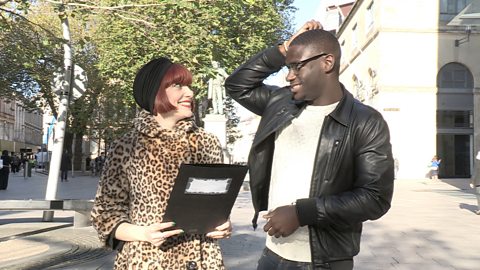
STEPHANIE:Hi, I'm Stephanie Hart, I'm 24, and for the last 4 years I've campaigned here in the UK for teenagers to value themselves for who they are and not just how they look. But in this film I'm going to be looking at how Western culture is impacting body image confidence around the world. And what better place to start than here, Heathrow Airport, the busiest airport on Earth.
STEPHANIE:'Planes fly back and forth to 193 destinations right around the world and every day nearly 200,000 people arrive and depart. It really is a global village.'
STEPHANIE:People landing here in the UK are bombarded with thousands of images of super slim women and six-packed men. But around the world people still hold very different views of what they consider beautiful or handsome. It's not just about the colour of our skin, it's about the way we dress, style our hair, and apply our make-up. These are the outward expressions of global diversity. Everywhere on Earth, beauty is absolutely in the eye of the beholder, so let's take a look at a few examples.
STEPHANIE:'For the women of the Suri tribe in Ethiopia lip plates are all the fashion, and the bigger the better. They stretch their lips by gradually increasing the size of the plate. The women start with a 4cm plate but they can go up to a 22cm plate. In Indonesia, the Mentawai women file their teeth into sharp points.
STEPHANIE:Straight teeth like ours are thought to be ugly.'
SUBTITLE:This is a good style for teeth. So that I am beautiful.
STEPHANIE:'In parts of Afghanistan, women want their noses to be bigger. The first cosmetic surgery clinic has now opened in Kabul where there's a large demand for nose enlargement jobs.'
STEPHANIE:Now I bet you guys are thinking that this is all about the girls, well you'd be wrong. There are many traditional cultures where it’s the men who do the dressing up.
STEPHANIE:'Only male birds of paradise have really beautiful plumage and in PNG, the Huli males take their fashion lead from the birds that share their jungle home. Once a year they come together to party and it's the men who spend months making fabulous outfits hoping to get the girls. The Wodaabe tribesmen in Niger, take beauty so seriously that the very first toy they are given as a child is a mirror. The young men compete in a beauty pageant wearing extraordinary make up and dance for days to impress a panel of female judges.'
STEPHANIE:Those examples are just incredible, but there's a problem on our planet - all around the world there's a takeover going on.
STEPHANIE:'Massive companies looking to make lots of money are pushing out global diversity.'
STEPHANIE:In the beauty business it's not about celebrating cultural diversity, it's about creating carbon copies. And the impact can be devastating. I've come here to meet up with Philippa Diedrichs from the centre for appearance research based here, in Bristol.
STEPHANIE:Great to see you, Philippa.
PHILIPPA:Really nice to see you too, Stephanie.
STEPHANIE:So there's been a few studies looking at the impact of Western fashion and beauty on people around the world. Can you tell me more about that?
PHILIPPA:One study in particular really stands out which was done in Fiji and what they did was, in 1995 there were very few islands in Fiji that had televisions and they asked lots of young women about their body image and how they felt about the way they looked, and then three years later there was televisions almost in every household on that island and they measured the girls' body image again. And what they found was that they felt a lot worse about themselves in terms of how they looked. So what this suggests to us is, is that television and lots of the beauty ideals that we always see on TV, can have quite a damaging effect on young girls.
STEPHANIE:Also, looking at these magazines here from Taiwan, China, and from the black community, they have a lot of, you know, skin lightening - what do you think about that?
PHILIPPA:Well what I find is it's really ridiculous because as you suggested in magazines that are targeted towards black girls or Asian girls or any group of girls that might have a darker skin tone they get sold and marketed all the products that are about you know, making your skin lighter. But the funny thing is, when you look at magazines that target white girls they're also told that their skin's not OK either and actually should be darker. We get nobody winning in this situation, nobody is perfect.
STEPHANIE:'The global beauty business is big business, making close to £200 billion every year.'
STEPHANIE:This is an industry whose future growth depends on making men, women, and children around the world feel bad about the way which they look. Selling dream products that are indeed, just dreams.
STEPHANIE:And in the process, making the world a boring place. Let's appreciate our natural beauty and not forget how exciting the world is with all these different, gorgeous people in it.
Video summary
Campaigner Stephanie Hart investigates beauty ideals around the world, and the people responsible for promoting them.
We take a trip around the world to look at the vastly different body and beauty ideals for men and women from the tribes of Africa, through the Middle East and South East Asia.
However there are threats to this global diversity - an interview with Dr Phillippa Diedrichs reveals a trend which pushes people from all nationalities towards the impossibly 'perfect' Western body and beauty 'ideal' - driven by the multi-million pound fashion and beauty industry.
No matter what they look like, people around the globe are being manipulated to feel dissatisfied with their bodies, and spend their hard earned cash in the pursuit of these 'ideals'.
What are the potential negative impacts of this trend on our body image and cultural identity?
Should we let this Westernisation influence our unique cultural diversity?
This clip is from the series Your Body, Your Image.
Teacher Notes
Students may want to use this clip to create a collage on the diverse ideas around what is beautiful.
Select a number of magazines from a newsagent and ask students to bring in their own.
What are the findings of the students? How do the print media define the notion of beauty and what differences exist between concepts of male and female beauty?
This clip is relevant for teaching Modern Studies and PSHE at Key Stage 3 and Key Stage 4 and National 4 and 5.
Body talk and body bullying. video
TV personalities Melissa Suffield and Radzi Chinyanganya aim to demonstrate the potential negative effects of beating ourselves and others up about our bodies.
Changes in body ideals and trends throughout time. video
A look back at the history of body image ideals - not just a 21st Century obsession.
Fashion and beauty industry influences on advertising. video
Why do advertisers usually use super skinny, super tall, super young white girls?