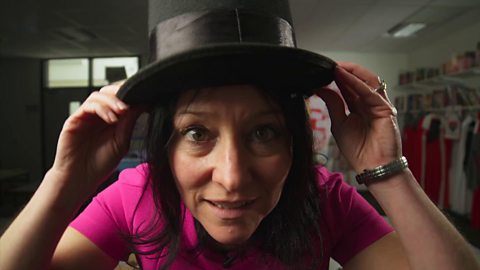
Vee:
Hi, I'm Vee, and I'm a classical archaeology and ancient history student at the University of Oxford.
Adam:
I'm Adam and I'm a Youtuber, and we're going to show you some of the skills that you'll need when you're out and about examining historical sites for GCSE history.
Adam:
So Vee, if my powers of deduction don't fail me, our site today is a castle?
Vee:
Adam, you are a genius.
Adam:
Well, you see, it's not just all about fancy degrees and textbooks.
Vee:
Whatever, you're right. This is a castle, but what sort of castle is it?
Adam:
It's a [UNSURE OF WORD].
Vee:
Oh, come on Adam. You can do better than that. What's the first thing that strikes you about this castle?
Adam:
Well, it's built high up on a hill, which I guess is for defence purposes.
Adam:
Yes. You're right. This castle was built back in the late 13th century. It was positioned high up on a hill as a sentinel post. So, the army of the English king Edward I, could keep an eye on the surrounding area.
Vee:
And this castle was part of a bigger scheme. A planned building of castles by Edward I in his quest to conquer Wales. And what's great about here is it's really well-preserved. In fact, it's one of the best examples of a late 13th, early 14th century building in the whole of Europe.
Adam:
Well, I'll give you that. It's a good-looking castle alright.
Vee:
So Vee, I'm guessing that we're going to go on out and find some history clues, but give me a chance here because I know we need to keep some things in mind. Like an overview of the site. What is it, and where is it? And the motivation. Why was it built, and who paid for it? The function, or purpose. Why was it built in this way, and who used it? And the people who used it and who lived there. And finally, is it typical of its time?
Vee:
Oh wow, Adam. I'm impressed. I had no idea your were paying such close attention.
Adam:
Well, I am a fast learner. Now, come on. I love a good detective sequence.
Vee:
Oh wow, Adam. You've really been doing your homework. You were on fire going around back there.
Adam:
You did advise me to spend quite a lot of time with my [UNSURE OF WORD] book, and that's exactly what I've been doing.
Vee:
Well, you see, it really does pay off. You know your stuff so well now, Adam.
Adam:
Well, what can I say? Late 13th century castles are really my speciality.
YouTubers Vee Kativhu and Adam Beales offer an overview of how to approach the exploration and interrogation of an historic site.
In this short film we see Adam and Vee exploring Harlech Castle, where they investigate the environment to see what clues they can find that tell them more about the history of the site.
They pose questions; Where is it located? Why was it built? Who built it, paid for it and lived there? When was it built? What purpose did it serve over time? How was it designed?
Teacher Notes
These films enhance the teaching of the new historic environment element of GCSE History. They can be used as part of a thematic or depth study. There is also application for a key stage 3 local study.
The films are designed as initial stimulus material to inspire curiosity and help students to refine and develop perceptive questions about their studies. The film format whereby clues are sought and questions posed should help illuminate how people lived at the time, their beliefs and how they were governed. They can act as a forerunner to study and familiarise students with methods of historical enquiry, helping them to understand how evidence is used to make judgements and reach conclusions about the past.
Different boards have different requirements in terms of the Historic Environment. In all cases, emphasising second order concepts is important: tracking changes, continuity cause and consequence, as well as the importance of the site as a source in its own right.
The approach taken encourages students to think for themselves and to make links, connections and pose questions.
The aim is to encourage essential study skills such as independence, self-direction and regulation as well as inspiring students to get out and about and apply these methods of historical enquiry.
Before Watching
You could ask your students to predict and discuss what clues Adam and Vee might uncover about castellology then draw up a checklist and later see how they fared after ‘active watching’. This might surprise them if they consider castles in their widest sense as homes as well as fortresses. Using this list, students could think about ‘bigger’ enquiry questions based around second order concepts of change, continuity, cause and consequence. e.g Explain why Harlech Castle was so difficult to successfully attack ? This approach can be applied to any location.
This film will highlight key features of Harlech Castle and generate wondering by posing questions to help students to make connections to the wider historical context. Key vocabulary and spellings will be reinforced appearing on screen. These could act as hooks for extended written responses. Adam and Vee will model the investigative approach that will be required when it comes to the student’s own site study.
Whilst the film focuses on physical features it could be used alongside other historical sources to allow students to practise their skills and assess the relative value of different types of sources. How typical and representative are the features seen, is another angle that could be explored in this way.
Students could draw inferences whilst watching. Key organising themes such as government, religion, economy and society, law and order and foreign affairs could be advertised in advance and students jot points down under these headings to make links to the site in context.
After watching
Students could be challenged to answer ‘What surprised you?’ ‘What questions do you now have?’ ‘What further study would you under take to close these knowledge gaps?’ ‘Which other sources could be used to supplement the film?’ Students could create a mind map of the investigative approach to site study, how might this be applied to the site your students will be investigating?
Next Steps
Encourage the transference of this enquiry based approach to the site under study. The films should prepare students to look out for key details in order to make connections and reach reasoned judgements.
Curriculum Notes
This short film is suitable for teaching at Key Stage 3/4 and GCSE history in England, Wales and Northern Ireland and National 4 and 5 in Scotland.

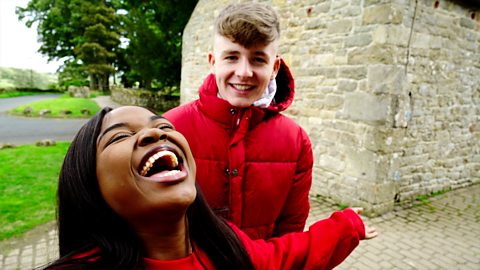
ClueTubers: At a military site. video
Vee Kativhu and Adam Beales offer an overview of how to approach the exploration and interrogation of an historic site - Birdoswald Roman Fort on Hadrian’s Wall.
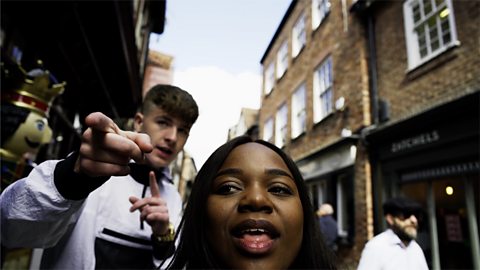
ClueTubers: In an urban environment. video
Vee Kativhu and Adam Beales are in York, where they explore the environment looking for clues around the theme of trade.
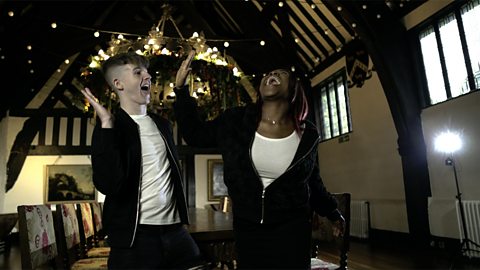
ClueTubers: In a manor house. video
Adam Beales and Vee Kativhu are exploring Samlesbury Hall, where they investigate the environment to see what clues they can find that tell them more about the history of the site.
Introducing ClueTubers - A guide for teachers. video
Carmel Bones introduces ClueTubers - a suite of films that will help students get to grips with the skills required to investigate historic sites.