ELDERLY WOMAN 1: They told us that Britain had declared war on Germany.
ALAN: I used to go home looking up to the sky and hoping I would see a dogfight.
ELDERLY WOMAN 2: It was like one big adventure.
ALAN: [indistinct]
ISABEL: That's me, Isabel.
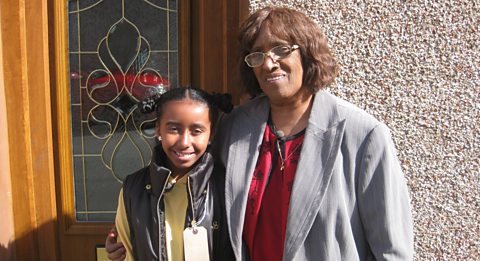
And that's my Grandad, Alan. He's eighty-two. At the start of World War II he was nine years old, just like me.
ALAN: [indistinct]
ISABEL: During the war, Grandad lived at the top of this hill.
From here he'd often see British warplanes going off to fight enemy planes attacking London.
Sometimes I go to school by car, but mostly I go to school by walking. How did you get to school?
ALAN: Well, I used to go to school on my roller skates. But of course, as you can see, this hill is quite steep. But there was no danger because there was no traffic.
ISABEL: The mile-long journey would take him twenty minutes to walk, or less than ten on his roller skates.
This is his school, Preston Park, in Wembley. It's still here today.
ALAN: All right.
ISABEL: Is this your classroom?
ALAN: Yes. I was last here in about 1940.
ISABEL: Grandad's classroom would have looked something like this one. The different things about, um, about that time was: our teachers don't wear suits.
ALAN: No.
ISABEL: And we don't have blackboards.
ALAN: Yes.
ISABEL: We don't have individual desks either.
ALAN: Yes.
AIR-RAID SIREN
ISABEL: Sometimes when Grandad was at school, they'd hear an air-raid siren, which meant that enemy planes were in the area and might be dropping bombs.
What would happen if an air raid went off during, er, you were in school?
ALAN: It really was, um, disruptive. And the headmistress here has written about the daily effect this had on the school.
So here you see, "September the 6th", for example: "School began at 10.30 this morning, and at 2.15 this afternoon, following air-raid warnings." "September the 14th. School opened at 10.50, following the All Clear', but children went to the shelters at 11 and remained until 11.40."
ISABEL: If the air raid ha-, happened during school, then I think I would feel a tiny bit scared.
But Grandad wasn't scared.
ALAN: I used to go home sometimes, hoping, looking up to the sky, and hoping I would see a dogfight, with the Hurricanes and Spitfires attacking the bombers, and all- and all the- the white lines and- and tracks left in the sky.
Because for a young lad, believe me, that was very exciting.
ISABEL: During the war, nine thousand bombs fell in the area where Grandad lived. Because of the bombing, many children were evacuated to safer parts of Britain or even to other countries.
Some of Grandad's school friends were sent to Canada on this boat.
ALAN: Here, on September the 23rd, is a very sad entry: "The whole school was shocked today when we received the news that seven children lost their lives when the ship in which they were being evacuated to Canada was torpedoed."
ISABEL: I would be a bit sad if two of my friends got torpedoed.
AIR-RAID SIREN
ALAN: This is an air-raid shelter that was used during the war by…
ISABEL: If a bombing raid happened when Grandad was at school the whole class was sent to an air-raid shelter.
There's one like it in the school today - it's now a museum.
A lot of old stuff from the war.
ALAN: Oh yes, yes. Yes.
ISABEL: Did you rush to get out of school and into the air-raid shelter or did you all have to line up sensibly?
ALAN: Ah, we filed out, and no one was allowed to run from the classroom. So, we came out in an orderly fashion, then the teacher checked that everyone was out of the classroom, and we'd be counted in.
It was like a fire drill.
ISABEL: Were you allowed to talk?
ALAN: Oh yes, in the-, oh yes, you could talk and carry on. We did take an exercise book thing and try to work.
But…but if anything's going on outside it is a big distraction. You can't concentrate, really, can you? I liked to sit near the door cause I liked to hear what was going on.
ISABEL: It's quite similar to this, because there's wooden benches going opposite each other and they're doing their school work, which they would be doing.
ALAN: This is a purpose-built solid-brick air-raid shelter, with a reinforced roof, as you can see.
ISABEL: How did you feel in the air-raid shelter when there were bombs going off around you?
ALAN: We weren't really scared, no, not at all. But the uncertainty of the rockets was the worst thing, because the V-1s you could hear.
And if it-, the engine stopped you knew there was imminent danger.
ISABEL: How did you know when the air raid was finished?
ALAN: Well, the siren would go up high and then stay on high for a steady pitch.
AIR-RAID SIREN (STEADY PITCH)
ISABEL: When the "All Clear" siren sounded Grandad and his friends collected pieces of metal, called shrapnel, from the recently exploded bombs.
ALAN: Here's two examples of shrapnel. And they really are thick, jagged steel.
ISABEL: Mmm.
ALAN: Yeah, just hold a piece and see what you think of it.
ISABEL: It's very sharp and heavy.
ALAN: Mmm. Yes.
ISABEL: It would hurt if you threw it at someone. It'll hurt a lot.
ALAN: Oh yes.
Oh yes. And it's very, very strong.
ISABEL: Grandad lived in this house with his mum, dad, and brother.
Is that, um, your mum?
ALAN: Yes, that's my mother.
That's my brother, Robin, and my mother, er, Elsie. Francis. And…that's me as a young lad. My mother was not pleased that I hadn't smiled. And, er… [chuckles]
ISABEL: Did you have a bomb shelter at your house?
ALAN: No, we didn't have anything like that here. My mother and father went to sleep underneath the table in the front room. So if the ceiling came down the table would protect them.
My brother, Robin, was behind a bookcase with a cover over the top, and he slept in the corner there.
ISABEL: Grandad slept on the sofa under an ironing board.
ALAN: Now, this ironing board was put across the back of the bed like this, and then put on the back of a chair, and the seat of the chair was level with my bed.
ISABEL: If feels weird because you can see like the ironing board in front of you instead of the top of your ceiling.
ALAN: Yes. Um, but of course when all the lights went out you wouldn't- you could forget about it, couldn't you?
ISABEL: Mm-hmm.
ALAN: Mmm.
ISABEL: I would have felt a bit scared.
One night when everyone was asleep a bomb fell on the house next door.
How did you feel in the morning when you woke up and you realised a bomb had hit the house?
ALAN: I realised something very serious had happened. And I could hear a lot of shouting.
And, er, then I was picked up by a police inspector, and my brother, Robin, was picked up by a fireman, and we were carried out of the house. The people next door, where six people had been killed, had stood no chance.
So, the emphasis on the rescue was to try to get my mother out.
And the worry was: would the house collapse while they were doing it? So, my grandfather said, "Well, um, I'm going in anyway."
So, er, the rescuers went in, followed him in.
And, er, but it was too late.
My mother had- had, er, been killed and we were all in a state of shock.
ISABEL: Grandad's mum, my great-grandma, was one of the sixty thousand people that died in Britain during the bombing raids of World War II.
Grandad's told me lots of stories about his life growing up as a child in World War II, but my favourite was that he slept under an ironing board and it saved his life.
Video summary
We meet Alan and his grand-daughter Isabel.
Alan lived in north London during World War Two and was in his home when the neighbour's house suffered a direct hit.
Alan lost his mother in the bombing.
Alan revisits his home and school, where Isabel gets a feel for what it was like to have lessons disrupted by visits to the air raid shelter.
This short film is from the BBC series, Children of World War Two.
Ed Murrow reporting on war torn London during the blitz.
Teacher Notes
You could pause this short film at 01:48, at the photograph of the 1940s classroom.
Ask your pupils to compare and contrast it with their own classroom. What are the differences?
Continue viewing, to see if Isabelle spots the same things as your pupils.
After viewing this short film, pupils could be asked what they have found out from it about World War Two.
Are there other things they would like to find out?
Pupils could make a list of possible research topics and possible sources of information.
This short film will be relevant for teaching history.
This topic appears in KS2 in England and Northern Ireland, Foundation Phase and KS2 in Wales and Second Level in Scotland.
A soldier's daughter. video
Sarah was a child in Bolton during World War Two. With family friend Tyler, she remembers the outbreak of the war and the effect of rationing.
An evacuee's adventure. video
Betty was evacuated to Aberdare during the war. She describes her experience to a friend.