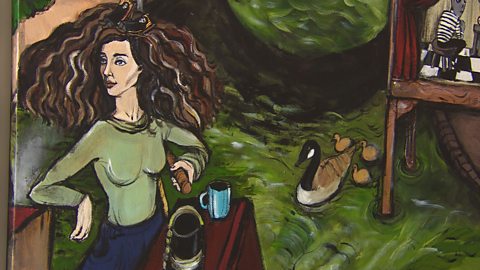
Maryam Hashemi:
It's quite challenging starting a piece of work because I get distracted so easily. So trying to be focused on one thing, getting to the point that I could only be focused on one thing is quite challenging. So I need to build up to that. Get my tea. That's important.
I guess it's a form of like a ritual, in a way. Like I need to be in the right mind-set. It's much easier once you've got everything around you and know that, 'OK, you're good to go. And nothing is going to stop the flow.' Need to be there. Need to be there.
I haven't worked on this table before. I'm trying to get to know it. I usually set a timer for, like, 10, 15 minutes to remind myself to get up and stretch. And now I'm going to begin, and I might not be able to speak for a bit. We'll see how it goes.
It's very scary to start with plain paper and plain canvas. You don't know where to begin. So I do lots of random lines and try to look at the images there. Even if I have a theme, I limit it to those lines. Once you have something on there, it's much easier to create an image.
I like to see forms in lines, in patterns and, you know, all of… In stains. I always see something. See fishes everywhere. Always.
TIMER RINGS
Stretch. So I see fishes. They always appear. And I see a car. It looks like a van. And there's a girl looking like this. And there is a mermaid in a kind of decanter… having a lovely time.
From my experience, what works better for me is to add the colours gradually rather than really, really strongly. It depends on the material you're using. With watercolour and pencil, it works really well, if you're layering it and not really applying strong colours. With paint, it's easier to correct it, because you can take it off while it's still not dry and you can paint on top of it. But on paper, you can't really go back. You tend to be more careful.
If you're working with watercolour and pencil and things like that, when you make a mistake, so what, you made a mistake - do another one. It's just really not the end of the world. It's OK. Nobody's going to come and find you… and punish you for it!
Video summary
Starting a piece of artwork can be challenging and we join Maryam Hashemi performing her personal rituals of making tea before beginning her painting.
She draws random lines and swirls on the paper and then identifies forms from the abstract lines.
She draws in pencil, then applies watercolour and washes of painting.
Maryam explains the technique as she completes the process of painting with watercolour, mixing her colours in the palette.
From a BBC series Making Art Work which explores the creations of six UK-based leading artists.
Teacher Notes
Encourage the students to take inspiration from Maryam's methods to produce a piece of art working in an abstract way; defining shapes and forms based on feelings and emotions.
These clips will be relevant for teaching Art and Design at GCSE/KS4 in England, Wales and Northern Ireland and National 4/5 or Higher in Scotland.
The topics discussed will support OCR, Edexcel, AQA, WJEC GCSE in England and Wales, CCEA GCSE in Northern Ireland and SQA National 4/5 and Higher in Scotland.
Iranian artist Maryam Hashemi. video
Iranian artist Maryam Hashemi introduces her artwork and tells her life story.
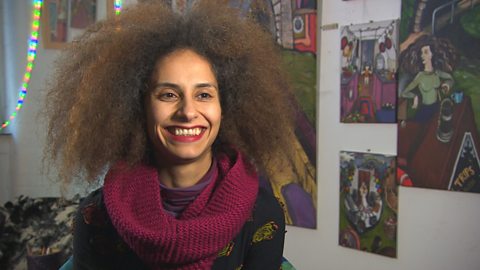
Transforming a white van into a piece of art. video
Artist Maryam Hashemi takes on the challenge of transforming a white van into a piece of art.
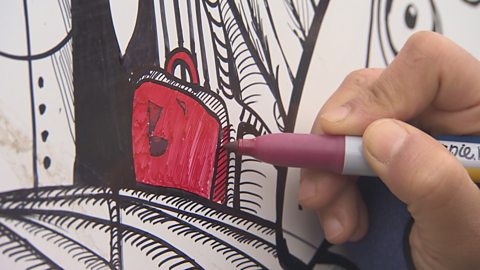
What inspires Iranian artist Maryam Hashemi? video
Artist Maryam Hashemi shows us around her canal barge and describes how life on the water has brought a new wave of inspiration to her work.