NARRATOR: This is a film about a man who became an artist because he missed a train.
This happened many years ago.
He left the station in a Manchester suburb and started to walk up the Bolton Road, wondering what to do.
He came to some streets of terraced houses, which lay at the foot of an immense mill.
As he took in the scene, he was filled with the urge to paint it. And at that moment he decided to become an artist.
His name is Lawrence Stephen Lowry.
What was there in these sooty streets to make Lowry wish to spend his life amongst them, painting a world in which other people could see no beauty.
LOWRY: I really don't know why I paint these streets.
I just paint them, as far as I can see, there is something about them which attracts me.
In a pictorial sense, but I do feel that the pictures that I like the best are pictures done entirely from, call it imagination if you like.
I start on an empty canvas, and prefer to paint from a mind's eye.
And often from nothing at all or the slightest idea of what I'm going to put on the canvas.
In that case I suggest something, call it a chimney or church or anything else.
And going along slowly and adding things, and in a strange sort of a way, it seems to come.
And I work like that until the canvas is completely filled.
My figures may be long and thin and the boots may be enormous, but I am not concerned, I don't mind it at all.
I see them like that, so I paint them like that.
If they like to call them matchstick figures, well, no, let them do it, I don't mind at all.
A friend of mine, a very knowledgeable gentlemen indeed, used to complain very much you see, he used to say you don't put any shadows in your pictures, that's entirely wrong, you know.
And for quite a long time I tried to put shadows in my pictures and I simply couldn't do it.
Of course, they're intricate pictures and they're full of figures and detail, it all takes balancing, which is not easy to do.
You work on this, and I say not working too often, or too rapidly, until I find that the time comes, and you can do no more with the picture.
And when you're satisfied with that, you leave it as complete.
Video summary
A short and easy to follow introduction to Lowry's style of painting and choice of subject matter narrated by Lowry himself.
The artist explains his technique, how he selects his subject matter and what he is trying to capture through his work.
This clip is from the BBC series: Bitesize Primary, Art and Design 2, Art History on BBC2
Teacher Notes
- Lowry’s work is highly accessible to younger pupils and creates lots of opportunities for discussing the subject.
- Looking closely at his works and asking questions such as “Who might this be?”, “What is he doing?”, “What do you think is happening here?” will help pupils to unfold the story within the picture and inspire their imaginations.
- This could be followed by encouraging them to create their own Lowry-style scene, perhaps by rearranging a cut-up version of an original print and rearranging the figures and subject matter as they see fit.
This short film is relevant for teaching Art and Design at KS1 and KS2 in England and Wales and Northern Ireland and first level and second level in Scotland.
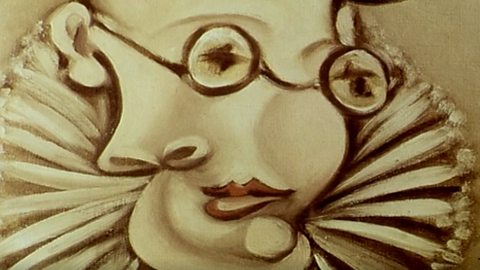
Pablo Picasso. video
A dramatized autobiography of the artist Pablo Picasso, showing his paintings and sketches and talking about the inspiration for his work.
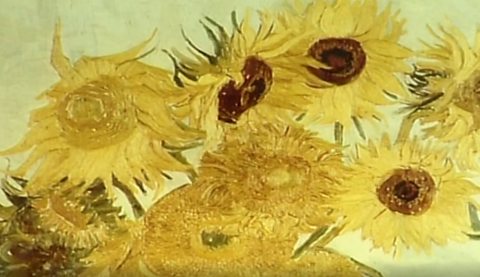
Vincent van Gogh. video
A dramatized autobiography of the artist Vincent van Gogh talking about his work. He painted using quick strokes and thick paint so that people could feel his paintings.
Andy Goldsworthy - Sculpture and art in a natural environment. video
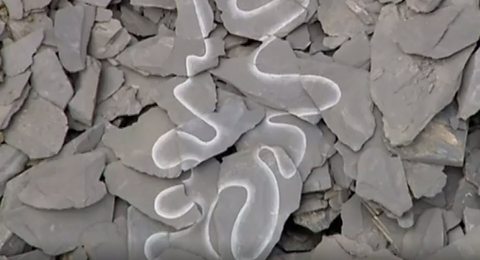
Artist Andy Goldsworthy talks about and demonstrates creating artwork in a natural landscape using natural materials. Working on site in a quarry, Goldsworthy makes an abstract drawing on slate.