Colons and Semicolons…
Colons and semicolons are punctuation marks.
They help express relationships between parts of a sentence.
A colon is used before describing or further explaining something previously mentioned in a sentence, or when introducing a list.
‘Farmer Frank had a sneaking suspicion he had forgotten something: something important.’
A comma would leave you with a run-on sentence.
A full stop would split the clauses entirely. Since ‘something important’ further describes the something that’s been mentioned, a colon is appropriate.
‘He had done all of the following: brought the ostriches in for the night, fed the ostriches and collected the ostrich eggs.’
‘He had done all of the following: brought the ostriches in for the night, fed the ostriches and collected the ostrich eggs.’
Here, the colon is used before the beginning of the list.
A semicolon is used to link phrases. It’s a better transition between two related sentences than a full stop, as it continues the thought.
‘He suddenly remembered what it was; he had forgotten to lock the gate.’
Again, a comma would create a run-on sentence and since these sentences are so closely related, a semicolon makes the transition smoother than a full stop.
Farmer Frank is in trouble. ‘Ostriches have a mean streak; big, powerful legs; and a tendency to charge.’
Because the attribute ‘big, powerful legs’ includes a comma within it, also using commas to separate the attributes would be very confusing. So a semicolon is used.
Oops. This could get messy.
Remember these egg-cellent definitions.
A colon: is used before describing or further explaining something previously mentioned in a sentence, or when introducing a list.
A semicolon; is used to link phrases. It is a better transition between two related sentences than a full stop, as it continues the thought.
Without semicolons, your complex lists could get scrambled. Get it? Scrambled.
Video summary
Part of a series of animated films, following a cast of characters’ adventures and mishaps as they get to grips with grammatical terms.
In this film Farmer Frank learns about colons and semi-colons whilst egg collecting, unaware that his ostriches have laid a trap for him…
This clip is from the series Grammar for 11-14 year olds.
Teacher Notes
Students explore when semicolons are used and practise adding them to sentences.
Starter activity in a lesson exploring complex sentences.
This clip is suitable for teaching English at Key Stage 3 or Third Level.
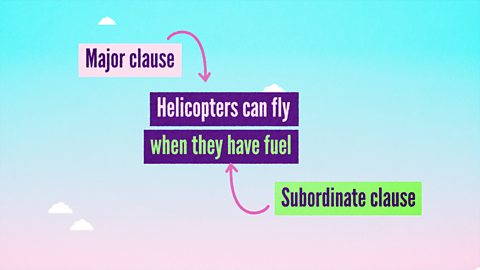
Major and Subordinate Clauses. video
Monty Huntington-Smythe gets to grips with major and subordinate clauses.
Adverbs and Adverbials. video
Farmer Frank gets to grips with adverbs and adverbials.
Prepositions. video
Space Cadet Carl and Selena Stardust get to grips with prepositions.

