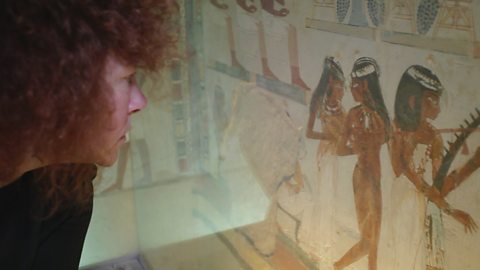
DR JOANN FLETCHER:Welcome to Pa-Demi, an ancient Egyptian village where nobody's lived for over 3,000 years. An yet, believe it or not, it was once really busy, teeming with life, a very noisy, bustling kind of place.
DR JOANN FLETCHER:
'The villages lies near a place called the Valley of the Kings, where ancient Egypt kings, known as pharaohs, were buried in huge tombs deep underground. And the men who built these royal tombs lived in the village with their families. Archaeologists exploring here can learn a lot about the everyday lives of these working people. And thanks to one very special discovery, we can actually study two of the people who used to live here. Their names are Kha and Merit, and they were husband and wife. When they died, their bodies were mummified to preserve them, and placed with all their clothes, furniture and even food in a secret underground tomb on the edge of their village.'
DR JOANN FLETCHER:And the tomb was so well hidden, that no-one entered it again for 3,000 years. It wasn't until 1906 when an Italian archaeologist discovered it, and took all the contents back to a museum in Turin in Italy.
DR JOANN FLETCHER:'So who were Kha and Merit? These are the mummies of Kha and Merit in the museum. By using computerised scanning, we can create an image of what they looked like beneath the many layers of linen strips in which they're still wrapped.'
DR JOANN FLETCHER:We know that Kha,who stood about 5ft 6", was a very striking looking individual, with a rather prominent nose and a great fondness for lots of black eyeliner. But then when we turn to his little wife Merit, a very dainty little lady, standing about 5ft 2". She also had a long crimped wig of dark brown wavy hair, which would have made her look really, really beautiful.
DR JOANN FLETCHER'The objects found in Kha's tomb are inscribed with hieroglyphics, which is how the Egyptians used to write. These little pictures and symbols tell us that Kha designed the royal tombs, and was in charge of the workmen who built them. Which of course made Kha and Merit very important people, both to their neighbours, and to the pharaoh.'
DR JOANN FLETCHER:But how did they live here? What did they eat? What did they drink? And how on earth, in this really, really hot climate, did they keep themselves clean?
DR JOANN FLETCHER:'Kha and Merit lived with their family in this close knit community, in homes like these. Over 3,000 years ago, these houses would have had roofs, with much higher walls, which have crumbled away over time. The houses gave them shade from the burning sun, but I have to use an umbrella. Archaeologists have carefully studied these houses to discover more about what each room was used for.'
DR JOANN FLETCHER:So, we go into the front room here. And this would be an area really where the women of the house hung out, chattered, gossiped, and so forth. Kids running in and out. Up the stairs, around the corner, into the perhaps most important room in the house where the men would retire in the evening.
DR JOANN FLETCHER:'This piece of furniture is what's left of an ancient Egyptian sofa.'
DR JOANN FLETCHER:The gentlemen of the house with enough time on his hands could recline with his friends, drink beer, have a natter. Then back up here, up this little step, and then into this area, which is quite a considerable size for a room like this, and probably storage, but also a bedroom. In the case of Kha and Merit, we know they had some beautiful beds. These beds were found in their tomb.
DR JOANN FLETCHER:The ancient Egyptians didn't have pillows, but used these wooden headrests, which look rather uncomfortable to us today. As we progress a little further into the highest part of the house, we come into a storage area maybe, for clothes, but almost certainly for food and drink also, because this area directly adjoins this wonderful fitted kitchen. And this is extraordinary, because we've actually got the built-in oven at the back of the house. And then here, ancient Egyptian refrigerator. You'd want a cool drink, on a day like this, you can understand why. And the only way to do this was to sink the vessels into a pit deep in the ground. Little tiny temporary roof over it to keep it as chilled as possible. So fridge, oven, they've got everything they needed.
DR JOANN FLETCHER:'Mud brick ovens, just like the one Kha and Merit had, are still being used in Egypt today. Just as in ancient times, they're still used to make bread. And I've come to the house of this Egyptian lady to see how it's done.'
DR JOANN FLETCHER:Now bread was the key ingredient in the ancient Egyptian diet.
DR JOANN FLETCHER:'This bread has been made using very similar ingredients to those used in Kha's day. It's an easy recipe, made with wheat and barley flour, water and salt. Around 50 loaves of bread of all different shapes and sizes were found in Kha and Merit's tomb.'
DR JOANN FLETCHER:It's a real direct link back into their world. The smell of this wonderful stuff, the feel of it, the way it was made. All Egyptians would have eaten this on a daily basis. Egyptian bread is fantastic. So I'm eating the very stuff that Kha and Merit would have eaten every single day of their lives, and it's fantastic.
DR JOANN FLETCHER:'And this is where the grains for the flour to make the bread, the wheat and the barley, were once stored. In ancient Egypt, money didn't exist. So people were paid with things like sacks of grain. And as well as making bread with it, they could also use some of the grain to exchange for clothes, furniture, and other things to eat. As well as bread, many different kinds of food were discovered in Kha and Merit's tomb, including fruit, vegetables, meat, and spices. And although this fruit now looks very old and dry, it would have looked delicious 3,500 years ago when it was still fresh.'
And it's quite wonderful stuff. You have the staple of the ancient Egyptian life here, the bread, accompanied by the all-important onions and garlic. And this was a standard sort of workman's packed lunch. One of these on a daily basis, with a garlic here, that's your kind of ancient Egyptian packed lunch. And the fruit, there were grapes, dates, and these amazing things. He had several sackloads of these. These are doum palm nuts. Although I've never personally eaten one, they apparently taste like caramel.
DR JOANN FLETCHER'There was another thing that the villagers needed a lot of, and that was water. Not that far away from the village is the river Nile. Flowing right through the middle of their country, the Egyptians used the Nile to transport people and goods from place to place. But most importantly, in a country with hardly any rain, the Nile was the only source of water. Donkeys were used to carry this water to Kha and Merit's village every day. Each family was given a daily allowance of about 100 litres of water, which would have been used for drinking and cooking and washing.'
DR JOANN FLETCHER:3,500 years ago in the village, you would have needed this stuff at the end of a long day to have washed away the dirt and the sweat. Now of course what goes in must come out, and just like you and me, the ancient Egyptians went to the toilet. Of course they did. But they didn't have flushing toilets, and toilet paper and all that.
DR JOANN FLETCHER:'This unusual stool with a hole in it was discovered in Kha and Merit's tomb. And it had a very important purpose.'
DR JOANN FLETCHER:When Kha and Merit needed the toilet, they'd sit on this special stool, do what they had to do, which would land in a bowl of sand on the floor underneath the stool. And some rather unlucky servant would have to come along, take the bowl, and then they'd throw the contents out on the surface of the desert, where the very hot sun would immediately dry any contents and kill all the bacteria, all the germs, that would be found in whatever was in the bowl. So it was a very, very clever way of dealing with the waste that all of us produce on a daily basis. Very clever solution.
DR JOANN FLETCHER:'It's amazing to think that 3,500 years after they lived, 'we can still discover so many details 'about the lives of Kha and Merit. 'And all thanks to the hundreds of fascinating objects 'discovered in their tomb.'
Joann looks at their mummies in the Turin museum to discover more about their clothes, food and furniture.
Joann then visits excavated homes in the village to explain what rooms the typical house would have and how they would have been used.
The clip shows how to make Egyptian bread and also the other fruits that would have been a main diet for them.
Joann then discovers the importance of the River Nile to the villagers and also the system they had for the toilet.
This clip is from BBC series: Ancient Egypt - Life and Death in the Valley of the Kings.
Teacher Notes
Task for the class could include:
Draw a plan of an Egyptian house. Label each room, write about which activity and objects you would find there. Compare with pictures of a modern house. Which one would you prefer to live in and why?
The class could discuss how the Ancient Egyptians didn’t use money. What did they do instead? Did the system work? Divide the class into two groups, one group to argue that we should get rid of money today, one to say why we should keep it.
Discuss use of persuasive language. Write up the argument using the persuasive vocabulary.
Look at the way the Egyptians dressed - compare this with fashion today. Draw and label Ancient Egyptian and a modern pop star.
Compare the daily diet of an Egyptian with ours. Children can record all the food they have eaten over two days on a table and compare it to an Egyptian's diet. Which is healthier? How could we eat more healthy?
Make a leaflet for the museum in Turin - look at features for leaflets. What exhibits would it have on the Egyptians? What vocabulary should be used? Design a poster or advert for the exhibition of everything that was found in the tomb.
Curriculum Notes
This clip is relevant for teaching History and Social Studies at KS2 level/second level (Scotland).
More from Ancient Egypt - Life and Death in the Valley of the Kings
Marriage and family in Ancient Egypt. video
Dr Joann Fletcher visits the village of Demi to try and understand more about the life of an ancient Egyptian architect called Kha, and his wife, Meryt.
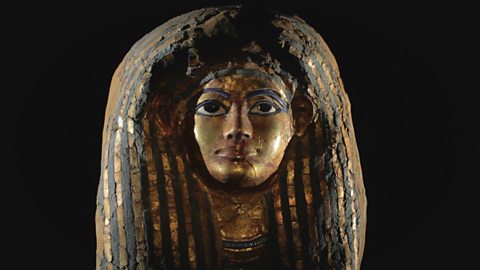
Mummification in Ancient Egypt. video
Dr Joann Fletcher explains how the ancient Egyptians preserved their dead and why mummies were buried in precious jewellery.
The afterlife in Ancient Egypt. video
Ancient Egyptians were buried with everything they expected to need for their journey through the afterlife. Dr Joann Fletcher explains their beliefs.
Tombs in Ancient Egypt. video
Dr Joann Fletcher travels to the Valley of the Kings to meet Steve Cross, who is an expert on tombs, she then explores the tomb of an Ancient Egyptian architect called Kha.