This short film, first published in 2015, is for teachers and review is recommended before use in class.
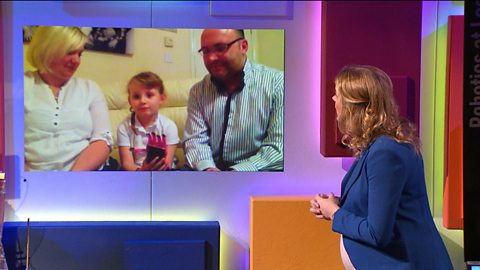
Professor Danielle George demonstrates how haptic technology lets you feel things that aren’t really there.
With the help of its inventor, Professor Sarah Baillie from the University of Bristol, she learns about the “haptic cow,” a teaching device for training vets how to feel if a cow is pregnant.
The haptic device clips onto her finger and restricts her hand movement, tricking her mind into believing that she is touching a solid object, when in fact it is the pressure from the haptic finger clip that is causing this sensation.
This is how the current generation of haptic technology works.
This clip is from The Royal Institute Christmas Lectures 2014.
Teacher Notes
Key Stage 3
Introduction:
Explain what a virtual object is and why, normally, we can’t touch virtual objects.
Video questions for pupils:
1. How do haptics help trainee vets?
2. How did the user make use of a feedback loop? (She adjusted the pressure she applied when the haptic cow ‘mooed’).
Activities:
- Start a discussion on haptic technology, and how it allows you feel things that aren’t really there.
- Ask, how could haptics be used in medicine to help people recover from operations more quickly?
- How could haptics be used to make computer games more realistic?
Related BBC News links:
Key Stage 4
Additional material:
- Think of three scenarios where haptic technology could allow users to be trained using virtual technology.
Curriculum Notes
These clips will be relevant for teaching Computing, ICT and Computer Science at KS3 and GCSE/KS4 in England, Wales and Northern Ireland and 2nd Level and National 4/5 in Scotland.
The topics discussed will support OCR, Edexcel, AQA,WJEC GCSE in GCSE in England and Wales, CCEA GCSE in Northern Ireland and SQA National 4/5 in Scotland.

More from The Royal Institute Christmas Lectures 2014:
Feedback loops. video
Professor Danielle George demonstrates what feedback loops are by asking a child to match the note that she plays on a swanee whistle.
How does a digital camera work? video
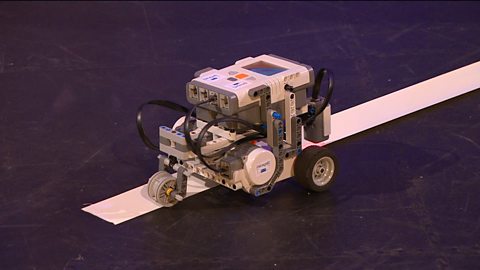
Professor Danielle George explains how a digital camera’s CMOS sensor captures an image, using balls and buckets to represent photons, electrons and capacitors.
How LED screens work. video
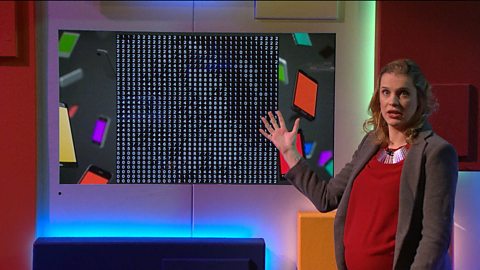
Professor Danielle George explains how an LED screen works, showing how the individual LEDs are controlled by switches.

How robots can work together in a swarm. video
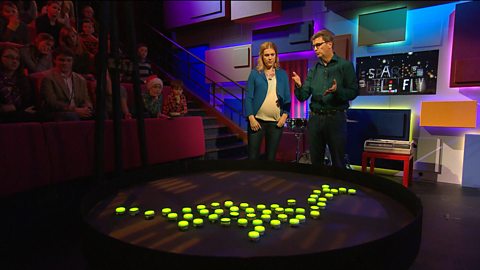
Paul Beardsley from Disney Research Zurich explains how the 50 pixelbot robots work together in a swarm to create animations.
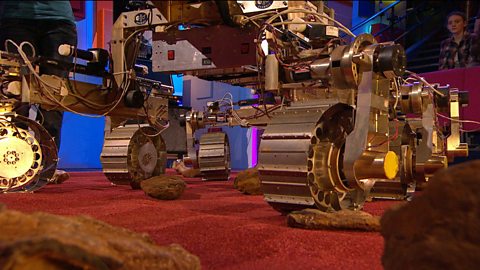
The Mars Rover and autonomous navigation. video
ExoMars Rover Engineer Abbie Hutty, from Airbus Defence and Space, explains how the Mars Rover uses 3D cameras to create a map of the Mars landscape.
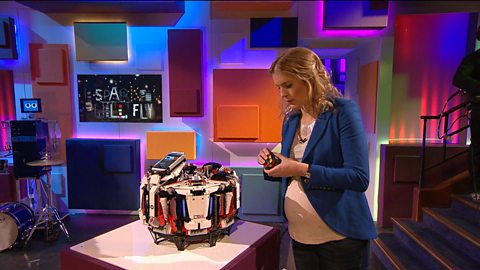
Solving a puzzle cube by smartphone. video
Professor Danielle George explains how a smartphone and mechanical arms made of bricks can solve a puzzle cube in less than five seconds.
What can 3D printing be used for? video
Professor Danielle George explains how 3D printing works and demonstrates an object being printed in real time.