DAN SNOW: Hi, I'm Dan Snow. I'm a historian and I've been going through the BBC's archives looking for material that will help with your understanding of one of history's darkest events ever. The Holocaust of World War Two. It was an event in which Germany was responsible for the murder of six million Jews. Many of whom were gassed to death in camps that were specifically designed to carry out mass killings. The clip we're about to look at isn't an easy watch, as it focuses on one of the first camps where poison gas was used. At a place called Chelmno in Poland, which was then controlled by Germany.
DAN SNOW: The camp was run by Herbert Langer, a German commander, and the local Jewish population was among the first to suffer under his terrible plans, which saw the use of gas vans rather than the notorious gas chambers.
NARRATOR: The selected Jews were taken here, to Herbert Langer's new improvised extermination facility at Chelmno.
NARRATOR: Jews from the immediate area had been the first to die here a few weeks before.
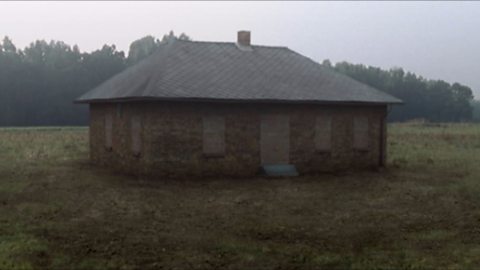
NARRATOR: The Nazi's blew up the large house which was the centre of the killing operations in order to hide evidence of their crime.
NARRATOR: This is one of the few photos that remain of the house itself.
NARRATOR: But evidence gathered after the war allows a picture to be constructed of what the Nazi's did here.
NARRATOR: The Jews from Lodz were told to undress. They were then pushed down a corridor in the basement of the house, up a ramp and into a small windowless chamber.
NARRATOR: Doors were then slammed behind them. They'd been locked in the back of a van.
NARRATOR: These vans had been invented two years earlier to kill mentally ill people, by cramming them in the sealed rear cargo area and then gassing them with carbon monoxide.
NARRATOR: Now Langer and other Nazi's used their own initiative to adapt this killing method to murder Jews.
NARRATOR: They made gas vans central to the new killing operations here at Chelmno.
ZOFIA SZALEK: There was a lot of screaming, how terribly they screamed. It was impossible to bear.
ZOFIA SZALEK: We could hear the screams but we couldn't see the people.
ZOFIA SZALEK: They were loaded in and murdered there. It was hell. That's why we called these vans Hell Vans.
ZOFIA SZALEK: When I saw it going, I'd say, "The hell's going."
NARRATOR: The van's carrying the bodies of the Jews who had been gassed were driven two miles through remote country roads to a nearby forest and buried in a clearing.
NARRATOR: Many of the German's who worked here at Chelmno believed what they were doing was perfectly legal, as the post-war testimony of Kurt Mobius, one of the SS guards, reveals.
OFFICER: We were told by Captain Lange that the order for the extermination of the Jews came from Hitler and Himmler. And as police officers, we were drilled to regard any order from the government as lawful and correct. At the time, I believed the Jews were not innocent, but guilty. The propaganda had drilled it into us again and again that all Jews were criminals and sub-humans who were the cause of Germany's decline after the First World War.
NARRATOR: Motivated by such anti-Semitic delusions, the German's created here at Chelmno the first systematic process for the mass gassing of the Jews.
DAN SNOW: In all, it's thought that somewhere between 200,000 and 300,000 people died in Chelmno, and according to records only seven people ever managed to escape.
Video summary
Dan Snow introduces a report about the use of gas as a method of killing Jewish prisoners.
This started at Chelmno camp in Poland. Vans were used initially to kill mentally ill patients.
The vans were then used to murder Jewish prisoners, who were put in the back of the vans before being gassed by the exhaust fumes.
Bodies were then taken and buried in a forest clearing.
Between 200,000 - 300,000 Jews were murdered at Chelmno.
SS guards after the war continued to argue that what they had done was justified as they were motivated by anti-Semitic propaganda they had seen in Nazi Germany.
This short film is from the BBC series, World War Two with Dan Snow.
This short film contains scenes which viewers may find upsetting. The films are intended for classroom use but teacher review is recommended prior to watching with your pupils. You know best the limit of your pupils, and BBC Teach does not accept any responsibility for pupil distress.
Teacher Notes
Before watching this short film, students could be asked what they already know about the conditions Jews faced in Germany, ghettos and at camps like Auschwitz.
Students could then be questioned on what they already know about gas chambers.
After watching this short film, there could be discussions about why the gas vans might have been introduced by the Nazis.
The SS guard testimony could also be used to place concentration camps in context of the wider events of the Holocaust, about the impact of Nazi anti-Semitic propaganda and its effectiveness in convincing people that anti-Semitic laws and actions were justified.
This short film will be relevant for teaching KS3 and KS4/GCSE history in England, Wales and Northern Ireland and National 4/5 history in Scotland.
What does Rudolph Höss' evidence tell us about Auschwitz? video
Dan Snow introduces a report about the role of Rudolph Höss, the commandant of Auschwitz, in the Holocaust, based on the testimony he wrote before his trial.
How did Auschwitz expand? video
Dan Snow introduces a clip about the expansion of Auschwitz to deal with the number of Jewish people being transported to concentration camps.
What were conditions like at Auschwitz? video
Dan Snow introduces a clip about the brutal conditions faced by people at Auschwitz, including testimony from a survivor.
What happened in the gas chambers at Auschwitz? video
A report about the gas chambers at Auschwitz, including some of the testimony from Rudolph Höss.
How did a pregnant woman survive the Holocaust? video
The story of Anka, who was pregnant when she arrived at Auschwitz, yet managed to survive and give birth to a daughter, Eva.