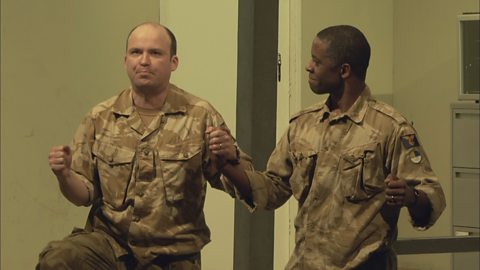
DANNY BOYLE : Sorry to interrupt. Let's do the croft. Thank you.You know one of those devices that holds the chest open?
FEMALE 1 : Yeah.
DANNY BOYLE : What are they called?
FEMALE : A chest spreader.
DANNY BOYLE : Chest?
FEMALE 1 : Spreader.
DANNY BOYLE : A chest spreader. Okay.
FEMALE 1 : A set of those?
DANNY BOYLE : Yeah, one of those from 1816, please.
THEY CHUCKLE
DANNY: What's extraordinary about working on it is that you realise it's timeless.
It will be here a long time after we're all gone. Because it swims into focus depending on different issues, either in a very specific way, like genetics or cloning, or in a very, very general way really, about what man is capable of and what are the repercussions of that.
ACTOR (THE SCIENTIST) : There is little time to explain, but the simple fact is, I've built a man.
ACTOR (WOMAN) : You did what?
ACTOR (THE SCIENTIST) : I built a man, and succeeded in animating him.
ACTOR (WOMAN) : Do you mean bringing him to life?
ACTOR (THE SCIENTIST) : Yes!
Yes, bringing him to life. My-my creature, I brought him to life.
NICK : I think Mary Shelley was writing, almost without appreciating it, a sort of creation myth for the science age.
In many countries there are creation myths, but they always involve a deity, a cosmic power, something sets the spark of life in motion and we humans come to life. For the first time, Mary Shelley comes up with a creation myth which doesn't involve a deity, doesn't involve a cosmic power, it involves solely the skills of humankind.
And that's why I think it stays with us now, because God doesn't play a very big part in our rationalisation about the world we live in and what we're gonna do with it and the extent to which we're destroying it, as we patently are.
Mary Shelley is a very literate, highly educated young eighteen-, nineteen-year-old woman when she comes to it. And the book is stuffed full of ideas which seem to me to remain very pertinent to us now.
ACTOR (THE SCIENTIST) : How does it feel being loved?
ACTOR (THE MONSTER) : I-i-it feels like a-all the life is [pants] bubbling up inside me and s-spilling from my mouth. It feels like my lungs are on fire and my-my heart is a hammer.
It f-feels like I could do anything in the world!
DANNY BOYLE : The most important thing about the production, hopefully, is that it gives the creature a voice. And I think a lot of people coming to it won't know the novel but they will know the movies, which robs him of his voice, really.
The movies just waded in there and robbed him of his voice straight away, and yet that is the most extraordinary thing. And so Nick's approach was to begin with the point of view of the creature.
ACTOR (THE MONSTER) : I've got arms flickering around a bit, legs, and then finding them.
Speaker 5 : What we've tried to do is begin with a being fresh from birth, with no language. We see him acquire language, we see him acquire intellect. And then by the end of the play we allow him a very high level of articulacy.
And that was, really was one of the reasons that we wanted to do it, was because we'd never seen this creature given a voice, both to justify himself and to question his creator and say, "Why did you do this?"
STAGE
AUDIO:
ACTOR (THE MONSTER) : You abandoned me.
ACTOR (THE SCIENTIST) : It speaks.
ACTOR (THE MONSTER) : Yes, Frankenstein, "It" speaks.
ACTOR (THE SCIENTIST) : You know my name.
JONNY LEE MILLER : That's the fantastic thing about this story is the relationship between father and son, master and slave, creature and creator.
BENDEDICT CUMBERBATCH : What's fascinating is seeing something come alive that's in a thirty-year-old form and have to re-educate itself. I looked at stroke victims in recovery, I looked at people, er, who'd had severe injuries both in wars or car crashes trying to re-educate their limbs and their bodies.
And when you see that happening, the amount of vulnerability.
JONNY LEE MILLER : It gets tired.
DANNY BOYLE : Yeah.
JONNY LEE MILLER : It gets tired.
BENDEDICT CUMBERBATCH : It's a very endearing thing to watch evolve. You really care for him.
J L MILLER : You know, there's a lot of my two-year-old in-in-in
BENDEDICT CUMBERBATCH : Buster's been a big influence–
J L MILLER : …in the way, that, er, the creature…
You know, it's a-a-a blank canvas as a body but the brain works extremely fast. It's a fully-grown brain, so it's absorbing everything super quick, all the learning comes really quickly.
FILM ACTOR (THE SCIENTIST) : "It's alive. It's alive. Oh, it's alive!"
DANNY BOYLE : Frankenstein eventually became the archetype of the mad scientist and what happens when science over-reaches itself, but what's interesting in the story of Frankenstein is that this becomes applied to the idea of creating people.
And in some ways that's something that could be seen as the ultimate unnatural act. And it raises all sorts of quite specific questions about the status of the created being, whether or not, for example, Frankenstein's creature has a soul, and what that means.
NICK : God doesn't really figure in Frankenstein. Er, the human creates life. And I think that's one of the reasons why it has so much relevance for us now, because we look at the world, and we see what we've done to it, and we're worried.
And that's very much the position that Victor Frankenstein, the scientist, is in.
How Mary Shelley’s 'Frankenstein' was adapted for the stage by the National Theatre in 2011, in Danny Boyle's critically acclaimed production starring Benedict Cumberbatch and Jonny Lee Miller.
Directed by Danny Boyle and written by Nick Dear, the production stars Benedict Cumberbatch and Jonny Lee Miller as Frankenstein and the Monster, alternating roles.
We see Boyle working in the rehearsal room, interspersed with footage from the classic 'Frankenstein' film of 1931.
Boyle explains how the text is timeless, and different themes will appeal to different audiences. For example, genetics and cloning being two contemporary themes for a new audience.
Nick Dear explores the context Mary Shelley was original writing in, suggesting she was writing a creation myth for the science age, a story of creation without featuring God.
Dear thinks the story is still very pertinent to us now. Boyle explains how in the NT production, the creature was given a voice, which was different to the classic films, which showed him as a silent and threatening monster.
We see Miller and Cumberbatch creating their roles in the rehearsal room. They discuss the challenges of playing a new-born creature and having to show him learning.
Cumberbatch explains how as research he looked at stroke victims, people having to re-learn how to use their bodies, and Miller used his two year old child as an influence.
This clip is from BBC series Arena: The National Theatre.
Teacher Notes
A thought-provoking piece that could be used as a stimulus for group discussion at Higher level.
Pupils could explore the themes raised: genetics, man V God, human frailty, nature v science in their discussion, as well as considering the final point in detail: ‘we look at the world and we see what we’ve done’ – this moves into other territory, such as global warming, advancing technology, terrorism.
A simple note-taking exercise could then develop into a group discussion, or teachers could use the clip as material for a more formal listening assessment which looks more closely at the structure and language used.
This could tie in with units on texts that deal with similar themes such as Macbeth, Lord of the Flies, The Road, Romantic poetry, MacCaig’s ‘Basking shark’ – ‘So who’s the monster’?
Curriculum Notes
This clip could be relevant for teaching Drama at KS4/GCSE level in England, Wales and Northern Ireland and Drama at National 4 and 5 in Scotland.
More from Arena: The National Theatre
An introduction to the National Theatre. video
Why did Britain feel the need for a National Theatre in 1963? We see archive footage of founder Sir Laurence Olivier, explaining what he wanted it to achieve.
Making Shakespeare Contemporary. video
Director Nicholas Hytner and the cast of the National Theatre's 2010 production of Hamlet talk through how they used the theme of surveillance to make they play relevant to a modern audience.
Making Theatre Relevant. video
Playwright James Graham talks us through the social and historical context behind his political drama "This House", which premiered at the National Theatre in 2012.
Othello – Themes and Contemporary Approach. video
We see inside the rehearsal room for Nicholas Hytner’s 2013 production of 'Othello' for the National Theatre. The cast and crew are assembled, and Hytner tells the company that the army are absolutely essential to this play.