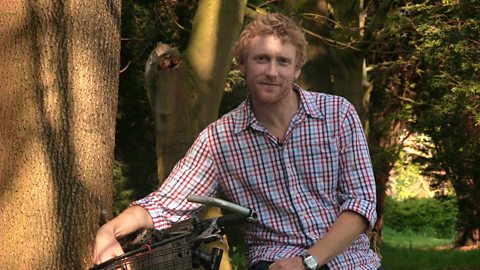
My name's Ade Adepitan. I kind of see myself as the kid who never gave up. Until the age of three, I lived in Lagos, Nigeria, and I contracted polio at six months. Polio affected me in a way that meant I was unable to walk without the use of callipers, which were like iron rods that the doctors put on my leg and connected to my shoe.
On my first day of school, I remember walking into the playground and seeing a group of kids playing football and wanting to join in. When they looked at me and saw me walking in on my calliper, limping, and wearing this crazy shirt that my mum made me wear, they thought, "There's no way he could play sport!" I moaned and nagged at them all day, and in the final playtime, they allowed me to play football and told me to go in goal. Within the first couple of minutes, the best footballer in our school blasted the ball, and I managed to jump to one side and save what was going to be a goal. The playground went quiet after I saved it, and I went from this crazy-looking, weird kind of kid to a sporting hero in one afternoon just because of that save. That moment changed my life.
Inspirational people are really important in your life. When I first watched the Olympic Games, I wanted to be like them so much that I would be on my sofa in my living room, and when the 100m would start for the Olympic Games, I'd have my eyes shut and start pumping my arms, imagining that I was there as part of the Games. My mum would look through the door, thinking I was crazy, but by seeing these people achieving great things inspired me. It's so important to have those types of people.
I got into wheelchair basketball by total luck. I saw some guys from the Great Britain Wheelchair Basketball Team, and they were training and they were amazing. They totally changed my ideas and perceptions because they were in these funky, amazing wheelchairs. The wheels were angled, they were doing wheelies, spinning around, shooting three-point shots, they had massive muscles, and they were doing things that my friends at school would only dream of doing. And that moment is when I looked at them and thought, "This is what I want to do. This is where I want to be."
I trained six days a week, six hours a day, shooting up to 800-900 shots a day. I was pushing about six miles a day and spending two hours in the gym. And I did this every day, and when I finally got selected for the team, it was just one of the best moments of my life.
SCREAMS
Yeeees! Yeeees! Come on!
My dream started when I was probably about nine years old, and I didn't make it into the Great Britain wheelchair basketball team until I was 27.
Yes! He's got it! He's got it! And Great Britain are through to the semi-final. 62 to 59.
What it was like, getting on that rostrum and having the medal put around my neck, looking at all my other teammates and seeing that we'd done it together, that's also something really special. Winning a medal for yourself is great, but knowing that you've gone through all of this and you've gone through all of that heartache with another group of people is just special. It was the best moment!
If you can believe in yourself, if you can go for something, go for everything, then other people will look at you and think, "Wow! Look at that person! Look how hard they're trying." And you will start being an inspiration for other people. It doesn't matter what you look like. It doesn't matter whether you have a disability. If you believe in yourself, anything is possible.
Video summary
Paralympic champion Ade Adepitan explains that he lost the use of his legs as a result of childhood polio, but decided to become an athlete after becoming obsessed with the Olympic Games as a boy.
Ade trained six hours a day, six days a week, until he became so accomplished in wheelchair basketball he was selected for the Paralympic team.
Ade tells us that being different does not have to stand in your way, "It doesn’t matter what you look like or if you have a disability. If you believe in yourself, anything is possible”.
Teacher Notes
Hold a class discussion on goal setting.
Students should consider long-term and short-term goals.
Introduce or re-cap the idea of goals being SMART, specific, measurable, attainable, realistic and time-specific.
Do their goals fit these criteria? If not, can they be adapted to fit?
Consider the idea of role models and have students research a role model (sporting or otherwise) to find out how they have achieved a particular success.
They should then consider aspects of this individual which they can apply to themselves and their sporting or physical activities.
This clip will be relevant for teaching KS2/KS3 PSHE and Citizenship in England, Wales and Northern Ireland.
It is also relevant for 2nd level Health and wellbeing, and 3rd/4th level and National 4 and 5 Physical Education in Scotland.
Becoming a record-breaking yachtswoman. video
Record-breaking round-the-world yachtswoman Ellen MacArthur talks about her life, in order to inspire others to recognise their own passions and talents.
A career as an entrepreneur. video
Fraser Doherty founded his SuperJam brand at just 15. He explains how hard work and feedback are key to his success.

A career as an adventurer. video
Alastair Humphreys' extraordinary journey from ordinary kid to round the world cyclist.