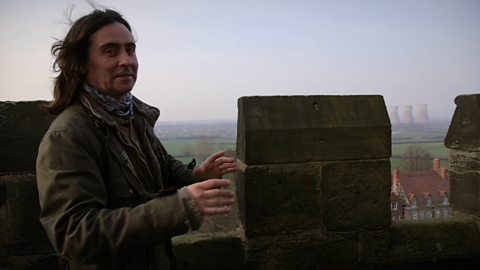
NEIL OLIVER:Over a thousand years ago, York, in Northern England, was one of the greatest cities of the Anglo-Saxon world.
NEIL OLIVER:And the people who lived here spent their time going about their daily lives.
NEIL OLIVER:But York had a shock coming, because in 866 A.D., an entire army arrived here, turned the place Viking, and called it Jorvik. This city, and half of England besides, became part of Scandinavia.
NEIL OLIVER:Today, even over a thousand years later, people still believe the Vikings were simply dangerous and fierce warriors.
NEIL OLIVER:Thank you.
NEIL OLIVER:I just want you to tell me what you think of when you hear that word, Vikings. What's the picture in your head?
Blue shirted man:Big bloke with a beard and horns.
Lady with pearl earrings:The guys are like big, brutal men, very hairy. Hats with horns on.
NEIL OLIVER:What about the women?
Lady with pearl earrings:They were probably quite hairy as well.
Man with shoulder strap:Big furs on their shoulders.
Boy in blue top:A Viking would raid monasteries.
Man with shoulder strap:Big swords. Beards. Looked quite scary, actually.
NEIL OLIVER:What we know, or think we know about the Vikings is much more myth than reality. Even the famed horned helmets are a modern invention. So, just who were the Vikings?
NEIL OLIVER:Here in Shetland, off the north coast of Scotland, is a place called Jarlshof.
NEIL OLIVER:It's one of the best-preserved Viking settlements anywhere.
NEIL OLIVER:And by looking at these archaeological remains, the buildings the Vikings left behind, we can see that they weren't just violent warriors, but that many were farmers trying to live peaceful lives. Because this is a farmstead.
NEIL OLIVER:Over here, there are the foundations for seven long, rectangular buildings. These were build and used by the Vikings. This should have been part of the main family quarters. Along here there would have been wooden-topped benches for sitting on and sleeping on, on either side. A central hearth. There would have been timber supports, probably, holding up the roof beam. It would have been quite dark in here, quite smoky. Then at the far end there's a corn-drying room, where there would have been heat that would have dried the crop for storage.
NEIL OLIVER:And then at the far end the archaeologists found burnt stone, so it suggests there may even have been a primitive sauna in use here.
NEIL OLIVER:In this end, where it's got all the hard standing, this would have been the buyer for the animals. So the cattle would have been in here, especially during the winter months.
NEIL OLIVER:The bones of sheep,cows, pigs and ponies have all been found on this site. But it's the many Viking objects dug from the earth across Shetland that show us how the people here really lived.
NEIL OLIVER:Gosh. What is it specifically for? Some kind of scoop, or a…?
Dr Ian Tait:It is indeed a scoop. But it's not a scoop for grain, as you might think. You'll see there's a hook shape on the handle there.
Dr Ian Tait:Now, the reason for that is that the thing is used in a boat. And you're bailing water.
NEIL OLIVER:Oh, it's a bailer. Right. Yeah.
Dr Ian TaitYeah. That's right. It'd be all too easy just to let the thing shoot out of your hand, and then it might plop into the sea, so you want to have a little bit of a backstop on it to stop it shooting out. And you can see here that the wear pattern is on that side. And…
NEIL OLIVER:It's a right-handed person.
Dr Ian Tait:Right-handed person.
NEIL OLIVER:That's gorgeous. Look at that. Look at the shine on it from being handled. You know, that patina there of being held and used.
Dr Ian Tait:Exactly. That's what brings the past to life.
NEIL OLIVER:Ian showed me many amazing objects from Viking times.
Dr Ian Tait:It's got this little depression there, and that's for your thumb. That's so you can carry it.
NEIL OLIVER:Things they used in their everyday lives.
Dr Ian Tait:A cooking pot, but it's much more interesting than just a cooking pot, because it's a half-made cooking pot.
NEIL OLIVER:But there was one single item that completely blew me away.
Dr Ian Tait:It's a piece of a glove or a mitten. It's been carbon dated to 975 A.D.
NEIL OLIVER:Oh, wow. How can that be a thousand years old? Is that knitted?
Dr Ian Tait:It's woven, believe it or not.
NEIL OLIVER:Gosh.
Dr Ian Tait:I think it's just absolutely electrifying to see an item like this where something as powerful as the human hand is… is there to be seen.
NEIL OLIVER:I think what makes these so special is that you think of Vikings and you think of men, warriors, graves, swords, and all the rest, but this kind of material reminds you that there are men, but there are women and children as well.
NEIL OLIVER:Finding objects in the ground shows us how the Vikings lived.
NEIL OLIVER:But I was interested in how they survived the winters, because Shetland, and Scandinavia, where the Vikings came from, are northern places, so food is hard to find in the long, cold, dark winter months. So I've come to a reconstruction of a house of the Vikings' ancestors, in Denmark to ask an expert how they coped.
NEIL OLIVER:What kind of challenges faced farmers as the long, dark nights of winter set in?
Bi Skarup:The most important thing was to get enough provisions to get you through the winter. If you were completely starved, in the spring, you couldn't, you know, start working with the land…
NEIL OLIVER:Yeah.
Bi Skarup:…and that was very important.
NEIL OLIVER:And is there anything interesting to drink?
Bi Skarup:Yes. Definitely. And I've made some for you.
NEIL OLIVER:I was hoping you'd say that.
Bi Skarup:Yeah.
Bi Skarup:The residue of this drink was found in a bark bucket in a burial mound,
NEIL OLIVER:Okay.
Bi Skarup:so it's malted wheat, honey, bough of myrtle, to give a bit of bitterness, and cranberries.
NEIL OLIVER:Slange var.
Bi Skarup:Skult.
NEIL OLIVER:That's fantastic. That really is. It just tastes like fruit juice.
Bi Skarup:Yes.
NEIL OLIVER:So we know that the Vikings could make drinks that would last the winter. But more of a problem was keeping food for months on end, especially meat. And they did this by preserving it in a milky liquid, to stop it becoming rotten.
Bi Skarup:It's raw pork, yes. In whey.
NEIL OLIVER:And all that's happened is it's sat in some liquid acquired from milk?
Bi Skarup:Yes.
NEIL OLIVER:Okay.
NEIL OLIVER:It's got all the texture, but it only tastes very faintly of meat. But, you know.
NEIL OLIVER:But then I do like raw meat. I've always been drawn that way.
NEIL OLIVER:Preparing for winter, storing and preserving food, collecting firewood and keeping warm, were all necessary if you were going to survive the freezing weather.
NEIL OLIVER:But I wanted to find out how comfortable it was to sleep in a house that the Vikings' ancestors would have slept in.
5500:08:11:03 00:08:23:17NEIL OLIVER:One thing I did know was that I needed to wrap up warm. We'll see how I get on. And hopefully these sheepskins will make all the difference.
NEIL OLIVER:I don’t suppose there were many occasions where a person had a night to him or herself inside a house like this. They would have been with their family almost all of the time.
NEIL OLIVER:There we go.
NEIL OLIVER:I have to report, first of all, that despite all my best intentions to report throughout the night, I fell asleep. LAUGHS So I've survived my winter's night. It was quite good, really.
NEIL OLIVER:After spending a night as the Vikings would have done, I've learned that they found ways of overcoming the wind and the cold.
NEIL OLIVER:But I've also discovered that the Vikings weren't just fierce warriors. They were farmers as well, with families and communities.
Video summary
Starting in York, once the Viking city of Jorvik, archaeologist Neil Oliver sets out to discover more about Viking home life as he challenges the myth that they were simply marauding, violent warriors in horned helmets.
At Jarlshof in Shetland he finds evidence of an ancient Viking settlement including the remains of a farm and he’s shown some of the extraordinary artefacts found at the site.
These reveal another side to Viking life – as peaceful farmers and highly skilled craftsmen.
In Denmark he spends the night in a reconstructed longhouse to experience how the Vikings and their families survived the cold winter months.
This is from the series Vikings.
Teacher Notes
Children could consider how past civilisations have been stereotyped, or think about how our current period in time will be remembered.
The class could discuss why archaeology is a vital source of information about ancient people and their lives.
Children could use some of the evidence seen in the film to begin to construct their own views of everyday life during Viking times.
Children could also explore the advantages and disadvantages of using reconstructions to find out about the past.
This clip is suitable for suitable for teaching KS2 and KS3 in England, Second Level in Scotland and KS1, KS2 and KS3 in Northern Ireland.
Vikings - Invaders and settlers. video
Neil Oliver visits three important sites associated with Viking invasion and settlement.
Viking ships. video
Neil Oliver learns how the Vikings became expert sailors and traveled so far from home.

Viking trade. video
Neil Oliver retraces the ancient trading routes of the Vikings all the way to Istanbul.

