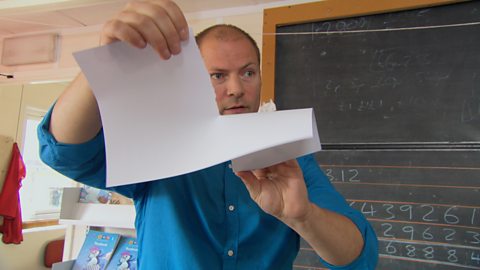
I'm here on the banks of the Tynewith a famous composerand also a bunch of kidswho are about to composetheir own piece of musicfor the very first time.
John Kefala-Kerr's workinvolves collaboratingwith all sorts of musiciansand today is no exception.He is keen to find out whatEmily, Nathan, Rachel,Maddy and Macy, Alexand Paul can come up with,especially since none of themhave ever tried to composea piece of music before.And there's another challenge.
Guys, listen up. Listen up.So we're working towardsmaking a composition,working towards some kind of shape.What I haven't told youthough is that, by the endof this afternoon,we will be playing the piece.
Yes!
But first, it's down to the riverto soak up some inspiration.
The waves on the water,when it's closer to the shorethey're quite small and gentle,but as you go further awaythey get larger and more choppy.
What about the object in front of us?
I think we should start with moreof a simple melody, to start with.And then like build it up to make itlike an arch of the bridge.
That's quite a complex lattice-workof girders and metalwork.
Can you picture a musical…a way of doing that musically?
SHE PLAYS FRENCH HORN
It's got a really interesting shapeto it. Tell us about it.
I was thinking aboutthe smoothness of the river,how relaxing and calm it isand shape it round that really.
I think Emily's little melody soundsmore like the arch of the bridgebecause it starts like quietlyand then it gets louderand then it sort of fades away.
I like the heavy soundand everything it represents,the heavy metal of the bridge.
It sort of just came out really,but…
Maddy's come up with a simple melodyshe hopes will work really well.
Nathan is learningthe chord structure.Then B, then F.B Flat Major.He in turn works with Emily,the French horn player,as they both layer in their soundsto complement the piano melody.They're really justimprovising with the melodyand playing about to see what works.
OK? What I want to do is letthe room have the first word.
OK.
The children use a single sound,or a chord,to fill the silence of the room.And then together they use thatto build a multi layered sound.
John, it seems to be working wellcos the kids are picking updifferent instruments, moving aroundand using different things.
Yeah, and I think that sort ofslightly… It's not chaotic exactly.It's got a mobilesense of creating stuff.It means that you're not toofixated on one end resultcos it's actually too earlyto become fixated.You need to try things out, movearound a bit and see what happens.
I think also we shouldinclude the vibraphonecos it's got a really nice soundand we haven't really given ita chance to play out in this piece.
I think that's a great idea.Rachel is going to bring that outand then we'll see wherewe end up from there.
Great call to add the vibraphonesolo to the composition.I think they've managed to createsomething really special.
OK, everyone. Time is up.Are you ready to go for the finalcomposition? One, two, three.
THEY BEGIN PLAYING
I've never really composed before.The part that I enjoyed most aboutthe whole composing process was,after having all the inspiration,finally turning it into a piece.
It was very helpful to see like howthe river moved and the structureof the bridge and how we could usethat to compose the piece of music.It had different instrumentsand you don't know like whether ornot they will clash or they'll fit.So I'm really pleasedbecause it sounds really good.
I've enjoyed most about when we wentto the river, it's been really fun.Being able to work with friendson like one big compositionhas been really good fun.We've got a really nice outcome.It's just amazing.
This is what we know todayas a silent movie.
Video summary
A group of children from Gateshead try to produce a piece of music inspired by the Tyne Bridge.
The students are individually accomplished players on each of their instruments, but will they be able to work together to compose an original piece of music?
This is from the series: Compose Yourself
Teacher Notes
Like the children in the clip, groups could take inspiration from their surroundings, thinking about how shapes and sounds might translate to musical sequences or moods.
Alternatively, they could take inspiration from their favourite book or a character from it.
They could then choose an instrument which portrays the character best - think about their mood and what kind of sound might match that mood.
Members of the group could think about the result and suggest changes.
Other players in the group could then think of the other aspects of the chosen character and invent music that portrays or underlines each trait.
The composition could be thought of as making a portrait of the character or telling a short story about the character.
Children could then perform the finished composition and make a recording, without telling the audience who the music is about.
Can the audience describe the characteristics of that person?
This clip will be relevant for teaching Music at KS3 in England, Wales and Northern Ireland. Also 2nd and 3rd level in Scotland.
Using everyday objects to create music. video
A group of children work with musical group ‘Trash’ to compose a piece of music using only rubbish and recycled objects.
Composing a piece of music using unpitched percussion. video
A group of children, who have no experience of composing music, work as a team to produce a short piece performed entirely using their voices and clapping.
Composing a silent film soundtrack. video
A group of children help composer Lauren Hayes make a soundtrack for musician Kid Carpet’s silent film.
Finding sounds around you to create music. video
Kid Carpet joins composer Jules Rawlinson and a class of schoolchildren to experiment with ‘found sounds’.