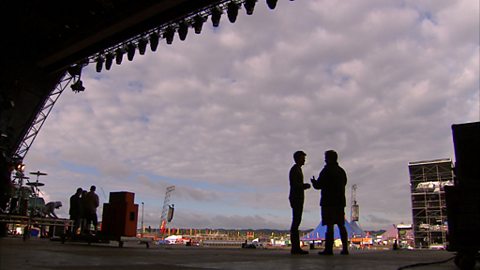
Of all the businesses trying to make a little cash at Reading, from the t-shirt vendors to the burger vans and noodle bars, there's one that's different from all the rest. And it's not because of what it sells, but because of the special way it's set up.
Ice cream is a festival staple, particularly when the sun is out, and Dominic Daniele knows how to cash in on this captive market. He's dishing out gallons of the stuff to the hungry crowds from his seven Wall's ice cream vans around the site. And what makes his business different is that it's a franchise.
We've all heard the word before, but how many of us actually know what it means?
What's a franchise? I don't want to look stupid.
It's when one company develops a string of companies, like McDonald's is a franchise.
A franchise is a business which is owned by yourself; it's a big business which is owned by individual people.
It's a simple idea, really. You pay an established company a fee, and that gives you the right to use its name and sell its products.
Franchises are common on our high streets. The burger you wolfed down at McDonald's for lunch, or that pizza from Dominos and the photos printed off at Snappy Snaps, were all bought from franchises. In fact, there are an estimated 897 different franchises in the UK.
What is the advantage to having a franchise like this, then?
We've got a multi-million pound company that is basically doing all of our advertising, and we do have the best-selling products in the ice-cream line in the UK. We've bought five brand new vans, and our sales and our purchasing power has increased.
Are there any disadvantages?
The only disadvantage is cosmetic, because when you own a business, you want your name in lights, but after five or ten minutes of Walls' products flying out of the window, that passes right away, so there's hardly any disadvantages.
Now, Dom, I'd feel like I'd do myself an injustice if I'm at an ice cream van chatting to the owner and not having a go. Please can I have a go? I've always wanted to.
Sure, hop on in.
Ahhh! There you go, sir, you can have that one.
Thank you.
Anyone else want one?
Oh! Look at that! One shot, one shot, and a shot in the middle. That deserves two flakes. That's one, and that's two. Anyone want…a lunch and dinner?!
Fortunately for Dominic, given my huge servings, it's not just the number of ice-creams he sells that's crucial to the success of his business. But there is one important group he has to impress to ensure he keeps his vans on the road. And that's the franchisor.
The franchisor is a big and well-established company that charges a fee to franchisees like Dominic, giving them the right to trade under its name and sell its products. In Dominic's case, the franchisor is Wall's, part of Unilever, a multinational company worth billions of pounds.
Franchisees like Dom seem quite happy with their lot, but what's in it for the franchisor? Bob Bhartiya is Dominic's boss. He's franchise manager for Walls. It's his job to keep an eye on the 15 franchises that run over 200 ice cream vans across the country. From Wall's point of view, the benefits of selling franchises are clear.
We can get our product to market very quickly and pretty inexpensively. Our investment is really around the graphicing of the equipment and also on the point of sale. We have operational standards that franchisees must meet. We have a very strict code on pricing, there is a minimum and a maximum size that ice creams should be, and monitoring those standards can be sometimes challenging.
That means if a franchisee mucks up, it's the reputation of the parent company that suffers.
So, to recap, a franchise is a partnership between two parties, and that means there are good and bad sides to the arrangement. On the plus side, the franchisee gets to sell an established product, which means they don't have to take such a risk going into business. And they don't have to worry about marketing costs, because that's usually met by the franchisor. Often, the franchisor will pay for staff training too.
There are some downsides for the franchisee. They don't get much choice about what to sell, and there's less room for being entrepreneurial. For Dominic though, the advantages massively outweigh any disadvantages.
My father-in-law built the company by himself for 40 years, and we've trebled the business since we joined Walls. The vans are impeccable, the ice cream is fantastic, so we just have to sit here and serve the public.
I've learned two things today. That franchising can be a very effective way of running a business, but more importantly, that I'm actually not that bad at making ice cream, and it is quite tasty.
Video summary
Radio 1’s DJ Greg James explores the franchise business model while at the Reading Festival.
Walls ice cream vans are used as a relevant and well-known example to discuss both the advantages and disadvantages of being part of a franchise business.
This is from the series: Music, Mud and Making Money
Teacher Notes
Could be useful to clarify the difference between a franchiser and a franchisee.
Examples will aid discussion on the advantages and disadvantages of buying into a franchise and introduce students to the high number of franchises we all see and use on a day-to-day basis.
Follow up by asking students to research other well-known franchised brands.
This clip will be relevant for teaching Business at KS4/GCSE, in England and Wales and Northern Ireland
Also at National 5 in Scotland.
This topic appears in OCR, Edexcel, AQA, WJEC, CCEA GCSE and SQA.
Students and teachers over the age of 16 can create a free Financial Times account. For a Financial Times article about TGI Fridays’ UK franchise from 2024, click here.
How to be an entrepreneur. video
A look at how festival businesses can bring out the best in entrepreneurs.
What’s it like being a sole trader? video
A detailed look at why people go it alone in business and set up as a sole trader.
Different types of companies – LTDs and PLCs. video
Businesses discuss their status as a Private Limited Company or a Public Limited Company.