TEACHER: Now, we're standing beside a Viking grave. Can everybody see the grave?
ALL: Yes.
TEACHER: Viking graves are really important to archaeologists because as well as the body that's buried, you also get objects that are buried with the body.
Can we all see the objects?
ALL: Yeah.
TEACHER: Now, this is different from the type of burials that we have today because generally when you're buried, it's just your body that goes in.
You don't get buried with objects.
The Vikings were different because when they were buried, they liked to be buried with objects that were important to them when they were alive.
So, if you were buried today, what kind of object would you like to be buried with? Yeah?
BOY 1: My fish.
TEACHER: Your fish.
BOY 2: My PlayStation.
TEACHER: Your PlayStation. Excellent. So these are some of the favourite things that you'd want to be buried with.
The Vikings were exactly the same. They liked to be buried with objects that they enjoyed using in real life.
So we're going to play a game now. Can everybody see the objects?
ALL: Yes.
TEACHER: Can you see every single one has a number?
ALL: Yes.
TEACHER: You have to try and tell me what you think the object is and what you think the Viking used it for when he was alive, OK?
We'll start with an easy one, let's start with number six.
What do you think number six is?
Yeah?
BOY 2: A comb.
TEACHER: A comb, excellent. So we know that the Viking liked to comb his hair in the morning. He's a bit like me, he likes to do his hair first thing in the morning.
OK, so he's quite proud of how he looked, OK? Now, the next one. Can everybody see number three? It's that collection of balls. What do you think those are?
Yeah?
BOY 1: A game.
TEACHER: A game, excellent. Do you know what kind of game it looks like?
BOY 1: Chess.
TEACHER: It's like chess, it's not chess, but it's like chess. It's like an earlier game before chess and it's probably something like draughts or something like that.
Now, we're going to do a bit more difficult question now. Can everybody see number eight, it's the carved piece of iron? Does anybody know what that is?
TEACHER: Yeah?
GIRL 1: A handle.
TEACHER: It's not a handle but it would have had a handle on it. The handle doesn't survive anymore. It's a sickle and it's for chopping down wheat.
What does this tell us about the Viking, then? Yes?
GIRL 1: It tells us he's a farmer.
TEACHER: Very good.
So we can see that this guy was a farmer, he liked combing his hair, and he also liked to play games.
Now most people, when they talk about Vikings, just think of the Vikings being a warrior or a raider with swords and shields, but we can see from this grave that the guy had a comb, he enjoyed playing games and he was also a farmer. So we can say that he was more than just a raider or a fighter.
Now, there's one object in this grave that's probably to do with fighting. It's very hard to see but cananybody guess what it is? Yeah?
BOY 2: It's a part of a middle of a shield.
TEACHER: Very good. Can everybody see the thing at the back?
ALL: Yeah.
TEACHER: Yeah? That's actually the centre of a big shield. The shield would have been made of wood but the wood doesn't survive.
It's like when you chop down a tree in your garden and over time it rots away. So it's only the middle bit that survives. So that's the only object in this grave that's probably to do with a warrior.
In this clip, an archaeologist explains to children visiting a museum why the discovery of a Viking grave is important.
This is because in Viking burials, objects important to the person were buried along with the body. These objects tell archaeologists a lot about the buried person. For example, a sickle found in one grave is evidence that Vikings could be farmers as well as fighters and raiders.
This video comes from the BBC series, See You See Me, The Success of the Norse.
Teacher Notes
- This clip can be used as part of a lesson about engaging with primary sources and artefacts. They can be used to provide evidence about the way people, in this case the Vikings, lived in the past.
- A possible activity would be to pause the clip at each point an artefact is shown. The class can be asked to try to deduce what it is, what it might have been used for and how it might have been made.
Curriculum Notes
This short film is relevant for teaching History at KS2 in England and Wales, KS2 in Northern Ireland and second level in Scotland.

More video clips on The life of the Vikings:
Viking beliefs. video
Discover which gods the Vikings worshipped and why. Find out about their powers, what the Vikings believed and why these beliefs were so important to how they lived, and died, in Viking society.
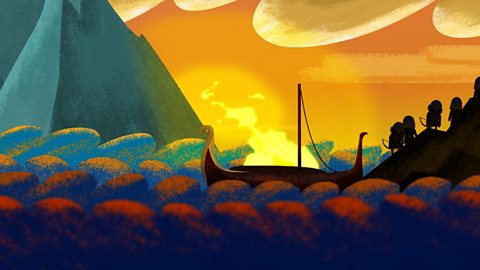
The importance of Lindisfarne for the Vikings. video
Lindisfarne, also known as Holy Island, was one of the first landing sites of the Vikings. However, the Vikings committed terrible violence against the Monks at Lindisfarne.
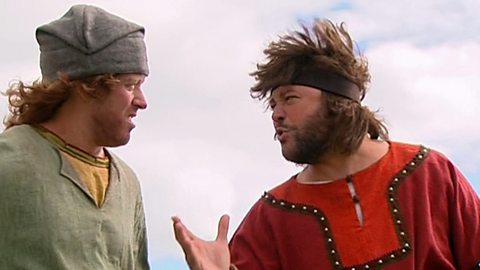
Viking clothing. video
A description of the sort of clothes the Vikings wore, which were handmade out of materials available at the time.
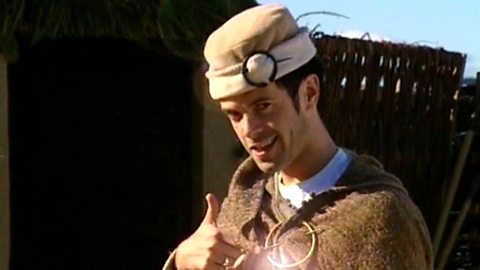
Viking food. video
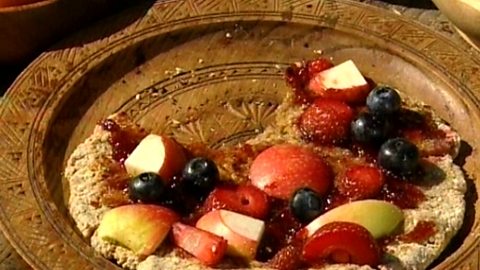
Presenter James MacKenzie is shown the types of food that the Vikings ate, how it was prepared and cooked.