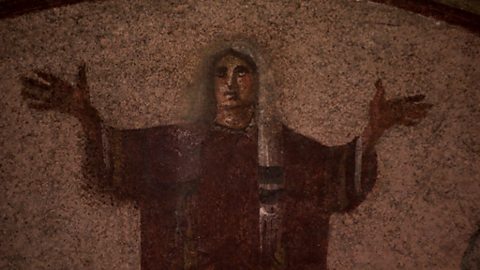
I'm on my way to a city in northern Italy to find out why women were pushed to the margins of the Christian faith. Our evidence reveals that Christianity began by championing women, but not everyone was happy with this situation. Many eminent theologians were deeply uncomfortable with women taking such a prominent position. How dare women presume they could play a leading role when their very essence was an affront to God.
One Christian, Clement of Alexandria, wrote in the 3rd Century AD, "The very consciousness of their own nature must evoke feelings of shame." And another said that women were not created in God's image, but instead they destroyed God's image.
But there would be one man whose glittering intellect and powers of persuasion would make this hotchpotch of women-hating bile stick.
I've come to the place where, for him, it all started.
Beneath Milan's cathedral lie the ruins of a 4th-Century baptistery. It's where people once came to be baptised into the Christian faith. What happened here was perhaps one of the most critical developments in Christian history. Here, in 387 AD, a man called Augustine became a Christian.
He'd go on to be one of the most brilliant Christian theologians of all time, but his attitudes would cause trouble for women for the next 1,700 years.
We know an awful lot about Augustine's life, thanks to his detailed autobiography, his Confessions.
Augustine tells us that, in his younger days, he was obsessed with sex and that, as a teenager, he spent every waking hour hungry with desire. "To love and to be loved was sweet to me, particularly when I enjoyed the body of the one I desired. And so I polluted the spring of friendship with the filth of concupiscence and I dimmed its lustre with the slime of lust."
But after becoming a Christian, Augustine embraced a life of celibacy. His preoccupation with sex, however, was far from over. He'd go on to develop a theory which would shape how humanity viewed itself. It was a theory so powerful, we're still living with its consequences today.
Augustine developed the concept of Original Sin. He believed that the crimes committed by Adam and Eve in the Garden of Eden, when they ate the forbidden fruit, would be perpetuated down the generations, thanks to the act of sex. In other words, when any of us are born, we're already creatures infused with sin to the very core of our being.
Women, in particular, come out of this very badly. Carved into the wall of Milan's cathedral is the moment when Augustine believed it all went wrong for humanity. It was Eve who'd encouraged Adam to sin. Eve becomes an archetype for all women, weak and easily fooled, but also a temptress who leads men astray.
Rather than eroticism and sexual desire being considered a gift of the gods, as they were in the classical world, now these things were thought of as unremittingly dark and sinful, a betrayal of God himself.
Video summary
The religious background to Original Sin is explained by Bettany Hughes.
She gives a brief summary of the early life of St. Augustine and the contrast with his life after baptism into the Christian faith.
Augustine's concept of Original Sin is explained by reference to the story of Adam and Eve.
Bettany looks at the implications this has for attitudes towards women and sexual relationships.
This is from the series: Divine Women
Teacher Notes
Students could be asked to assess what the concept of Original Sin might mean for attitudes to women in the workplace, in marriage, and in the Church.
Students might be asked to reflect on what Augustine felt was the cause of moral evil in the world.
Students could be asked to examine and debate whether the story of Adam and Eve is to be understood literally.
This clip will be relevant for teaching Religious Studies at KS3, KS4, and GCSE in England and Northern Ireland.
Also KS4 and GCSE in Wales and at 3rd and 4th Level in Scotland.
This topic appears in OCR, Edexcel, AQA, WJEC, CCEA and SQA.
Khadija and the founding of Islam. video
The life and role of Khadija in the founding of Islam is examined by Bettany Hughes.

Should women be priests? video
Bettany Hughes outlines the background to the debate on whether women can be priests or bishops.
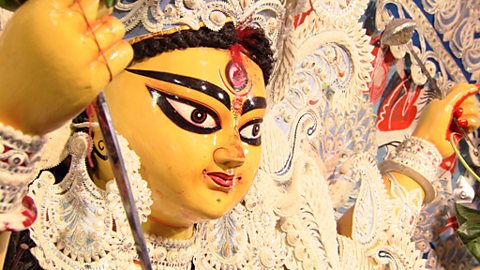
Taking part in the Durga Puja. video
Bettany Hughes visits the Kamakhya Temple to learn about the Durga Puja.