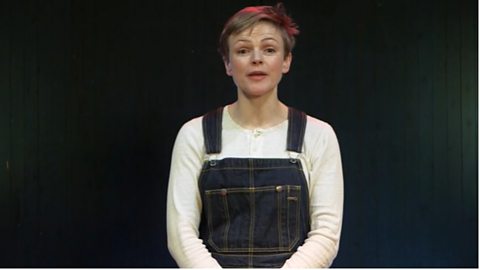
Lorianne Tika Lemba of The Hip-hop Shakespeare Company compares Shakespeare’s verse rhythms to hip-hop. It is thought that Shakespeare used rhythm to give direction to actors.
Placing her hand on her chest to feel the rhythm of her heart, she explains that the rhythm of the human heart consists of two beats, which make a ‘Da-dum’ sound.
She tells us that Shakespeare used this double-beat five times in each line of blank verse in his plays.
She explains that the technical term for this is 'iambic pentameter.' It is similar to the beat that runs through hip-hop music.
Teacher Notes
Students could investigate iambic pentameter further by conducting internet research on rhythmic variations, such as lines which are shorter or longer than ten beats, or which have inverted stresses or unstressed line endings.
Rhythmic variations suggest that Shakespeare is forcing the actor to pause or alter delivery. Students could analyse a blank verse speech and establish how the emotional content and rhythm of the line are matched.
Curriculum Notes
This clip is relevant for teaching Drama and English at KS3 in England, Wales and Northern Ireland, and third level in Scotland.
More from How to put on a Shakespeare play:
Shakespearian characters' costumes. video
Robin Belfield of the Royal Shakespeare Company gives ideas as to how to dress a Shakespearean character.

What did actors sound like in Shakespeare's day? video
Actor, author and Shakespeare specialist Ben Crystal talks about how actors would have spoken in Shakespeare's day.

Putting on a Shakespeare play at home. video
Bill Buckhurst, theatre director, shares his thoughts and ideas about how to put on a Shakespeare play at home.

What tips are there for acting in a Shakespeare play? video
Maxine Peake shares her tips for acting in a Shakespeare play, including ‘actioning,' movement and body language.