Do you like building things?
Oh whoops!
How can we make our structures stronger – so they don’t fall over?
We could give our structures strong foundations.
Like Isabel here. She's building her tower wide and thick at the bottom.
Nice work, Isabel!
Or we could use strong shapes to make our structures stronger.
Bridges carry the weight of people, cars, lorries, even trains.
If you look closely at a bridge, you will notice that they often have triangles in their design. It’s like that because triangles are stronger than squares.
When you push hard on a square, the whole thing collapses.
But when you push on a triangle, it keeps its shape.
So triangles make stronger structures.
Rio is going to test this using this heavy bowl.
The structure made out of triangles should be stronger.
Nice one, Rio!
Or we could stack materials to make our structures stronger.
Laying bricks so they are not directly on top of each other, like this, makes this house stronger.
This is a good way to make a strong structure that won’t collapse.
By changing the way the blocks are laid in each row, the weight is spread out more evenly.
So the next time you want to build something, remember, give it strong foundations to hold it steady; use triangles instead of squares; and don’t lay the bricks directly on top of each other so the weight of the bricks is evenly spread.
Video summary
This short film for primary schools explores the key properties of structures and how they can be refined and changed to make them stronger.
It is an ideal introduction to any design and technology unit dealing with construction.
It explores different approaches to construction and explains the features of structures that make them stronger and more resilient.
Teacher Notes
This short film is an ideal tool to introduce pupils to the techniques that can be used to make structures stronger.
As they watch the film, pupils can give their own thoughts on why they think some structures are stronger than others.
They can also try to relate these ideas to everyday structures and objects, which will help them link theory and practice.
Points for discussion:
- What considerations have to be taken into account when designing a structure?
- Which are the stronger shapes to use when creating a structure?
- How can structures be altered to make them stronger?
- Why are some structures weaker than others?
Suggested activities:
After watching the film, you could work with pupils to investigate structures in different contexts.
The pupils could be given the opportunity to build their own structures, making predictions about their strength, and testing them to see if they were correct.
Pupils could explore annotated diagrams of structures to find out why some are stronger than others.
Pupils could also look for real life examples of structures in various contexts using books and on the internet.
Suitable for teaching design and technology (D&T) at KS2 in England, Wales and Northern Ireland, and 1st and 2nd level in Scotland.
How to make a structure waterproof. video
Follow two primary-aged pupilds as they build a den in their garden and learn how make it waterproof.
Axles. video
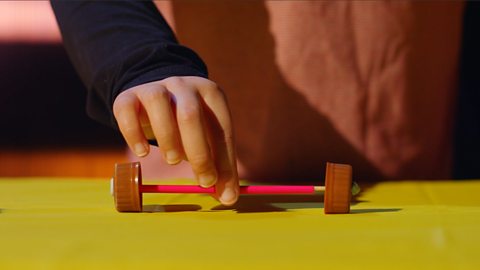
Two primary-aged pupils show us how to make balloon cars to help us understand how axles work.
Hinges. video
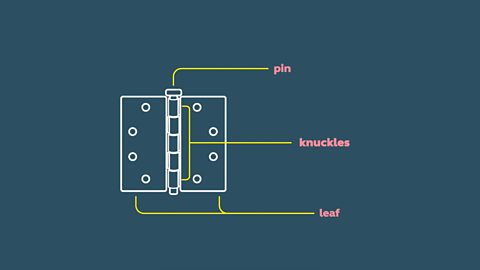
In this short film we observe two primary-aged pupils as they make simple hinges for their treasure boxes.