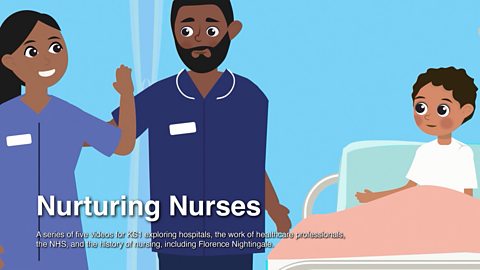
Krish finds out how hospitals and health care have changed rapidly within living memory.
The video
Krish's Mum: How are you finding them, Krish?
Krish: It's tricky, but I'm getting used to them mum. Can I have a rest?
Krish's Mum: Of course we can. Let's take a seat on that bench over there.
Eileen: Hello, what a lovely day it is.
Krish's Mum: It is.
Eileen: How did you hurt your leg?
Krish: Playing football.
Eileen: Oh dear. I came to hospital with a broken arm when I was about your age.
Krish: Hospital is lots of fun. I was put to sleep and had to have an operation to fix my broken ankle.
Eileen: Very exciting. But it wasn't quite the same in my day. I had to stay on a huge, long ward with the youngest children at one end and the oldest at the other. And my mother wasn't allowed to visit me as much as your mum can visit you. I was quite frightened on my first night.
Krish's Mum: Oh dear, that doesn't sound much fun.
Krish: The ward here is great. It's very bright and colourful and I've made new friends with the other kids in my room. We have TVs and games to play and a dog called Bevan was brought in to cheer us up yesterday.
Eileen: That sounds wonderful.
Krish: The nurses all wear bright coloured uniforms and the children who are staying on the ward for longer than me even have school lessons with a special teacher.
Eileen: When I was a little girl, the nurses all wore the same uniform with caps and skirts. They looked very serious. I had to stay there for days and there was no school or entertainment but I did read some books, which was fun.
Krish: It sounds much more fun now. I even had my favourite food last night, spaghetti bolognaise.
Krish's Mum: You do love spaghetti bolognese.
Krish: What was the food like when you were in hospital?
Eileen: Do you like boiled soggy cabbage and potatoes?
Krish: Soggy cabbage, yuck.
Eileen: I agree. Hospital food is so much nicer today. Oh, here's Josh the porter to take me back to the ward.
Josh: Hi Eileen, time to get you back to the ward for your lunch.
Eileen: We were just talking about what hospitals were like when I was a little girl.
Josh: Oh yes, they've changed so much over the years as we learn about illnesses and how to treat them. The thing I've noticed the most since I've been working here is all the new technology like computers and scanning machines.
Krish: And my entertainment screen by my bed.
Josh: Ha-ha, exactly.
Eileen: We didn't have much technology when I was a girl, although we did have X-ray machines back then.
Josh: Yes, they've been used in hospitals for almost 100 years now and they're still very important today to look for broken bones and other problems.
Eileen: Krish had to have an operation to fix his ankle.
Josh: Were you put to sleep?
Krish: Yes.
Josh: You would have had some medicine called an anaesthetic for that, to make sure you didn't feel any pain. That was first used more than 200 years ago. Before that, I can imagine surgery would have been very painful.
Krish: Oh yes that doesn't sound very nice. There are also lots of other machines on Nightingale Ward, where I'm staying.
Josh: Yes, they have ECG monitors that check your heart is working okay and electric blood pressure monitors to check that blood is being pumped around your body properly.
Eileen: We didn't have any of that in my day.
Josh: Well, we know so much more about treating and caring for people now and we also want to make hospital stays as comfortable and enjoyable as possible. So most hospitals now have gardens or areas like this where patients can go to relax.
Eileen: I was never allowed to leave my bed back then. Yeah it seems better now. Right I'm starving, shall we head back Josh?
Josh: Good idea.
Krish's Mum: Nice to meet you.
Eileen: You too. I hope you go home soon Krish.
Krish: Bye Eileen.
4. Hospitals now and then
Krish is in the hospital grounds with his mother and meets Eileen, an elderly patient who tells him about her time in hospital when she broke her arm as a child. They discuss some of the differences between hospitals in the past and the present. This includes changes in uniforms, food, technology and the ways that children can pass their time when staying in hospital. Eileen tells Krish how dull it could be as she wasn’t allowed out of bed; whereas Krish shares some of the ways that children are supported in modern hospitals, with hospital schools and entertainment screens. A porter comes to collect Eileen and discusses how technology has changed over recent years, including anaesthetics, ECG and blood pressure monitors.
Duration: 3' 42"
Final words: '…go home soon, Krish. / Bye Eileen!'
Questions to ask
- Can you remember any of the ways that hospitals were different in the past?
- Would you have liked being in hospital in the past?
- What things that Eileen speaks about would you not have liked?
- Do you think hospitals are better now? In what ways?
- Are there any things that have stayed the same?
Before and after watching
- Give children pictures (photographs or stills from the animation) of hospitals in the past and hospitals now. Ask them to sort into 'Past' and 'Present'. Discuss how they are different.
- You could ask a child to 'hot-seat' in the role of Eileen or another elderly patient and invite children ask her or him questions about their time in hospital. What did they like best? What didn’t they like? How did they feel? Etc. They could then write a diary entry or draw a picture of their experiences on a ward in the past.
- Alternatively, ask the children to think about one of the nurses from the past that that they heard about in the previous video (eg Florence Nightingale or Edith Cavell). What would they think of modern hospitals? What would they notice was different between the hospitals they worked in and hospitals now?
- Ask the children to write a letter to Florence Nightingale, Mary Seacole or Edith Cavell, explaining how hospitals now are similar to and different from hospitals in the past.