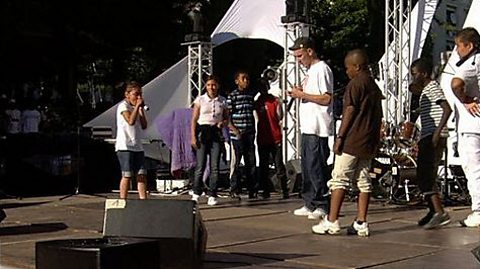
CHILDREN: Nous, on aime se promener dans les Calanques.
NARRATOR: 'Along the coast from Marseilles is an area that's wild and beautiful, and it's called "Les Calanques". The deep inlets in the limestone have been formed by the sea, eating into it over millions of years. It's a very special landscape and a great place to explore.'
NARRATOR: 'Et voilà les explorateurs!'
'Out for the day from Marseilles, they're off on a discovery trip to find out what make the Calanques so different.'
'The Calanques are a fragile place, and visitors are asked to treat it with care.'
TEACHER: Donc les enfants, les consignes dans les Calanques.
"Ne pas jeter de détritus par terre."
"Ne pas arracher les plantes."
"Ne pas faire de feu ni fumée."
TEACHER: Très bien. Donc on va prendre le chemin. On va y aller.
NARRATOR: 'The limestone cliffs hold very little water, and with the glare of the sun, the temperature can often shoot up so high that it can be hard for plants to survive. The only ones that do are those that have adapted to the very dry conditions.'
TEACHER: Bien les enfants, vous allez chercher une feuille douce et une feuille qui pique.
NARRATOR: 'The first task is to find leaves that have clever ways of retaining water.'
GIRL 1: Oh… ça, c'est une feuille douce.
BOY 1: Tiens, une feuille qui pique! Voici la feuille qui pique.
TEACHER: Les enfants, voilà une feuille qui pique. Elle est en forme d'aiguille. Elle est adaptée à la sécheresse, elle est typique des Calanques.
Et voilà une feuille douce. Elle est aussi dans les Calanques. Et elle a des poils qui retiennent l'eau.
NARRATOR: 'When you're used to living in the city, you can get lost in a place like this!'
BOY 2: C'est à gauche ou à droite?
BOY 3: À droite.
BOY 2: Ah oui.
NARRATOR: 'And out on these cliffs, everything seems so quiet! But is it?'
TEACHER: Bien, on va faire une séance d'écoute. Donc, vous allez arrêter de bouger. Fermer les yeux et ouvrir vos oreilles. Vous êtes prêts? On est partis.
Alors, quels sont les bruits que vous avez entendus? Mélina.
MÉLINA: La mer.
TEACHER: La mer. Louis.
LOUIS: Des insectes.
TEACHER: Des insectes. Pierre?
PIERRE: Un bateau.
TEACHER: Un bateau. Estelle?
ESTELLE: Le vent.
TEACHER: Et le vent! Très bien. Donc par rapport au vent… Le vent, il a aussi une action sur toute la végétation.
Si vous regardez l'arbre qui est juste derrière vous, vous voyez que l'arbre est penché. C'est le vent qui couche l'arbre pendant qu'il pousse.
NARRATOR: 'There are trees bent by the wind all over the Calanques.'
'Le soleil brille et il fait très chaud. On a envie d'être près de la mer.'
TEACHER: Bien, nous sommes arrivés à la Calanque de la Mounine. Vous pouvez aller chercher des animaux.
NARRATOR: 'The waters around the Calanques are full of life. But it's not easy to find!'
BOY 4: Il y a une méduse!
BOY 5: Ah ouais, la violette, là?
BOY 6: On a trouvé un crabe.
TEACHER: Très bien. Mets-le dans la boîte. Très bien. Vous avez bien vu?
BOY 7: Oui. Il bouge beaucoup.
NARRATOR: 'Dommage, c'est l'heure de rentrer! À la prochaine!'
Video summary
A group of children go on a school trip to les Calanques in Marseilles and explore the flora and fauna.
This video includes a description of les Calanques and its special features.
The children read a poster stating rules while in the area and then go with a teacher to investigate plants and sea life. They also take time to stand and listen.
This video comes from the BBC2 series, Being French.
Teacher Notes
- Pupils could discuss what the Calanques are, how they were formed and compare the limestone cliffs with other places in England.
- The clip could be paused to check the pupils understand the rules to protect the Calanques. Pupils could design their own signs in French to illustrate the rules.
- Pupils could perform their own listening exercise to focus on the language needed to describe their surroundings.
- Pupils could revisit commands and play 'Simon says'.
- Pupils can be asked to predict the name of the creatures they will find. They can then draw and label them in French and watch to check what French children actually found.
This video is relevant for teaching French at KS2 in England and Wales, KS2 in Northern Ireland and second level in Scotland.
Welcome to Marseilles. video
An introduction to Marseilles showing its position on the map of France. This clip also introduces children living in or around the city and the leisure activities available in the area.
A fishing trip in France. video
A father and son go on a fishing trip in Marseilles and les îles du Frioul. They go to the market and show different types of fish on offer. They also buy tickets to cross by ferry.
Going to primary school in France
A day at a primary school in Marseilles, including lessons and games. Children express opinions about their favourite lessons, playtime with games, their favourite books in the library, and lessons in the computer suite.
Going shopping in France. video
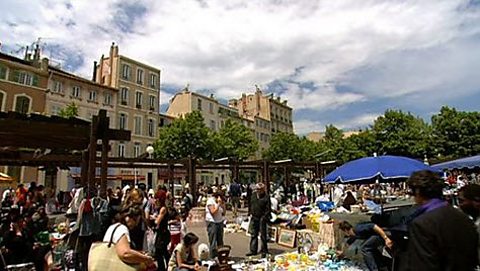
A boy called Tom sorts out his toys and clothes, and takes them to the local second-hand market or vide-grenier to sell.
Sports activities in France. video
A description of the annual Jours de Sport weekend event in Marseilles with activities such as skipping, rushball, American football and Tai Chi. Children express their opinions on the activities.

A summer concert in France. video
A summer concert takes place in la Castellane in Marseilles, celebrating cultural diversity. The video introduces two children and their coach ahead of their performances for a talent competition.