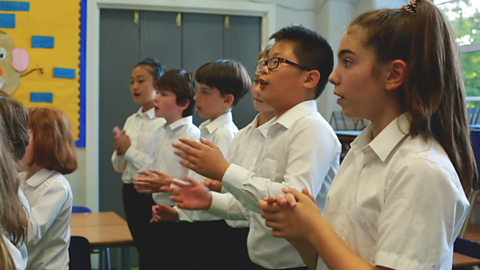
Gareth Malone:
A one, a two, a one, two, three, four…
Gareth and children:
Engine, engine, number nine. Going down Chicago line.
Gareth Malone:
I think that singing is one of the most beneficial things that you can do with your students.
Children:
Engine, engine, number nine. Going down Chicago line.
Gareth Malone:
It's fun, it's emotionally good, it helps kids to learn language. It's just an excellent activity and it's so easy to achieve.
Gareth and children:
Maybe, maybe, slow, slow.
Gareth Malone:
In this series of films I'm going to show you how to get your class singing and how to make them love it.
Gareth Malone:
Let's stand up and let's get ready to sing.
Gareth Malone:
The first part of the warm up should be a physical warm up. That could be any kind of shaking, stretching.
Gareth Malone:
Stretch up and touch the ceiling. Stretch right up, stretch one side.
Gareth Malone:
The kids can make up their own moves, something to just get the body and the breath going.
Gareth Malone:
A one, two, three, four, five, six, seven, eight. A one, two, three, four, five, six, seven, eight. One, two, three, four…
Gareth Malone:
It should be fun, it should be quick, it should be lighthearted.
Gareth Malone:
One, one, one, one, hey! Very good. We're gonna warm up our faces now. Can you make a really big face?
Gareth Malone:
The face is a very important part of singing.
Gareth Malone:
Ooh.
Children:
Ooh.
Gareth Malone:
The whole apparatus needs warming up.
Gareth Malone:
Suck a lemon. Very good.
Gareth Malone:
It's about getting the kids using it and that will help them to be more expressive singers.
Gareth Malone:
Can we make the jaws really, really floppy, like… That's wonderful, wonderful.
Gareth Malone:
Next the all important breathing exercises.
Gareth Malone:
Sss… very good.
Gareth Malone:
It doesn't need to be too formal at this stage but shh, shh, shh, sss, sss, sss, fff, fff, fff… that will do, just to get the muscles going.
Gareth Malone:
Shh, shh, shh, phd, phd, phd…
Gareth Malone::With children this young, they're not yet ready to use their breath to sing very long phrases.
Gareth Malone:
Woosh, woosh, woosh…
Gareth Malone:
But we want to encourage them to use their breath and think about their breath a bit more.
Gareth Malone:
Would anyone else like to lead something?
Gareth Malone:
Why not get one of the kids up to have a go, that's a great way of engaging them and making it fun.
Girl:
Sss…
Gareth Malone:
Sss…
Girl:
Shh, shh…
Gareth Malone:
Shh, shh…
Girl:
Bup…
Gareth Malone:
Bup…
Gareth Malone:
Round of applause, very well done. Back you go.
Gareth Malone:
After you've got them breathing a little deeper, then move on to pitch.
Gareth Malone:
We're gonna warm up the voice now and I'd like you to make a sound, an um, from the very bottom part of your voice to the very top of your voice. Like this… Can you do that for me?
Children:
Um… wee…
Gareth Malone:
Any kind of noise just to get the, get the vocal apparatus working.
Gareth Malone:
Mmmmm…
Children:
Mmmmm…
Gareth Malone:
'Cause very often they will just speak on a monotone and those sort of exercises, they don't feel like singing, they're just making sounds. It's a great way to encourage kids to sing.
Gareth Malone:
Ahh.
Children:
Ahh.
Gareth Malone:
Hey.
Children:
Hey.
Gareth Malone:
Once you're using your voice, making sounds like ooh and aah and aw, you know imaging a story, will really help the kids to be engaged with it.
Gareth Malone:
In a minute, I'm going to open this box and inside this box is your favourite food. Are you ready? I want you to hum and go um really, really enthusiastically. Ready, here we go.
Children:
Mmm!
Gareth Malone:
Very good.
Gareth Malone:
Hopefully now your children are warmed up, energised and ready to sing. In the next film, I'm going to show you how to teach them a song.
Singing is beneficial to help encourage learning in various subjects including improving confidence.
Watch Gareth Malone's singing techniques to help your class warm up their vocal cords and ready for singing.
The activities he demonstrates are designed to help with voice and pitch.
This clip is suitable for teaching music at EYFS and Key Stage 1 in England, Foundation in Wales, Early Years and Foundation KS1 in Northern Ireland and Early and First Level in Scotland.
More from Gareth Malone
Teach a song
Get your children to discover rhythm and pulse and learning the words and the melody.
Lead or conduct your singers
Use these tips on standing with good posture, using your voice and knowing the words, including how to use emotions while singing with your children.
Preparing to perform
Try these tips about how to use the body while singing and get your children prepared to perform.