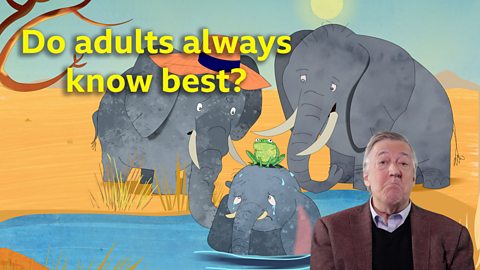
Vulture: Outrageous!
Zebra: Lying is wrong!
Cheetah: No, lying is good!
SIR STEPHEN FRY:
QUIET! (All noise stops, beat) That’s better.
SIR STEPHEN FRY:
Things in the Savannah have taken a slight turn for the worse. King Lawrence, this chap (illustration pops up), seems to have lost control of his kingdom. You’re probably wondering how things got so bad? Well, before we ask for your help, let me explain how we got here…
SIR STEPHEN FRY:
King Lawrence’s morning started in the way it always does. Refusing to get out of bed while his trusted advisor, Maple the Meerkat, read him his schedule for the day.
MAPLE:
At 2pm you’re booked in for a mane-cut” replied Maple, “Trim on top with layering on the sides. Then at 3pm I’ve got you pencilled in for some generic roaring, just to keep up your public persona —"
SIR STEPHEN FRY:
But Maple was interrupted by Lawrence’s two children: Prince Otis and Princess Flo.
FLO:
“Dad, Otis went in my room again”, whined Flo.
OTIS:
“Firstly, you don’t have a room, you sleep on a rock” replied Otis “and secondly, no I did not”.
FLO:
Fine. Who stole my new trainers then?”
OTIS:
“Not. Me.” Otis stressed again.
FLO:
“He’s lying, Dad! Look at his paws, and he’s ruined them” cried Flo, exasperated now.
SIR STEPHEN FRY:
King Lawrence, yawned, stretched, and took it upon himself to explain to his son that lying is wrong.
LAWRENCE:
“Your sister deserves the truth Otis”, said Lawrence. “You did go into her room and take her trainers didn’t you.”
OTIS:
“Rock” corrected Otis, with a nod.
LAWRENCE:
See…lying is bad, telling the truth is always the right thing to do, said Lawrence.
SIR STEPHEN FRY:
And with that the King picked up his robe and ordered Maple to gather all the animals together. He was going to announce, or sing, this new law to his subjects.
MAPLE:
“Ladies and gentlemen, please, put your hooves and paws together for King Lawrence and his Royal Decree”, announced Maple.
LAWRENCE: (singing)
Gather, creatures of land, sea and sky
It’s time you listen to The King (that’s me),
From today, I rule, no one should lie,
And that is my Royal Decree.
Because lying is bad…
Of that I am sure.
So I’ll sign the decree,
With a stamp of my paw!
SIR STEPHEN FRY:
Lying was now outlawed across the animal kingdom and harmony was restored. Or at least, that’s what King Lawrence thought…
SIR STEPHEN FRY:
On her morning jog, Maple the Meerkat passed by the local nursery. She saw Mrs Warthog pushing Will the Warthog in a pram. It was his first day at the Nursery.
MRS MACAQUES:
“This must be little Will” exclaimed Mrs Macaques, Will’s new teacher.
MRS WARTHOG:
“Yes, he’s still dozing, my sleeping angel. Isn’t he beautiful?” smiled Mrs Warthog, lovingly.
SIR STEPHEN FRY:
But as Mrs Macaques peeped into the pram, she saw what she could only describe as… the snottiest baby she had ever seen. She wanted to agree and say how beautiful Will was, but then she remembered… she must tell the truth, as lying is wrong.
MRS MACAQUES:
“ I’m sorry but I have to say I’ve been teaching at this Nursery for ten years now” explained Mrs Macaques, “and in all that time, I have never seen a baby quite so unbelievably snotty”.
SIR STEPHEN FRY:
Mrs Warthog and a now-awoken Will burst into tears.
MRS WARTHOG:
“I’m reporting you to the authorities!” wailed Mrs Warthog, as Will snotted over himself some more.
SIR STEPHEN FRY:
Maple the Meerkat was shocked. Maybe telling the truth isn’t always the best thing to do, she wondered.
SIR STEPHEN FRY:
Later that evening, Maple was on her way to Samba dancing class, when she heard a commotion coming from the leopard den. Norm the leopard was spending the evening with his Grandma Leslie.
LESLIE:
“You know how I’ve got into crocheting recently”, said Grandma Leslie.
NORM:
“Impressive with your claws, Grandma!” replied Norm.
SIR STEPHEN FRY:
Well, Grandma Leslie, who always liked to treat Norm, had a present for him. Norm opened it up to find that she had crocheted a jumper for him. It was stripey, orange and black, just like a… well, a tiger!
LESLIE:
“Very trendy I hear. Do you like it, love?” asked Grandma Leslie.
SIR STEPHEN FRY:
Norm wanted to say he loved it, to not hurt his Grandma’s feelings. But that would be lying. ‘Remember the royal decree’, he thought…
NORM:
“The thing is Grandma” stuttered Norm, “ I’m a leopard, and leopards have spots. I’m proud of my spots. Why would I wear tiger stripes! Honestly, I hate it.”
SIR STEPHEN FRY:
And with that, Grandma Leslie grabbed the jumper from him, threw it out the window, and burst into tears. Maple watched on - she knew she needed to report this to King Lawrence right away.
SIR STEPHEN FRY:
Now dressed in a stripey orange and black jumper, Maple arrived at King Lawrence’s throne room.
LAWRENCE:
“Where did you get that ghastly jumper from?”, asked Lawrence.
MAPLE:
“I thought it was nice!” replied Maple.
LAWRENCE:
“I’m just telling my truth”, said Lawrence, defensively.
SIR STEPHEN FRY:
But that was exactly what Maple wanted to talk to him about. His decree whereby everyone should tell the truth and never lie has been causing great upset. Lawrence hated criticism, but Maple had a simple solution.
MAPLE:
“What if animals can lie, but only if they think it will have good consequences or make others happy?”
SIR STEPHEN FRY:
Lawrence’s eyebrow twitched. Anger? No. A smirk appeared. He liked the idea.
LAWRENCE:
“You know what this calls for” said Lawrence. “Another decree! Maple, fetch me my robe!”
LAWRENCE:
Brothers and sisters, there’s a tweak to my decree,
No longer is lying strictly outlawed.
Lying is ok if it makes others feel happy.
So that’s final, with a stamp of my–
MRS WARTHOG:
“No no no no no. That will never work”, cried Mrs Warthog, as the music came to a sad halt.
SIR STEPHEN FRY:
The King’s royal decree had never been interrupted before. King Lawrence looked as if he was about to explode with rage, when Maple stepped in.
MAPLE:
“Mrs Warthog, could you please explain to us, and his majesty, why this won’t work” she said, gently.
MRS WARTHOG:
Well, your majesty” explained Mrs Warthog, “I was on my way to the mud hole with Wayne, my little boy. Wayne was dragging his hooves and saying he wanted to play with the monkeys who were climbing and swinging above us. So he asked me if us Warthogs were good climbers. Not wanting to hurt his feelings I lied and said “Of course! Probably better than the monkeys are!” Well, before I could say Hog’s your Uncle, he’d wrapped himself round the nearest tree trunk and up he went. Come down, darling, I shouted. And that’s the problem. He did come down- rather too quickly… and snout first!”
MRS WARTHOG:
“I lied to make my little Wayne happy. But it had the opposite effect” Mrs Warthog cried.
We see little Wayne in a full body cast and neck brace.
WAYNE:
“Everything hurts mummy”, moaned little Wayne.
SIR STEPHEN FRY:
The King didn’t know what to do. To lie or not to lie – that is the big old question. And that’s when…
The watering hole bursts into the protest we saw before.
SIR STEPHEN FRY:
Well, you’ve seen this bit before.
SIR STEPHEN FRY:
So, we need your help. Is it ever right to lie? And don’t worry, even the greatest philosophers in history don’t agree on this. For example, the philosopher Immanuel Kant believed no matter what, no one should ever lie.
It is our duty not to lie, whatever the circumstance, whatever the consequence.
SIR STEPHEN FRY:
But then there’s another famous philosopher, Jeremy Bentham, who thought it was okay to lie if it had good outcomes.
It’s not the lying that is right or wrong, it is the consequence. We should do the act that produces the most happiness for the most people.
SIR STEPHEN FRY:
So what do you think? Is it ever right to lie? And if so, when? Over to you.
Video summary
In this illustrated story narrated by Sir Stephen Fry, a community of animals living in a fictional savannah try to navigate some tricky philosophical questions.
After witnessing his two lion cubs squabbling and lying, King Lawrence the Lion orders a decree that no one can ever lie. However, this leads to a number of incidents in the community that highlight the issues with this new law.
Luckily, his trusted advisor, Maple the Meerkat, offers a voice of reason and tries to explain to the king the error of the king's ways.
Sir Stephen Fry explains how the issue has divided some of the greatest philosophers, from Immanuel Kant to Jeremy Bentham.
This video is from the series Fantastic Philosophy.
Sir Stephen Fry is the patron of Thoughtful (formally SAPERE), the Society for Philosophical Enquiry. Thoughtful have provided this free resource to help teachers further develop some of the themes explored in the Fantastic Philosophy videos.
Teacher Notes
Key Questions
Before watching the video:
- Is it ever right to lie?
- Could there ever be a ‘good’ lie?
During / after the video:
- Can you think of any other examples when someone might lie because they think it is the right thing to do?
- What do you think Mrs Warthog should have told Wayne?
- How easy is it to know the consequences of telling a lie?
After the video:
- What could you do if you didn’t want to lie but thought the truth might upset someone?
- Who was right, Bentham or Kant?
- If you were King Lion, what decree would you make?
Philosophy and Meta-Cognition
The term ‘metacognition’ is often translated as ‘thinking about thinking’ (Flavell 1979). In primary schools it is becoming more and more popular as children are encouraged to think about their own learning more explicitly.
The Global Metacognition Institute recommend the following metacognitive questions you might ask your students that might lead to deeper philosophical reflections, questions and/or discussions.
- How do you know that's a better answer than the alternatives?
- How strong is the evidence on which that claim is based?
- Is that something you are 100% certain about or is there any room for doubt?
- How might you challenge that idea?
- Why might other people claim that the opposite is true?
- What would good evidence to support that claim look like?
Philosophy and the KS2 English Curriculum:
Fantastic Philosophy will facilitate teachers in achieving the aims of the English National Curriculum for KS2, particularly:
- Teachers should therefore ensure the continual development of pupils’ confidence and competence in spoken language and listening skills.
- [Pupils] must be assisted in making their thinking clear to themselves as well as to others and teachers should ensure that pupils build secure foundations by using discussion to probe and remedy their misconceptions. Pupils should also be taught to understand and use the conventions for discussion and debate.
Philosophy and Religious Studies:
There is no set National Curriculum for Religious Studies, but Fantastic Philosophy will facilitate the teaching of Religious Studies by helping to show children that there are different perspectives on the same topic, all of which may have valid arguments. It will help teach essential skills of listening to others' perspectives, and showing respect for different views.
Philosophy and PSHE:
In a world where children are increasingly exposed to social media and fake news, Fantastic Philosophy helps them develop critical awareness and evaluative skills. It teaches them to identify weak arguments and develop their own viewpoints.
More from this series:
Should everybody be allowed to say what they like? video
Sir Stephen Fry narrates an illustrated story asking whether everybody should be allowed to say what they like? Even if it means causing offence or upset.
Do adults always know best? video
Sir Stephen Fry narrates an illustrated story asking do adults always know best? Or are there times when children can even teach adults a thing or two?