BBC announcer Lionel Marson reports on the German invasion of Poland on 1 September, 1939.
LIONEL MARSON:
These are today's main events. Germany has invaded Poland and has bombed many towns. General mobilisation has been ordered in Britain and France. Parliament was summoned for six o'clock this evening.
Orders completing the mobilisation of the navy, army and air force were signed by the King at a meeting this afternoon of the Privy Council. Details will be given later in this news.
The British Cabinet met from half past eleven this morning until half past one, and both Houses of Parliament were summoned for six o'clock this evening. We hope to give the first part of Mr Chamberlain's statement later in this news.
France has decreed general mobilisation and martial law. The French Parliament is meeting today.
Hostilities have been going on since early this morning along the frontiers between Germany and Poland. There is no news about the progress of either side. What news there is comes chiefly from the official broadcasting stations in Warsaw and Berlin.
The German Supreme Command announced at half past eleven this morning that German troops had crossed all the frontiers, that the German Air Force had gone into action and that the German Navy had taken charge of the Baltic.
At half past five this morning Herr Hitler, as Supreme Commander of the German armed forces, issued a proclamation to the German people. It began by repeating allegations against the Poles and continued, "From now on I have no other choice than to meet force with force. The Germans will fight the battle for the honour and vital rights of reborn Germany with hard determination."
It is stated in London on the highest authority that if the proclamation of Herr Hitler should mean, as it would seem to mean, that Germany has declared war on Poland, Great Britain and France are inflexibly determined to fulfil to their uttermost their obligations to the Polish government.
Prime Minster Neville Chamberlain announces the declaration of war on Germany on 3 September, 1939.
NEVILLE CHAMBERLAIN:
I am speaking to you from the Cabinet Room at 10 Downing Street. This morning, the British Ambassador in Berlin handed the German government a final note stating that unless we heard from them by 11 o'clock that they were prepared at once to withdraw their troops from Poland, a state of war would exist between us.
I have to tell you now that no such undertaking has been received and that, consequently, this country is at war with Germany.You can imagine what a bitter blow it is to me that all my long struggle to win peace has failed, yet I cannot believe that there is anything more or anything different that I could have done and that would have been more successful.
Up to the very last, it would have been quite possible to have arranged a peaceful and honourable settlement between Germany and Poland. But Hitler would not have it. He had evidently made up his mind to attack Poland whatever happened. And although he now says he put forward reasonable proposals which were rejected by the Poles, that is not a true statement.
The proposals were never shown to the Poles nor to us. And though they were announced in the German broadcast on Thursday night, Hitler did not wait to hear comments on them but ordered his troops to cross the Polish frontier the next morning.
His action shows convincingly that there is no chance of expecting that this man will ever give up his practise of using force to gain his will. He can only be stopped by force. And we and France are today, in fulfilment of our obligations, going to the aid of Poland who is so bravely resisting this wicked and unprovoked attack upon her people.
We have a clear conscience. We have done all that any country could do to establish peace. But a situation in which no word given by Germany's ruler could be trusted and no people or country could feel itself safe had become intolerable. And now that we have resolved to finish it, I know that you will all play your part with calmness and courage.
Audio summary
These are two brief audio clips from BBC news bulletins, which would have been first heard on the radio.
The first news report focuses on the events which precipitated World War Two.
It acknowledges that the information comes from the official broadcasting stations of Warsaw and Berlin, the latter providing Hitler’s justification for the invasion.
It also includes the response of Britain and France. In the case of Britain, it highlights the different groups who would be consulted on the matter (the Privy Council, The King, Parliament).
The second broadcast is of Prime Minister Neville Chamberlain’s famous speech declaring war on Germany.
In the first part (up to 0:44) Chamberlain informs the nation that Britain ‘is now at war with Germany’.
In the second part, Chamberlain goes on to describe (from 0:48) his own personal disappointment at not being able to avoid war.
He lays the blame for this on the ‘wicked and unprovoked’ actions of Hitler, who he believes had no intention of finding a peaceful agreement with Poland.
He justifies Britain’s actions by stating that Hitler cannot be trusted and ‘can only be stopped by force.’
These two clips are taken from the BBC Archive.
Teacher Notes
This video could be shown as part of a series of lessons around the possible overarching enquiry questions:
- Why did Britain go to war in September 1939?
- To what extent do the events of September 1939 prove that the policy of appeasement was a failure?
Before the audio:
These clips are likely to be played after a study of the events leading up to September 1939, including German foreign policy, possibly from 1936 or before, and the British attempts at appeasement. However, the clips would be more dramatic if no further context were provided so the students can witness history as it happens, imagining they too were listening to the radio in September 1939 and hearing the events unfold for the first time.
While listening to the audio:
Students could consider the following:
- According to the first news bulletin, which different groups were consulted about the events? Why do you think this detail was included in the news broadcast?
- The news report acknowledges that the information comes from the ‘official broadcasting stations of Warsaw and Berlin’. How may this impact on the information being broadcast?
- How do you feel the British people at the time would have reacted to the Chamberlain broadcast?
- How does Chamberlain defend himself and his actions?
At the end of the audio:
The follow-up work will depend upon whether the lesson is for lower secondary pupils or students studying for an external examination. If the former, the question may be:
- Why was Hitler’s invasion of Poland a significant turning point?; the focus could be why the previous actions of Germany did not lead to war, but the invasion of Poland did.
If it were examination students, the lesson may focus on a discussion about the extent to which appeasement was a success or failure. These arguments could help to frame the debate.
The audio clips could be interrogated as a historical source by answering a question like:
- How useful are these sources to a historian studying the outbreak of World War II?
Also, it could be compared with a contrasting source to explore different interpretations.
Suitable for teaching at KS3 in England and for National 5 examinations in Scotland.
Where next?
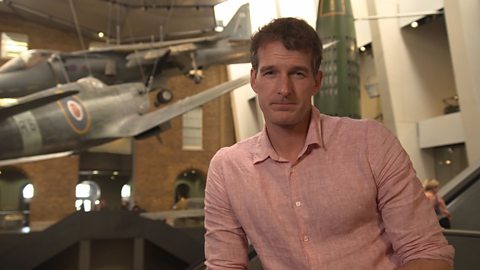
World War Two with Dan Snow. collection
Dan Snow introduces some of his favourite clips from the BBC archive, perfect for exploring World War Two with your class.
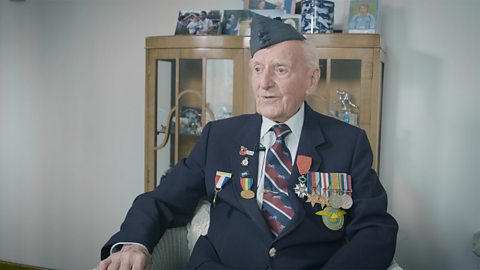
World War Two stories. collection
Perfect for classroom activities marking VE Day, these short videos produced in partnership with Imperial War Museums feature the personal testimony of veterans and eyewitnesses of World War Two.
VE Day 80th anniversary – secondary assembly. collection
An assembly framework and video to commemorate 'VE Day' on 8 May and to consider what life was like in the UK in the years immediately after World War II.