The conductor Sir Roger Norrington explains what conductors actually do.
Sara Mohr-Pietsch asks ‘What do conductors actually do?’
Sir Roger Norrington: It’s an extraordinary thing how an experienced and charismatic conductor can completely transform the sound of an orchestra.
Simone Young: There’s a very precise science about conducting; I mean there is a set school of gestures, there is a clear set of instructions in the work that you’re dealing with, but as it is about communication the interpretation can then be as individual as the person themselves.
Sir Roger Norrington: You can do conducting all sorts of different ways, what you need is imagination. You need to be able react to the music and bring out all its secrets, all its hidden perfumes.
Sara Mohr-Pietsch: This is Maida Vale Studio 1 where the BBC Symphony Orchestra rehearse and record; and down there at the front of the orchestra you can see its nerve-centre, the conductor’s podium. There have been, over time, some great orchestral partnerships: Herbert von Karajan and the Berlin Philharmonic, Georg Solti and the Chicago Symphony Orchestra, and Proms founder Sir Henry Wood and the BBC Symphony Orchestra.
Some conductors have had a huge impact on popular culture, like Leonard Bernstein in America or Leopold Stokowski who famously jostled with Mickey Mouse in Walt Disney’s Fantasia. Other conductors have got embroiled in politics: Wilhelm Furtwängler conducted in Nazi Germany throughout the Second World War; or the East German conductor Kurt Masur who had a huge part to play in the fall of the Berlin Wall. You’ll notice that all of these are men’s names: it’s taken hundreds of years but slowly the gender barrier is being breached. Marin Alsop became the first woman to conduct the Last Night of the Proms in 2013, and Simone Young has become the first woman conductor to record Wagner’s Ring Cycle.
Conducting hasn’t always been a job in and of itself. It started off as a way for performing musicians to keep time: first of all in the mediaeval church to keep the singers together, and then as a role for an individual musician, using a tool, either a staff that they would bang on the floor or a baton which was an evolution of the violin bow. It wasn’t until the 19th century that conductors stepped out of the ranks of the orchestra to lead without also having to play. There are some famous composer conductors as well, like Berlioz or Mahler or Wagner who drove up standards and paved the way for what we now know as the international conductor, a trend that was also fuelled by the rise of the recording industry in the 20th century.
Today conductors are among the highest paid and most respected musicians. If you’ve ever been to an orchestral concert you’ll have experienced something of the cult of conductors. They are clearly the most important person in the room, standing up waving their arms in front of the orchestra, but at the same time they’ve got their back to you, the audience and you don’t hear them at all. So what is it that conductors are actually about? They’re waving their arms around ‒ how do they use those gestures to get what they want out of an orchestra? What do they want the orchestra to be doing? In this iWonder Guide we’re going to be finding out, what do conductors actually do?
1. Stepping up to the podium
'It’s an extraordinary thing, how an experienced and charismatic conductor can completely transform the sound of an orchestra,' says Sir Roger Norrington. 'There is a clear set of instructions in the work that you’re dealing with,' adds Simone Young. 'But as it is about communication the interpretation can then be as individual as the person themselves.'
These two conductor perspectives indicate the complex processes involved in translating the notes composers write in their manuscripts to what we hear as music. Standing alone on the podium before an array of expectant orchestral players, the conductor is the medium through which that transformation takes place.
What do conductors actually do? How important are technique, emotion, personality? In this interactive guide, Sara Mohr-Pietsch explores the world of the conductor with Matthew Rowe, musical director of Dutch National Ballet, and a mentor on the BBC TV series, Maestro!
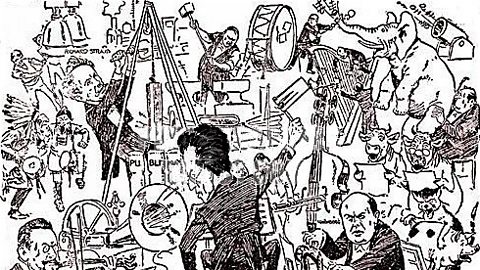
2. Where did conductors come from?
Conductors now and then
'This is what conductors do: they concentrate the efforts and skills of an orchestra in one powerful individual, so that the paying public experiences the music, its emotional highs and soothing lows, through the personality of the maestro.'
This quote from Financial Times critic Andrew Clark neatly sums up the role of the modern conductor. But conductors of the kind he describes are a relatively recent phenomenon.
Leading from the front
'Conducting' probably began in the Middle Ages as the development of multi-voice writing for singing in church created the need for a steady pulse or beat, and the means to indicate it ‒ bare hands, and latterly a stick or staff. The French Baroque composer Jean-Baptiste Lully famously met his end when his conducting staff pierced his foot; the wound turned septic, but Lully refused amputation and died soon after. In Baroque orchestras, the ensemble might be led by a violinist waving his bow, or by a harpsichordist. As orchestral writing became more complex in the 1800s, a new breed of composer-conductor emerged, including Weber, Mendelssohn and Berlioz ‒ the first 'virtuoso' conductor.
Emergence of the modern maestro
Radio 3 commentator Ivan Hewett says, 'The rot set in with Wagner, and successors such as Mahler. Their grand manner engendered the idea of the conductor as an inspired being, whose sacred role is to divine the "message" of the creator and transmit it to a grateful audience.' But Wagner, and pioneer conductors Arthur Nikisch and Hans von Bülow drove up standards. The advent of recorded music, film, radio and TV enabled conductors to grow in reach and reputation as never before. As a result, conductors like Toscanini, Furtwängler, Stokowski, Karajan, Klemperer, and Bernstein became household names. Conductors today are among the most respected ‒ and highest paid ‒ musicians.
3. What is the conductor's job?
Conductors stand alone on the podium in front of the orchestra. What they do is a form of non-verbal communication which produces music. What are the processes involved in getting the notes off the page and into our ears?
Sara Mohr-Pietsch and Matthew Rowe discuss the conductor's many-faceted roles.
Sara Mohr-Pietsch and Matthew Rowe discuss the conductor’s role
Sara: So when we see a conductor stepping on to the podium, that’s only a tiny bit of what they’re actually doing. What else does the job involve?
Matthew: Well in a sense, what we see on the podium is the conductor being the leader of the orchestra, guiding them through a piece. But the preparation for that goes very deep and a very long way because of course you can’t stand up in front of a large group of people and lead them if you don’t know what it is you’re leading; so the process begins with very, very intensive study of the music. You have to know the score, you have to know the music, what the composer wrote. You have all the information; of course the musicians and the orchestra only have the bit that they play, they have one line of music, whereas we have all the information in front of us. So you build it up and you build it up horizontally, the melodies and the harmonies, the vertical part of the music; you build that up by looking at everything that the composer wrote, and conducting began with composers conducting ‒ they knew what they’dwritten. But the conductors today are their representatives, and it’s the conductor’s job to know what the composer wrote, and also not only to know what they wrote, but also to try and work out what it is they wanted.
Sara: But with all of that going on, I mean that multi-tasking is 12 things all happening at once, future, past, everything plus reading score, plus coordinating your hands doing different things left and right, and there is always that sense with musicians that part of them loses themselves, you know they lose themselves into the experience, into the emotion; so how does a conductor do all of that and also let go into the emotion of the finale of a great symphony?
Matthew: Well if you know it well enough it just happens because you’re just in the music, you’re not thinking about anything else. You don’t really think, ‘I need to beat four here, or I need to show a crescendo’ ‒ you just feel the music so much inside you that you then show what your priorities are at that particular moment; you feel that the music has to have an accelerando ‒ it needs to get faster ‒ and you then are listening to how it’s speeding up and where you’ve got to get to at the next climax point: you therefore have to judge it. But you’re not kind of going, oh we have to, it’s not mechanical like that ‒ you’re just in the moment with the musicians.
Sara: How do you, as a conductor, persuade 80 to 100 people in an orchestra, all of whom are highly trained musicians and have their own very particular ideas about how the music should go and about what they as instrumentalists are capable of ‒ how do you persuade them to come on your individual journey?
Matthew: For me it’s about respect and trust. If they trust you to help them do the things that are difficult and in the rehearsal they get the opportunities to work on the things that are difficult, I mean, sometimes playing in an orchestra can be very challenging, the distances across the orchestra can be very big, the acoustics can be difficult. You are there to help, you are there to make their lives easier. And if you can do that, and if you come to an orchestra with good ideas that come from the music and you inspire them, you get them to think, then it’s no problem.
4. Conductor Cam ‒ Arturo Toscanini
Watch as Matthew Rowe gives a bar-by-bar commentary on archive footage of Arturo Toscanini conducting the Prelude to Wagner's Tristan and Isolde, explaining the techniques as Toscanini controls the orchestra.
The Italian conductor Arturo Toscanini (1867-1957) was one of the most gifted orchestral technicians of the 20th century. A fiery perfectionist, he was renowned for his acute ear for orchestral sonority and detail.
Learn more
Play On! collection
A series of short films in which celebrity presenters reveal their personal thoughts on classical music and explain why certain pieces are their favourite compositions.
Compose Yourself. collection
In this series of short films groups of children work together to create and perform pieces of music.
Ten Pieces. collection
BBC Ten Pieces helps classroom teachers and ensemble leaders open up the world of classical music to 7-14 year olds. Explore our exciting films, lesson plans, instrumental arrangements and live events.