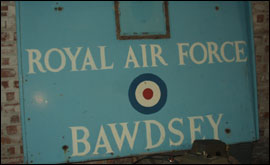
The transmitter block in the grounds of Bawdsey Manor has been chosen as one of the finalists for the new series of Restoration which begins on Saturday 8th May on BBC TWO.
Suffolk-based Griff Rhys Jones presents the programme to launch the 2004 Restoration campaign. He will also announce the 21 historic buildings that viewers will be able to vote for this summer.
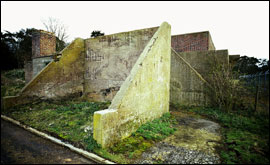 | The transmitter block at RAF Bawdsey |
With Grade II* listed status, the T-block was built between 1937 and 1939. It is now very overgrown and rather mysterious. Thirteen WW2 pillboxes encircle the windswept site and at one time the surrounding land was heavily mined because at the start of the last war this was one of the most important buildings in England and pivotal to our victory in the Battle of Britain. It is the world's first radar station. In 1936, the RAF bought Bawdsey Manor, an isolated Victorian pile on a particularly desolate part of our Suffolk coastline. In it they housed a remarkable group of boffins, including the physics genius Professor Robert Watson-Watt.
Their task was to develop the nascent radio direction finding technology into an operational device that could detect approaching enemy aircraft from a great distance.
Their invention - Radar - could do just that and Bawdsey became the first of a chain of Radar stations that surrounded the south-east of England.
They located the enemy and directed our spitfires and hurricanes to the Luftwaffe formations before they reached the coast. The work carried out here was so secret that the public only found out about it after the war. Even today, the story of Bawdsey, its Radar and the women who operated it is little known, despite it being of equal importance to the code-breakers of Bletchley Park.
The transmitter block at Bawdsey Manor will be up against Newstead Abbey, Nottinghamshire and the Old Grammar School & Saracens Head, Kings Norton.
Picture gallery » Restoration 2003 in Suffolk » More on Restoration 2004 »
|