 | 27 November 2014 |

| |
| BBC Homepage | | |
| |||
| Contact Us | | |
Great Storm 1987You are in: Suffolk > History > Great Storm 1987 > My second hurricane 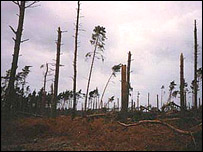 My second hurricaneBy Bruce Wright "I can assure you that it can be called a hurricane," writes Bruce Wright regarding the storm of 16 October 1987. While serving in the forces in 1967 I had the misfortune to be on a small Royal Navy vessel which went through a typhoon in the South China Sea. I never thought I would ever experience wind like that again but I did 20 years later. In 1987 I was living at Sandy Lane in Eyke. It's well out of the village itself and on the edge of Rendlesham Forest. In hindsight we should have known something was going to happen as during the afternoon and evening prior to the storm the herds of deer that lived in the forest appeared in large numbers on the bordering fields. We went to bed as usual that night. There was a stiff breeze blowing which was normal for mid October. My late wife woke me at 4.30 to 5am saying 'what's that noise?' I looked out of the bedroom window and I said 'I don't know what's happening but I can see the lights at RAF Woodbridge'. As the crow flies that was about two miles away and normally obscured completely by trees. I looked in another direction and could just make out another section of the forest. The trees were falling like dominoes. Hanging onThe electricity was off, but being country people and used to power failures we always had a torch handy and candles stored ready. After getting our son up I decided I had better check our pet goat that we kept in a hut and pen in a small plantation next to our garden. As I went out of the gate at the top of the garden a sudden gust of wind blew me along about 10 to 12 yards and I only managed to stop by hanging on to a telegraph pole at the side of the track. I had to remain there a good two minutes as it was a long sustained blast. To get to the goats pen I had to climb over eight or nine fallen pine trees. The goat was bleating as loud as she could and kicking at the door of her hut. Luckily she wore a collar and I had her lead chain with me. She was absolutely terrified. I managed to get her back to the garden after lifting her over the fallen trees and tied her up to the house. I then went back to get her feed bowls and found that two trees had fallen across her hut and pen and would have, if not killed, would certainly have seriously injured her. Assessing the damageAt this time I was manager of the fruit farm on the estate where I lived so at daylight I went with the farm and pig unit staff to check for damage to buildings and stock. Most of the buildings were undamaged but one of the stables out in the horse paddocks had lost its corrugated iron roof. We found it in one piece - that is 12 sheets nailed to timber - over 100 yards away in the next field. Luckily from the end of September onwards the horses were taken into the proper stable block at the house so were not there. 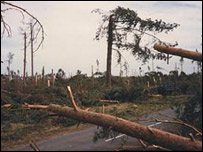 Bromeswell to Butley Road, 16/10/1987 Another corrugated iron structure - rather like a miniature Nissen hut - that was used by the fruit farm workers to shelter in was never found in the following five years that I worked there. As there was a large pig unit on the estate a lot of their feed had to come in by road so opening up the roads was a priority. So we spent the rest of that day and the next with four wheel drive tractors and chains and chainsaws just getting access. Albeit only a single track. The phone and electric lines were down for about a week and so consequently we lost all our perishable and frozen stuff. But as I said before, being country born and bred we were and still are prepared for bad weather. Resilient orchardAnother surprising thing was the orchards that I was in charge of suffered amazingly little wind damage. Only four trees out of approximately 25,000 were blown over and we only had about two per cent loss of the late apple crop. The main damage was to the foliage, which was severely shredded and scorched by what we later found out was due to salt spray that the storm must have picked up in its journey over the sea - as normal rain is condensed water which is salt free. The next major job we had was in the ornamental gardens of the rookery house where my father was head gardener at the time. It took us the best part of a month to clear the fallen trees including beech, oak, lime, larch and Scot's pine. Some of the deciduous trees were over 100 years old. An area next to our farm was used by the Forestry Commission to park their heavy moving equipment. These were used by gangs brought in from Thetford Forest and Scotland. They also brought in two minibus loads of chainsaw operators to our area to trim and try to salvage what they could from the carnage. Apocalyptic scenesAnyone who drove along the road from Bromeswell to Butley could have been forgiven if they had thought that they had driven onto a film set for a movie about World War One. It was not until later that we realised that although a lot of trees had been blown over just as many had been snapped clean off anywhere between 6 and 20 feet off the ground. In some places a complete swathe had gone and there would be 10 to 20 completely untouched. One other strange fact, at least in our area, was that we never found any dead deer in the woods and the forests when we were brushing that season. It was as if they knew something was coming. last updated: 19/03/2008 at 12:03 SEE ALSOYou are in: Suffolk > History > Great Storm 1987 > My second hurricane      |
| | About the BBC | Help | Terms of Use | Privacy & Cookies Policy |
