| 13 November 2014 |

| |
| BBC Homepage | | |
| |||
| Contact Us | | |
BlastYou are in: Suffolk > Blast > Tchoukball  TchoukballBy Nick Rowland Suffolk is a hotbed for a sport which has recently produced 12 European gold-medal winning British team members. It's hoped the GB squad will now go to next year’s World Championships in Brazil with a chance of even greater success. The sport is tchoukball and the chances are you won't have heard of it, let alone know the rules. Sudbury has a thriving club which is arguably the Manchester United of the British game, although like United they're not the top-dogs at the moment! OriginsTchoukball was crafted in the late 1960s by a Swiss biologist, Dr. Hermann Brandt. His idea was to limit the injuries he saw in other sports. The result was a highly competitive team game. The players aren't keen to compare their unique sport with more familiar ones, but it does have similarities with a number of other games. It's played on a similarly sized court (40x20 metres) to basketball. Like a five-a-side football pitch there are two goals situated at each end with a D-line drawn three metres around them, but it's a 9-a-side game. The ball is not far off a handball. 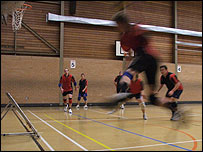 Training in Sudbury However, the goals are unique because they are metre squared ‘frames’ which stand at a 45 degree angle, strung with bungee/mesh. The game is unusual in the fact that teams attack and defend at both ends and there is no contact between players or interception of the ball. The idea of the game is to score points by getting the ball to the ‘shooters’ to slam it down on to the frame making it bounce back and land anywhere over the D-line. The player can't step into the ‘D’. If the shooter is successful in doing this the team score a point. If the frame is missed or the ball bounces within the D the opposition scores a point. If the opposition stops the ball from touching the floor, they steal possession. The game is played in threes - three steps, three passes before a goal, and three shots. The sport can be played on a hard indoor surface, on the grass or on sand and because of its non-contact principles it allows for people of all sizes and ages to play together. European Tchoukball Championships 2006At Macolin in Switzerland in August, Great Britain scooped gold in the Men's senior competition, silver in the Women's seniors and gold in both Under-18s events. In each case, the finals were against the Swiss. 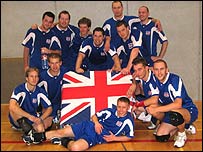 The GB men's senior team 2006 Sudbury's Richard Jackson is also the head coach for the British mens' and ladies' teams: "It was a massive sport towards the end of the 1980s, early 1990s. It really had a good hub of people playing, probably several thousand. In 2002, we hosted the world tournament and now have four or five established clubs. It's definitely on the way back up." Sudbury provided 12 players for the European Championships including Martin Cates, Richard Gosling, Dan Hills and Clive Horsley for the men, Melanie Hibberd, Janine Lesiak, Nikki Stewart and Charlotte Vanner for the women and in the two Under-18s teams were Firoz Jetha, Andrew King and Chris Roberds. Soon after the Europeans Championships, Nikki Stewart became Nikki Horsley - tchoukball's answer to Andre and Steffi?! 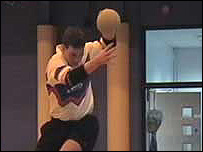 Richard Jackson It's hoped the squad and teams can now go and claim a further titles at the 2007 World Tchoukball Championships in Brazil. Sudbury and the club sceneThe rest of the GB squad was drawn from three clubs - Broadland in Norfolk, and Portsmouth and Liphook in Hampshire. Portsmouth are the current Andrews Shield holders - which is the biggest domestic club trophy. The Sudbury club are looking for new members and particularly some more ladies. For all further information and contacts telephone Andrew St.Ledger on 07092 018251 or send an email via the Tchoukball Association of Great Britain website using the link on the right>> last updated: 17/11/2008 at 14:06 Have Your SayWill it ever be more than a minority sport? Symone Bromley Dom Raeyen holland Foz corinne ansell Stefan Hurn Amy Hill Chris Roberds Rebecca martin  |
| | About the BBC | Help | Terms of Use | Privacy & Cookies Policy |