| 29 October 2014 |

| |
| BBC Homepage | | |
| |||
| Contact Us | | |
FeaturesYou are in: Suffolk > Faith > Features > From Berlin To Auschwitz: Part 3 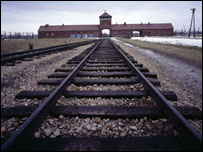 Auschwitz, Poland From Berlin To Auschwitz: Part 3Frank Bright saw his father for the last time on 29th September 1944. The family had been together in a Jewish ghetto town in Czechoslovakia. Auschwitz Fact File
Frank's father Hermann Brichta was sent by train from the Teresienstadt ghetto in Czechoslovakia to Auschwitz concentration camp in Poland. Two weeks later 16-year-old Frank and his mother, Toni, were put on the last train to the same destination .. "Well the train journey was at night so you didn't see a lot. When we did arrive it was a bizarre sight. We saw barbed wire, guards with sticks and people approaching the train asking for bread. 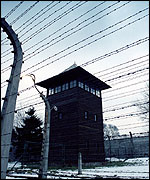 Guard tower, Auschwitz "The train stopped and we were put into groups. I got separated from my mother, she was in one group, I was in another. At 16 years of age, I was a bit overwhelmed by the place. My mother saw me and came over a shook my hand and went back to her place. "Her group went first and she was sent left. When it was my turn I simply followed her, but I was called back. That was the last time I saw my mother. I was called back because I was considered fit for work and then we were marched to the right. We were given prison garb, which was actually just old clothing. Mine had a big red cross on the back and everyone's hair was shorn.  Pile of shoes, Poland, Auschwitz. "We were taken to a hut which looked like it was used for horses originally. There was no heating and we had one thin blanket between five. It was horrific." And the nature of the camp was obvious "It was surrounded by electrified wire and there was the body of a man stuck in the fence. He was all contorted and it was absolutely awful. You could see the flames from the crematorium and I remember watching on the first night wondering if that was my mother. "Quite early on, possibly my second day, I got lucky and was told I wouldn't be staying, but I'd be going to work elsewhere at the VDM propeller factory. It shows how organised the slave labour system was. "The factory owner had had other workers from Lodz and he came to Auschwitz for another group, so in a sense I was fortunate. Once you found out you'd be leaving within a week it took the burden off us." However, the purpose of the death camp, where over a million people were killed, was clear "The sense of the place was terrible. It was the stench of death. People had the power of life and death over you. You had Russian POWs, gypsies, communists, homosexuals, Jews - all sorts of people who'd been there for a length of time or had just arrived. Very few people survived. 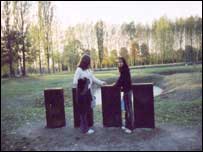 Schoolchildren visiting modern-day Auschwitz "The worst part was the selections. Once or twice a day an SS officer would inspect you. You had to strip and if your ribs could be seen you were sent to the gas chambers. Some were sent outside to the mines. "They went underground and never came up again. The were literally worked to death. So we were again fortunate that we were sent to a factory." "You didn't get a sense of the scale of the genocide operation. You were more or less confined to your hut. You had no idea of the extent of it. So to only spend a week there made it more bearable, but it was absolutely awful. It was hell on earth." Frank was then transferred to the propeller factory in Friedland... Help playing audio/video last updated: 18/01/2008 at 16:59 You are in: Suffolk > Faith > Features > From Berlin To Auschwitz: Part 3 
Podcast[an error occurred while processing this directive] |
| | About the BBC | Help | Terms of Use | Privacy & Cookies Policy |