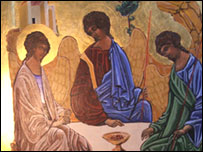
Q: What is an iconographer? A: Well an iconographer is someone who paints icons, or 'writes' icons, is the correct terminology. Q: How did you become one? A: Well, it’s something that developed very slowly in me, coming from an Anglican background, a Protestant background icons were something, for a long time I didn’t even look at. But perhaps age, perhaps maturity began to enable me to see icons and to begin to enjoy them as an artist. Then when I came to the time of retirement from St Edmundsbury in Ipswich Diocese, I asked if the Diocese would send me on an icon course. In fact I found an iconographer in London and I went to paint with her for about seven or eight days to learn the basics. I’d read the books but I needed the experience of hands on. I enjoyed it so much, I was about to retire and when I did retire I started painting in earnest and I paint practically every day now. Q: Presumably you had a background in painting and art anyway? A: I’m not formally trained, I did design at the Nottingham Art College, when I was a youngster. I was a book binder when I left school, so I was interested in art and I learned gilding there, so gilding icons now is something I love doing and something that was very natural for me to do. I have been on obviously, lots of classes about ordinary painting and I ended up painting icons enthusiastically. Q: Can you explain the actual process of making an icon? A: It’s a long and drawn out process, which I love , it’s very slow and it’s very suitable for my time of life and maturity. You have to start from a wooden board, you make the board and you cover it with layers of gesso, which is a fine plaster. You then draw the image onto the board and you surround the image with bole, which is a red clay slip. You then use gold leaf and gild the bole area around the image and then you paint the icon itself with egg tempora, which is all natural pigments and mixed with egg yolk. Q: What about the ideas for the icons…are they your own ideas or are they traditional? A: They are all traditional ideas. I select an icon that I like from the past and use that as my pattern, or people ask me to do a particular icon or sometimes they say, is there an icon of….. For instance on the stand there’s one of St Vincet Ferrer, he’s the patron saint of plumbers. My plumber said is there an icon for me, a saint for me? And I found Vincet Ferrer, this was research I had to do and on my stand in the cathedral now there is a painting of St Vincet Ferrer. It’s quite an animated icon and I like it, so he will be getting that after this exhibition. Q: So how long does each icon take you to do? A: Well, it’s a very slow process. I enjoy doing it and right from making the board, from a wooden board to the finished icon, probably needs six months. I’m not working on it for six months but it involves a number of drying periods. One of those drying periods is two months before I can apply any finish, any kind of varnish, to the icon. So it’s a long drawn out process, it’s a slow process, it’s a meditative process. It begins in prayer and it’s an inspired thing. I believe that it’s a gift that I have from God. Q: You are actually the Diocesan Iconographer? A: I am Portsmouth Diocesan Iconographer… Q: So what does that entail? A: Well, it’s a title that I don’t know how often is used in the Church of England, but Exeter has a Diocesan Iconographer and so does Portsmouth. It’s an honorary title, I’m not a paid servant, but I need a spiritual Father in God, so Bishop Kenneth Stevenson of Portsmouth is that, he’s my spiritual Father and I need that kind of oversight in the work I’m doing as an iconographer. It’s just wonderful, painting icons in a cathedral, talking to all the people, there’s trem Q: So what sort of people buy them? A: I don’t actually sell many icons over the counter, they’re fairly expensive items, although on my very first exhibition in Portsmouth, two years ago, I’d just set up my stall and a lady came and was brought in in a wheelchair saying: “where’s the iconographer”. And she came and bought an icon, this was my first experience of selling an icon and I phoned my wife and I said, “I’ve sold an icon!”. This was in the first two hours of being in the cathedral and that was a real confirmation of what I was doing. They are mostly bought to celebrate wedding anniversaries, as birthday gifts, as gifts for special occasions, for people who are being ordained. Although some people buy one icon and have come back again this year for another and will come back again next year for another. So no special occasion, they are just collecting my work and that’s very exciting. Q: Can you tell me about your faith? A: Yes, well I was a church goer, I was baptised in the Methodist Church, so I occasionally went to church into early adulthood. At the age of 24 I set sail for Africa – this was my great adventure, I was going to live in Africa for a few years. Within a short while I really came to know Christ in a very powerful way in my life – conversion and God. I came back from Africa a few years later really a changed man. So many things had changed in my life. I met my wife in Africa, I met my Lord in Africa and I then realised I needed an education and since then I got a degree and I eventually became ordained. Q: So how does somebody with that background come to paint icons? A: Well, I think it’s just God at work within me, because when I was young I was very suspicious of icons and I don’t know whether it’s maturity. It’s just something I have grown to like and icons are an expression of my faith. There are three strands of my life that are intertwined in it: there’s the craft from being the bookbinder when I left school, there’s the art that I’ve always taken part in – painting and drawing, and there is my faith and those three strands of my life are bound together and they are expressed in the icons that I produce. I believe it’s a gift from God. |