LISTEN TO NICK RISBY TALKING TO CECIL WILLIAM WARREN ABOUT HIS EXPERIENCES DURING THE LIBERATION OF BELSEN. CLICK ON THE LINK AT THE TOP RIGHT OF THIS PAGE >> Background to the liberation In the weeks leading up to the liberation the Germans had deposited over 60,000 additional prisoners in No 1 Camp, mostly Jews transported from other concentration camps threatened by the Allied advance.
The prisoners at Belsen lived in appalling conditions of starvation and dehydration. The dead and the dying lay in the open, while diseases like typhus, dysentery and TB were rife. The liberators arrived at the camp to find 20,000 emaciated, naked bodies lying unburied on open ground. These bodies were later buried in mass graves, using a bulldozer, to try and prevent the further spread of disease. 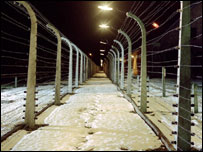 | | Security fencing |
Of the 50,000 'survivors', all were shaven-headed and starving. Many were too weak to even respond to the British troops. Of these survivors 20,000 were seriously or critically ill. In the ensuing weeks, soldiers and relief personnel worked tirelessly to save lives. Many were gradually nursed back to health, but despite the best efforts of the medical teams a further 13,000 inmates died after the liberation. Interview with Cecil Warren Nick Risby spoke to an Ipswich man who was sent to Belsen at the time of the liberation. Cecil William Warren, 91, known to his friends as Charlie, was in the 11th British Light Field Ambulance regiment. Nick asked him when he knew he was going to be involved with the clearance of the camp: | " I have seen a grave with 10,000 in. A grave with 1,000 and 2,000 was nothing." | | Cecil William Warren |
"We were pulled out of action and our Commanding Officer said, 'Well lads, we're being pulled out of action, we're going into a place that tomorrow will be front page news.' "They never used to tell us anything, but we just heard it would be Belsen. That was the 15th April, on the 16th we went to Belsen. When we went there they were lying dead on the ground. "Dead on 7 o'clock three Messerschmitt German fighter planes came over our lines and of course we done the drill. I dived in a big pit, got scratched and put my head down. "One or two were wounded. One who was wounded badly was my mate Frank Phillips. They took him off to 25km from where we were, and he died that day. He had been shot away. He was a D-Day veteran."
What about life in Belsen, what was that like?
"I was so handy to them in the cook house that they didn't shove me on the stretchers. I was working in the cook house and I never handled any of them at the start. "My mate, one of whom I've been writing to up until two year ago, he's just died, poor old Ken. He come to me, he say 'Charlie, come down after tea, you'll be surprised.' "I went in there against orders, nothing to be proud of really. I went in, and this is as true as God is my judge, I climbed up onto the top bunk in one of the huts. There were three people still there. They had been working on them. "They were dying every day and we had what we called the death wagon at night. I looked at the top bunk and there were three bodies. I've never seen anything like it, but we were hardened to it. "The Gerrys had garages, lovely garages for their SS troops. I went in there with a mate and picked up three skeletons on one stretcher. "But I've actually been in No 1 Camp, which was the worst one. Belsen is made up of four camps and I've been in Nos 1, 2, 3 and 4. "I lifted the stretcher up with three bodies on, which were waiting to be disposed of. I shouldn't have gone in, if they had found out I was in there there would have been a row. "We were there for several weeks. One thing I will say is this: I have seen a grave with 10,000 in. A grave with 1,000 and 2,000 was nothing. "As I say, my mate died and we had one or two wounded, but we were lucky we weren't all wiped out because these planes came. We knew what a shock it was going to be, but we had to clear it." |