| 'Kindertransport' booking information | Gallery Players present: 'Kindertransport' At: The Sir John Mills Theatre, Ipswich From: Wednesday 9th to Saturday 12th March 2005 Tickets priced at: £8.50, concessions available on Wed/Thu at £7.50 Box Office: 01473 211498 |
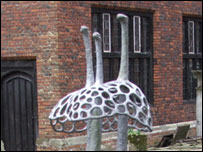
LISTEN TO STEVE WOOLDRIDGE, DIRECTOR OF KINDERTRANSPORT, FOR THE GALLERY PLAYERS, TALKING TO JOHN HOOD. CLICK ON THE LINK AT THE TOP RIGHT OF THIS PAGE >> Kindertransport: the play The play follows the story of 'Eva' who was evacuated from Germany in 1938, under the traumatic rescue and forced separation effort that became known as Kindertransport. Eva travels to England, where she meets her foster family and becomes known as Evelyn. The play looks at the extraordinary events that occur in Evelyn's life and her struggle between her past, present and future. She yearns to be re-united with her family but the outbreak of war changes her life forever. 'Kindertransport' also examines the complex relationship between mother and daughter, as Evelyn has to confront her displaced childhood through her own daughter, Faith. 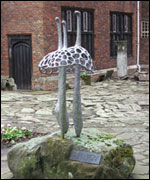 | | Memorial sculpture in Christchurch Park |
The play was written by Diane Samuels in 1992. She was born in Liverpool, but is of Jewish descent. The author interviewed many 'kinder' as part of her research for the play and their experiences are woven into the fictional character of Eva/Evelyn. Director of the Gallery Players production is Steve Wooldridge. He says the play deals with the Holocaust on a personal level. It looks at the complex relationship between parent and child, the effect the separation has on that relationship and the guilt of being alive. "We know that of the 10,000 that came across barely one tenth saw their parents again." Kindertransport runs at the Sir John Mills Theatre, Ipswich from Wednesday 9th to Saturday 12th March 2005. Box Office: 01473 211498. Kindertransport: the background In Germany, during the Holocaust, Jewish and Gypsy children were subjected to many injustices and cruelties. They were forbidden from going to school and German children were taught that Jews and Gypsies were racially inferior. Jews were forced to live in ghettoes under dreadful conditions and children risked their lives to smuggle food for their families. On 9th November 1938 the Jewish population in Greater Germany faced a night of terrible violence and persecution. They were physically attacked, their shops were looted, their Synagogues set on fire and the men deported to Concentration Camps. These events became known as the Night of the Broken Glass or Kristallnacht. Thousands of children were left homeless and in danger. Pressure was placed on the British government to relax immigration controls for a limited number of children. It was agreed that 10,000 children could enter the UK on a warranty of £50 each. 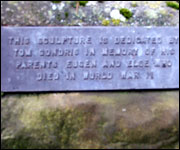 | | The plaque that appears on the memorial |
The Jewish Refugee Committees, along with charitable organisations such as the Red Cross, helped organised this programme of sanctuary, but the children had to travel without their parents, and by the end of the war many of them were orphans. Only about 10% of the children were reunited with their families. The Kindertransport, as it became known, was only open to children between the ages of 5 and 17. The children, mostly Jewish, were sent to the UK from Austria, Germany, Poland and Czechoslovakia. They were allowed to travel to Britain by train and boat, many of them arriving, in groups of 100-150 at Harwich and Liverpool Street. There is a bronze statue of a little girl on the concourse of Liverpool Street station to mark these events. It was unveiled in 2003 by the Association of Jewish Refugees. The children arrived in a foreign country where they couldn't speak the language, they didn't know anyone and they didn't know who was going to care for them. Older children lived in hostels while others were placed with foster families. A group of the children were billeted at Butlins in Lowestoft, some stayed in a renovated workhouse at Barham near Claydon and others were sent to a hospital in Colchester. Behind Christchurch Mansion in Ipswich there is a sculpture commissioned by Tom, who came into the UK under the Kindertransport rescue operation. He now lives locally and the sculpture is in memory of his parents who died during the War. |