| 29 October 2014 |

| |
| BBC Homepage | | |
| |||
| Contact Us | | |
FeaturesYou are in: Suffolk > Faith > Features > Suffolk Emergency Unit 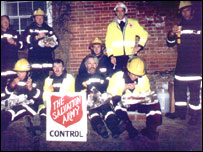 Firefighters receiving refreshments Suffolk Emergency UnitMike Baker If someone said to you 'Salvation Army', what would be the first thing that came into your head? Brass bands, Bonnets? Quite possibly, but usually it would simply be the good old Salvation Army cuppa. All of us have had friends or relatives that have said to us at sometime that they have benefited from receiving one of them. Usually in the back of beyond where no one in their sane mind would expect it. That tradition of providing refreshment in time of crisis continues even to this day. 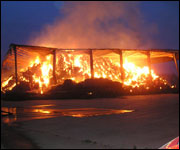 Burning building at Barrow How it all startedDuring severe flooding in the Wisbech (Cambs) area in 1978, a call went out for assistance. Some S.A. members from Stowmarket felt that they should respond and after managing to obtain insulated urns and equipment from a local company, travelled to Wisbech to provide hot drink and refreshments to those who were affected by the flooding. Facts and figuresThe group was formed in 1979 but in the first ten years was only used on average about once a year. However the last 15 years has seen a developing confidence by the emergency services in its reliability and the professional approach it has to its work. 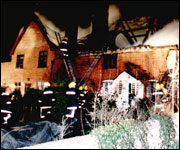 Burning thatched building There were 21 call outs in 2001, 12 in 2002, 18 in 2003 and 7 in 2004 so far. In total the group has been called out 141 times, with the new unit being used 25 times. The statistics are impressive. During the 3,200 man-hours spent at incidents 7,791 people have been assisted, 22,000 drinks served, 1,441 loaves of bread turned into sandwiches and 2,300 hot meals made. The Unit is entirely run and operated by volunteers. 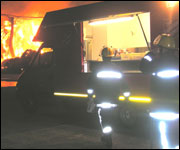 The Emergency Unit in action at Barrow Much of the credit must belong to the current coordinator, Mike Baker who has built up the expertise of the team and tailored that to meet the requirements of the emergency services. The Unit now has a service agreement with the Suffolk Fire Service to have the lead role in providing refreshments to the emergency services staff at major incidents in the county. How does all this happen?A pager that has been provided to the unit by the Fire Service is carried 24 hours a day by the duty volunteer coordinator. When a major incident occurs that requires four or more pumps and is likely to last more than four hours that pager is activated and a well-established routine begins. From a list of about 40 volunteers, a prime group of three or four available volunteers are called up, often from their beds and make their way to the appointed place in Stowmarket. By the time they arrive, someone has seen that fresh water has been put on the unit and a visit has been made at the Tesco hypermarket on the edge of town to purchase the fresh ingredients which will make up the sandwiches or meals required.
Usually within 40 minutes of callout, the volunteers are setting off to the incident in the purpose built mobile unit. On arrival, the Fire Control Officer allocates them a spot within the incident boundary. They set up the unit and start to serve men and women that could well have been called away from a meal a couple of hours earlier and need their flagging energy restored with a good cup of tea and a sandwich. Fire Officer Smith said, "The first couple of hours at any large incident are intensive and fire-fighters use up a lot of energy. They are often working in hot and difficult circumstances in all types of weather. The support provided by the Salvation Army is invaluable to us." 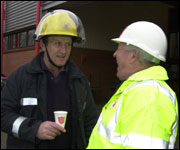 Robin Bryant talking to a Firefighter
The origins of the Red ShieldThe tradition of providing such support in the most unlikely of places began in the trenches of WWI. Two Salvation Army lassies from the United States of America set up a front line canteen at Montiers-sur-Sauix serving coffee to the troops. To cheer the men up after 36 days of continuous rain, they started frying donuts, seven to a pan. The word soon went around, "If you're hungry and broke, you can get something to eat at The Salvation Army". 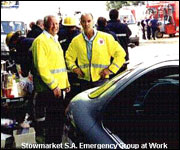 Stowmarket group in action The Red Shield logo used today was created in these circumstances. In 1917 it began life as a white shield with red writing but quickly adapted into the red shield with white lettering known throughout the world and still used by the Emergency Unit even today. The civilian population also came to know the Sally Ann canteens during the blitz of WWII but with the cessation of hostilities, this facet of work also faded. It wasn’t until the Moorgate disaster in February 1975 that The Army started to move this work from an ad-hoc arrangement on to a more professional basis. Ready to goPride in what has been achieved is very obvious when you are shown around the Mobile Unit. You can really see a fuller picture of their ability to provide necessary support. Protective day-glo clothing and hard hats, as well as organisational and communication items, are all to hand, all to be used at a moments notice. 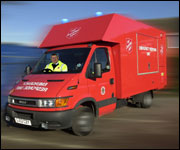 Suffolk Emergency Unit The group has attended: house and street flooding, house and commercial fires, ship fires, assisted with search parties, serious road traffic accidents, snow-blocked roads, oil pollution exercise with river and harbour authorities. Group members consist of: Engineers, Teachers, Project Managers, Building Inspectors, Shop Assistants and Retired Workers. Man-hours are voluntarily, with contribution by Suffolk Fire Service for food and running costs. Christianity with its sleeves rolled upThe Salvation Army is not primarily an emergency disaster relief organisation. Its mission statement makes it quite clear that the motivation behind all it does in this, and other related community service, is found in following the example and teachings of the Lord Jesus Christ. It still wants people to know that where there is need, there it will try to be. It is said that the Salvation Army is Christianity with its sleeves rolled up, and represent God’s love in action. last updated: 22/04/2008 at 12:55 Have Your SayYou are in: Suffolk > Faith > Features > Suffolk Emergency Unit 
Podcast[an error occurred while processing this directive] |
| | About the BBC | Help | Terms of Use | Privacy & Cookies Policy |