Voices| You are in: Stoke & Staffordshire > Voices > Listen to Stoke Accents | 
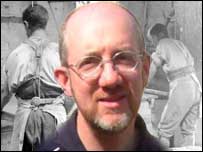 | History expert Steve Birks.
(images courtesy of Past Track) |
The history of the Potteries dialectSteve Birks, a Potter himself, and chronicler of the Stoke on Trent area, tells us about the origins of the local dialect of North Staffordshire... | The existence of dialects is not unique to the North Staffordshire area. In many areas of the UK and indeed the world there are regional variations in the spoken word.
Listening to a broad Geordie, Liverpudlian or Potteries inhabitant will leave the average eavesdropper baffled. In China the dialect spoken by those living in Shanghai is almost impossible to understand by other Chinese speakers. The Potteries way of talking is another such dialect.
Potter patter
English language scholars say that the Potteries dialect derives down from Anglo-Saxon Old English.
For example the local word Nesh meaning soft, tender, or to easily get cold is derived from the early English, nesc, nescenes. The local word Slat meaning to throw, is from the old English slath, moved.
Language, especially the spoken word, continually changes (hence the now annual round of additional words to be included in the Oxford English Dictionary).
John Ward, in his book The Borough of Stoke-upon-Trent published in 1843, recalls A Burslem Dialogue which took place in the market place in 1810. Although Ward wrote only some 30 odd years later he felt the need to explain the meaning of such Potteries words as mewds (moulds), kale (being called upon in order, first, second
.), heo (she), shippon (a cow-house).
Regional variations
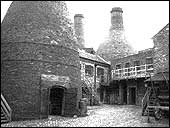 | | Gladstone Pottery in Longton |
There are even variations within a region, and it used to be that the dialect was broader and more obvious in "Tunster" (Tunstall, the most northerly of the Six Towns) and less pronounced in the more refined Neck End (Lane End or Longton, the most southerly).
Its interesting as a sideline to note that in the six Potteries towns, the broader the dialect - the coarser the product manufactured. For example, Tunstall had a preponderance of brick manufacturers, the other towns largely produced earthenware and stoneware; with Longton having the most china potworks.
The fact that there used to be two main occupations in North Staffordshire the pits or the pots meant that people of these specific social classes spent most of their days in close proximity with people with the same way of speaking. This helped to reinforce and preserve the dialect.
Where does 'duck' come from?
Firstly the word duck (a term of greeting, for man or woman) has nothing at all to do with the winged bird of the same name!
It is said to find its origin in the Saxon word ducas which was meant as a term of respect; similar to the Middle English duc, duk which denotes a leader, commander; from which comes the title Duke and the Old French word ducheé - the territory ruled by a Duke.
From these origins it became a greeting and then a term of endearment.
Mercia
This use of duck as a greeting is not restricted to the Potteries; although the use here is very common. It is still used an many parts of what was Mercia.
Even though they have very different dialects from the Potteries the greeting is used in the Black Country, in Derbyshire, as far east as Warwickshire and Nottinghamshire. In Yorkshire the main term of greeting is luv but in Sheffield, which is close to the Yorkshire Derbyshire boarder the greeting Ey up mi duck can be heard.
In A Midsummer Night's Dream, Shakespeare uses the phrase O dainty Ducke: O Deere! as a term of endearment.
Many of the differences of a dialect compared with standard English are to do with grammar and pronunciation. Even though a dialect can be difficult to follow, with a little care and patient the average person can work out what is being said.
However many dialects have words that are unique to a particular area and the speaker would not know what the word meant if used in isolation. The greeting duck is an example.
Unique words
There are other words which are unique to the Potteries and surrounding area such as:-
Surry meaning friend as in Ay up surry, ars biznes? Hello friend, hows business? - (as Arnold Bennett noted in his short story His worship the goosedriver, in the Potteries business takes the place of weather as a topic of salutation).
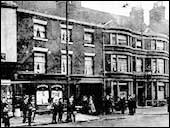 | | Crowds outside the Leopard pub in Burslem |
Surry (also spelt sirrah or surrie) is derived from an obsolete form of sir used as a form of greeting or address yes sir how are you, sir it gained an extra syllable ah when spoken in general conversation and became sirrah.
Farrantly as in That wer a farrantly mon - that was a good man. Farrantly means good and amiable; a worthy person.
Brazzle as in Hard as brazzle - either hard (as opposed to soft) or hard-faced. Brazzle were hard iron pyrites nodules found during the mining of the Black bank Ironstone deposits.
Clemmed short of food, starving. Derived from a Norse word meaning press, squeeze; then to pinch as hunger or fasting does; to waste with hunger, starve. From these origins it was used in general conversation to mean very hungry, just as people today will say Im starving or Im famished.
Diluted dialect
As we enter the 21st Century, certainly the use of a broad dialect is not heard amongst the general population of the area.
The ease of travel, the movement of people from one area to another, the influence of "standard English" on radio and television and the uniformity of teaching have all contributed to the dilution of dialects.
However visitors from outside immediately notice that Potteries folk do have a different accent and a strange way of speaking; sometimes we have to repeat our selves or speak slowly to be understood. This shows that the dialect is still present in everyday conversation. There is also a growing interest in preserving, reading about and speaking dialects.
John Ward, in his book, noted that the Potteries dialect was now almost banished by the schoolmasters assiduous care. Well the dialect may have softened and changed but it is still alive and kicking a bit like th bo agin th wo.
What to listen for
The presence of an accent and dialect can be seen by these three things:
Firstly a method of pronunciation which is unique to a restricted geographic area, for example in the Potteries the vowel O followed by an L is pronounced OW as in towd (told), owd (old), cowd (cold), gowd (gold).
Secondly a localised difference in the intonation or meter of a sentence. Its difficult for the person who lives in the locality to notice this because everyone speaks in the same manner. However listen to the slow drawl of the Southern States of America or the high-pitched twang of the Birmingham / Dudley area and you immediately know what I mean.
Thirdly there are words that are particular to that area, or sometimes a couple of areas. These words are not present in Standard English, you can tell by spell checking them in a word processor.
For example Sneap or sneep as in to snub or upset appears to be local to the Potteries and a fried of mine from Sheffield, which has a dialect all of its own, had no idea what I was talking about.Steven Birks www.thepotteries.org
| | | SEE ALSO
| | | You are in: Stoke & Staffordshire > Voices > Listen to Stoke Accents | | |
On the rest of the web The BBC is not responsible for the content of external websites |
|