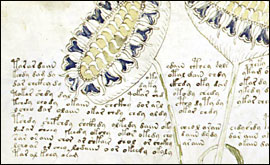
| | The Voynich manuscript, illustrated with strange unearthly plants and sophisticated scenes, has baffled experts since its discovery in the sixteenth century. It has been described as a 'parchment book' and dates back to around 1550.
Now a computer expert has suggested the book may be an elaborate hoax. Cracking the code of ....
Originally it was thought the manuscript contained a previously undiscovered language or that it may have been an ancient herbal remedy book.
However, no one managed to come up with a theory to crack the codes.
Dr Gordon Rugg, a senior lecturer in computer science at Keele University near Newcastle in North Staffordshire , has devoted his spare time to try and break the code on the mysterious manuscript and now believes his theory shows a hoax is entirely possible.
Experts before him had tried to recreate the script using complex modern code breaking techniques.
Dr Rugg however used a technique which he had developed with Dr Joanne Hyde, a researcher at Bath University, to re-assess difficult problems.
He found that a possible solution was a 'Cardan grille', which is a relatively low tech approach. ... the code
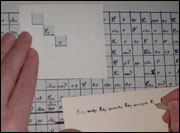 | | The simple but effective Cardan Grille code-breaking system, as used by Gordon Rugg |
The Cardan grille involves putting the script in a table formula, then placing a piece of card with holes cut out, to replicate words.
This enabled Dr Rugg to find out the consistency of each letter and any patterns that were formed.
He found the evidence suggested the manuscript is in fact 'gibberish!' Dr Rugg says: 'It does not prove indefinitely that the manuscript is a hoax, but it does mean it is now a possible explanation and also the most likely one". Elizabethan con
It is now thought that the colourful Elizabethan adventurer Edward Kelley wrote the manuscript some time between 1550-1586, as a hoax purely for monetary gain.
Edward Kelly was a known con artist, claiming among other things that he could turn iron into gold and that he communicated with the angels.
He wrote a book containing the 'language of the angels', which has later been discovered as a hoax language.
So convincing was Kelly that he was made a Baron, before been jailed for fraud, where he escaped by drugging his guards and was never heard of again. History of a hoax
The manuscript first appeared in the late sixteenth century, when an unknown seller sold the book to Emperor Rudolph II in Prague for 600 ducats, the equivalent to about £35,000 today. The book then passed through the libraries of a number of noble men before disappearing in the late seventeenth century.
It was not then rediscovered until US book guru Wilfred Voynich purchased the manuscript in 1912. The manuscript is currently kept in Beinecke Rare Book Library at Yale University, to which was donated after Voynich's death.
Dr Rugg did his research using images downloaded from the internet, as a complete copy of the manuscript is available on line. Not ALL questions answered
However this does not mean the end of the mysterious manuscript.
There are still some unanswered features of 'Voynichese', the name given to the script, which Laura Aylward, a final year computer science student of Dr Rugg's, is continuing to research.
Laura is writing computer software that allows the symbols to be replicated in larger quantities, which may lead to more conflicting and interesting theories. Dr Rugg is continuing his work with Dr Joanne Hyde, and they are now applying for funding to research medical problems, using the same technique they have developed to try break the code on the manuscript.
Liz Daniels
YOUR COMMENTSVoynich
We read your article with interest. However we have now deciphered the manuscript completely, and anyone who wishes to understand the puzzle can order the result (in English) from our website.
See www.ms408.com.
Ursula Papke
Germany
Click Here to add a message |
|