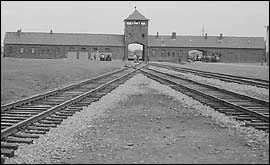
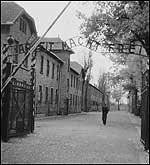
:: Facts » | Over the main gate of Auschwitz I stood the sign “Arbeit Macht Frei” (”Work Makes One Free”)
Heinrich Himmler ordered the establishment of the camp on April 27, 1940
The notorious camp doctor was Josef Mengele
Holocaust Memorial Day takes place every year on January 27th. The date is significant as it was on that day in 1945 that Auschwitz-Birkenau was liberated |
:: Have your say » | What do you think of this story? Send us your opinion...
Have your say |
| | In November 2003, Lucy Wilson and Anna Winson who both attend John Taylor High School in Barton-Under-Needwood in East Staffordshire first walked through the gates of Auschwitz-Birkenau concentration camp.
Teenagers Lucy and Anna had been selected to represent their school on a visit to the former death camp.
It was all part of an educational scheme called 'Lessons From Auschwitz' which is run by the Holocaust Educational Trust.
These courses, which incorporate a visit to the former Nazi camp, focus on the universal lessons of the Holocaust and its relevance today.
'Hearing is not seeing'
The basic idea behind the visits to Auschwitz is to show teachers and students that hearing is not the same as seeing.
Therefore they provide the opportunity to gain a greater understanding of the Holocaust as people get to see, first hand, the horrors of the Holocaust.
Auschwitz
Auschwitz-Birkenau was the death camp set up near the existing work camps of Auschwitz in Poland during World War Two.
In the region of about 1.1 million 'prisoners', of whom one million were Jewish, died at the complex.
Spreading the word
A further aim of the Auschwitz visit is to share the experience with other students and members of the local community.
The Trust specifies that all students must give their school a presentation about the visit, so that as many people could benefit from the trip as possible.
Holocaust Memorial Day
The Holocaust Educational Trust has been closely involved in the establishment and development of Holocaust Memorial Day.
It offers an opportunity for people in the 21st Century to reflect upon, consider and discuss how those events still have relevance for all members of society today.
Holocaust Memorial Day takes place every year on January 27th.
The date is significant as it was on that day in 1945 that the former Nazi extermination camp at Auschwitz-Birkenau was liberated.
Beginning
Its inception came about following an MP's visit to Auschwitz with the Holocaust Educational Trust in 1999.
Andrew Dismore MP was so moved by the tour, that he proposed a bill, "to introduce a day to learn and remember the Holocaust".
It was formally launched by the Prime Minister the following year in 2000.
Rwanda
Holocaust Memorial Day also seeks to reflect on recent atrocities that raise similar issues.
In recognition that 2004 will mark the 10th anniversary of the genocide in Rwanda which resulted in the deaths of up to a million people, in a little over 100 days, the theme for this year is From the Holocaust to Rwanda: lessons learned, lessons still to learn.
It will strike a balance between remembering the Holocaust and the Rwandan genocide - an event which many teachers and students will remember.
In their own words
Staffordshire students Lucy Wilson and Anna Winson, describe their experience in their own words...
 Going to Auschwitz has been, for some years, a deep interest of ours. We both felt a mixture of excitement and apprehension upon being chosen to represent our school on an annual visit to Auschwitz-Birkenau with the Holocaust Educational Trust. Going to Auschwitz has been, for some years, a deep interest of ours. We both felt a mixture of excitement and apprehension upon being chosen to represent our school on an annual visit to Auschwitz-Birkenau with the Holocaust Educational Trust.
On arrival to Auschwitz we were split into groups and introduced to a Polish guide. Auschwitz 1 was our first stop.
It is today a museum, yet still in the original buildings. It was a volume of information - being fed to us through sight and hearing. The amount of things we were seeing and hearing in such a small amount of time was overwhelming.
However, there were many things we learnt that had escaped our previous knowledge of the Holocaust. One of these shocking revelations was a kind of punishment that some of the prisoners endured. It was called "standing".
Prisoners were forced into brick cells that measured yard by yard, and there were four prisoners to each cell. The insufficient air inflow and deprivation of sleep often caused a very slow and agonising death.
We left Auschwitz 1 and took a short journey to Auschwitz 2 or Birkenau. It was completely different here.
The camp is still in its original state since liberation. Vast, empty, quiet and eerie were our instant impressions.
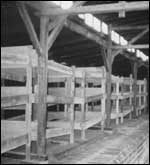 |
We were able to see the bunks (pictured right) that prisoners slept in, the famous rail track and the remains of the number of crematoriums.
The physicalities of the camp were expected, but what struck us most were the prisoners' experiences at the camp.
Families arrived at the camp and were instantly separated, men from women and weak from strong. Most never to be together again. The emotional pain of the prisoners must have been tremendous yet people had hope, and this has often been described as a vital factor to survival. It is only after the visit in November that we have really come to terms with what we have experienced. Whilst there our concentration was more focused on absorbing what we were seeing rather that what we felt.
We both feel very strongly about awareness of such atrocities and this year Holocaust Memorial Day focuses on From Holocaust to Rwanda: Lessons Learnt, Lessons Still To Learn. Rwanda saw the murder of 1million people in 100 days and was only 10 years ago.
Education and awareness is the key to preventing such devastation and horror. |