:: Web Links» | www.ta.mod.uk
The official website of the Territorial Army | The BBC is not responsible for the content of external websites |
:: Facts » | | Mac joined the Territorial Army "as a hobby" in 1978 and is attached to 495 Movement Control and Liaison Staff, an Army unit specialising in transport matters. |
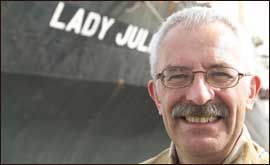
| | The challenges of his duties in Iraq have included working in a hot, humid environment, dodging kidnap attempts, and being asked to do a job he knew nothing about. But for Mac McCoig, it has all been in a day's work through his service as a Lieutenant Colonel with the Territorial Army.
Since the summer he has switched his expertise from bricks and mortar to the world of international shipping, after being appointed to help run the Iraq's biggest seaport at Um Qasr.
The Mother of All Ports...
Um Qasr, which in Arabic means the "Mother of All Ports", has been at the centre of action in Iraq ever since Coalition forces began the overthrow of Saddam Hussein earlier this year.
In March, it was the scene of fierce fighting when British troops chose it as their first landing point during their invasion. Now, more than six months later, it is back up and running as a vital lifeline to the outside world for both Iraqi commerce and Coalition forces.
But with only one roll-on roll-off loading bay, only one ship can load and unload there at a time, meaning competition for using it is extremely fierce. Mac's job is to sort out when local ships have priority, and when the needs of Coalition forces must come first:
 | Mac McCoig |
 Um Qasr is a civilian port run by civilians, and my job is to sort out the conflicting priorities between civilian shipping and military shipping. Um Qasr is a civilian port run by civilians, and my job is to sort out the conflicting priorities between civilian shipping and military shipping.
My job is not to run the port but to co-ordinate the multinational forces that want to use it.
I have to know what ships are coming, and when they are going to arrive, in order to prevent them turning up to find a ship already in berth. 
It's hard to please everybody...
As he has found, it can be a job where it is hard to please everybody.
At present we have ships coming in from Norway, Holland, and all manner of other countries whose troops are now contributing to the Coalition effort here. The trouble is that with shipping, estimated times of arrival are very much give or take a day or two. Sometimes, incoming Coalition ships preposition all their drivers there so that they are prepared to pick up all the stuff up. Then they arrive, only for me to say that the port is already busy and they'll have to wait a day or two. You do get a few who aren't very happy when that happens.
We are the occupying authority and we can lay the law down if we wish, but we try not to do that as we don't like using a heavy hand.
Port politics
The port is run by an American firm, but owned by the Iraqi Port Authority, which works jointly with the Army and the Coalition Provisional Authority, the body supervising the reconstruction of Iraq. Mr McCoig, whose job is to liaise with all three, admits it has been a steep learning curve.
I knew nothing about port operations when I came out here - absolutely nothing - and I would not say I am an expert now. But there is a lot of experience you can draw on.
The standard port operating procedures have been built up here by the Coalition by trial and error, and we also have the help of the Army's specialist Port and Maritime Regiment.
Tough working environment
The working environment is also tough adversary too. As well as temperatures reaching up to 56C during the hottest month of August, safety on the roads between Basrah, Um Qasr, and other towns Mr McCoig visits is never guaranteed. At one point we had what we think was an attempted kidnap.
We were coming back from the border crossing with Kuwait and this car pulled across the road in front of us.
Luckily we just swerved around it and carried on, but it is something you have always got to watch for here.
A very different job...
While his job in Iraq is very different from the one he does back home, he feels he will bring back a lot to the workplace when he returns.
A lot of people forget that their jobs are very routine, and they don't get the opportunity for planning completely on the hoof, like you have to here.
You are learning to work in a completely new organisation and getting the opportunity to really stretch your skills. I think people will view the TA in a different light now, and I think it will be seen as a much more professional force because of the work we've done here in Iraq. |