| 13 November 2014 |

| |
| BBC Homepage | | |
| |||
| Contact Us | | |
Local HeroesYou are in: Stoke & Staffordshire > History > Local Heroes > Bethesda Chapel 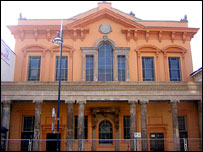 Bethesda ChapelThe historic Bethesda Chapel on Albion Street in Hanley last opened its doors to the public over 20 years ago. The re-opening of the 'Cathedral of the Potteries' - after much restoration work - attracted a lot of attention. On Saturday, 8 September 2007, hundreds of people flocked to the Bethesda Methodist Chapel in Hanley. The building opened its doors to the public for the first time in 22 years. And how great it was to see the ground floor of the chapel full again. In fact, there were long queues of people desperate to get in. Inside the historic chapel the Biddulph Male Voice choir were singing and you could feel the emotion of the congregation. In its heyday, the so-called Cathedral of the Potteries is reputed to have seated in excess of 2,000 people. It was Stoke-on-Trent’s leading place of worship. The chapel closed down on 28 December 1985. For years it was neglected until ownership transferred to the Historic Chapels Trust (HCT) in 2002. How it used to look...Exclusive 360° images of how the Bethesda Chapel looked BEFORE the renovation. In 2003, the building narrowly missed out on winning the BBC’s Restoration competition which would have ensured a £3 million facelift. Impressive frontageHCT has now completed Phase I of the renovation work. Over £800,000 has been spent on re-roofing and waterproofing the building as well as completing the stonework that makes up the impressive frontage. The outside is now sporting a vibrant shade of ochre – based on a traditional colour scheme. The BBC is not responsible for the content of external websites ************************************** Local historian Chris Wakeling has been campaigning for years to try to save the Bethesda. Chris explains the building's significance...The Bethesda Chapel in Hanley - in the centre of Stoke on Trent - is an impressive example of Methodist architecture, dating from the period when Methodism was growing very rapidly. It was designed to accommodate the huge congregations that were attracted by Methodist preaching, and could even hold up to 3000 worshippers on occasion. Packed inHowever, such audiences must have been tightly packed, as one can see from the original narrow pews and flap-seats which survive in the gallery. Yet almost everyone had a clear view because the steeply curved gallery focused attention on the pulpit and there were no ceiling columns to interrupt the sightlines. Because of the chapel's great size, special roof timbers had to be obtained and these were apparently brought over from North America. HymnsBethesda is also a reminder of the role hymn-singing played in the success of Methodism, for the interior is dominated by a handsome organ and the encircling gallery must have encouraged singing as a corporate activity. Beyond the chapel is the large school building, a symbol of the Methodists' important contribution to education in the nineteenth century, and a reminder that the chapel provided more that a place of worship for its members. New ConnexionAlthough Bethesda in many ways typifies Methodism, it did not belong to the mainstream of that movement. It was a product of the first division in Methodism after Wesley's death - the Methodist New Connexion. This New Connexion was created in 1797 by those who wanted laymen to be represented equally as well as ministers in the church's governing conference. The Methodists of Hanley were sympathetic to this movement and in 1797 began to worship in a coach house in Albion Street. In 1798 a purpose-built chapel was erected on the same site, and was enlarged in 1811 to seat a thousand. Even this was too small and so in 1819 the chapel was rebuilt to its present dimensions, following designs by a local schoolmaster named J.H.Perkins. Central place of worshipBethesda became the most important place of worship in Hanley. It had the largest congregations and boasted more than twice as many seats as St. John's, which did not even have the status of a parish church until 1891. Bethesda attracted many leading pottery manufacturers and those who were active in public life. The Ridgway family, whose factory stood across the road in Bethesda Street, were most prominent, but there were many others, including Job Meigh, Joseph Clementson and Michael Huntbach. The Methodist New Connexion made headway in almost all the local towns and, to avoid confusion with the main Wesleyan Methodists, its chapels were given distinctive names: e.g. Zion (Longton), Mount Zion (Stoke), Ebenezer (Newcastle), Zoar (Burslem), Mount Tabor (Tunstall). Bethesda was not only the hub of the Methodist New Connexion in North Staffordshire, but also figured significantly in its national affairs. Almost all the ministers stationed at the chapel served as President of the Connexion's Conference, and Bethesda was a regular venue for that Conference. It is a mark of the affection in which it was held that Bethesda was the only chapel to have its interior illustrated in the official history of the Methodist New Connexion. The nineteenth centuryOver the years the fabric of the building has seen many changes. Robert Scrivener, a committed member of Bethesda's congregation, created the present pulpit and communion area in 1856, and three years later replaced the building's original facade with the proud classical design which is still so important a part of the street scene - it makes an interesting contrast with the front of what is now Hanley Town Hall, of which Scrivener was also the architect. In 1887 the ground floor of the chapel was rearranged with more comfortable seating and an enlarged vestry. During the Second World War part of the area below the gallery was partitioned off. New church bodyThe Methodist New Connexion was one of the bodies which joined together in 1907 to form the United Methodist Church, which in turn amalgamated with the Wesleyans and Primitive Methodists to create the Methodist Church in 1932. Through all this Bethesda continued to play an important part in local Methodist life, albeit against the background of a declining town-centre population. But nowadays, the congregation has become too small to be able to maintain the premises, and the building was declared redundant by the Church. Chris WakelingChris Wakeling is also the author of a number of other articles about Methodist chapels and of other articles about Bethesda. (text reproduced with permission from the Newsletter of the Staffordshire Historic Buildings Trust, 1986) last updated: 27/01/2009 at 10:40 SEE ALSOYou are in: Stoke & Staffordshire > History > Local Heroes > Bethesda Chapel |
| | About the BBC | Help | Terms of Use | Privacy & Cookies Policy |