| 24 September 2014 |

| |
| BBC Homepage | | |
| |||
| Contact Us | | |
Local HeroesYou are in: Stoke & Staffordshire > History > Local Heroes > Sir Robert Peel 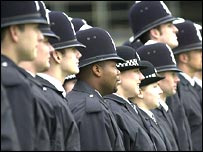 Sir Robert PeelLocal historian Fred Hughes reminds us of one of Tamworth's favourite sons - and how he transformed Britain's idea of The Law. Did you go to a football match at the weekend? Did you notice how many police officers were on duty? And do you ever wonder why the policing of large crowds seems to be an automatic necessity? ...Well, the concept all starts back in Ancient Greek times where the principles of civic protection and administration were first designed. Centres of education and enlightenment were established inside townships. Here men gathered in groups - forums - to lay-out laws that were meant to control all aspects of city life. The law according to the Greeks & RomansSo far as the administration of the law was concerned, the Greeks set down a loose form of policing during the later Athenian period which was later adopted and regimented into a military force by the Romans - as they took over the mantle of world leadership. When the Romans conquered Britain, they brought their form of town-policing with them in order to keep a tight control to prevent any form of uprising against the state. Inside Greek and Roman townships good order and civic discipline was kept by offering citizens the protection of the law. If you lived outside the towns, you were said to be 'with-out the law' and therefore you were classed as 'law-less.' Whenever crowds of law-less people visited the cities for fetes or for the gathering of performance games and athletics, the military police were in attendance in force to protect the local citizens from acts of assault, vandalism and theft. There is a direct correlation between this style of civic duty and the rules of responsibility of modern policing in our townships today. The law arrives in modern BritainHowever, after the Romans withdrew from Britain, national law descended into scrappy local rules. And so it remained, parochially administered, until the onset of the Industrial Revolution in the late 18th century. It was at this time that the new factories were literally gobbling up people into the furnaces and pits.  New towns became overcrowded, life was cheap, and there was no definition between those protected by the law and the law-less. Chaos reigned in these new industrial districts and crime and vandalism became endemic. Something desperate was called for to prevent revolution. "Bobby" appearsRobert Peel, (1788-1850) represented Tamworth in Staffordshire for eighteen years - during which time he became famous as the inventor of the modern police service. As Home Secretary he first tackled the organisation of London's weak police-force (known as Bow Street Runners). These men were thief-takers, and supplemented the activities of night watchmen who were made up of old men and were of no deterrence to aggressive criminals. Peel put his new force of young men into a dark uniform, and they soon became known as 'Peelers' or 'Bobbies'. Despite a great resistance at first to what was perceived as a breach or interference of civil rights, Peel's bobbies soon became a common and respected sight in London and paved the way for the popular form of policing by consent throughout Great Britain - and also throughout the emerging 'civilised' world. It is a fact that all western democracies are today based upon Robert Peel's 'Metropolitan Police Force' which was instituted in 1829. Peel PMRobert Peel also went on to become one of the greatest Prime Ministers to have held high office in this country. Under his administration of Protectionism, as applied against Free Trade, Peel introduced an income tax and applied a form of early anti-VAT when he lowered or abolished the duties on important items of international commerce. Peel was the first of the 'modern' Prime Ministers. In a single year he carried parliamentary reform kicking and screaming into modern times. His own occupancy of the position of Prime Minister set a compulsory pattern for his successors; it was a system that reinvented British politics. He split his archaic Tory Party and in doing so laid out the culture of the Victorian Liberals - some historians say he invented the Liberal Party.
Drayton Manor - his Tamworth homeHe made his home at Drayton Manor, near Tamworth, a fantastic house much visited today on the international tourist trail. So valued was Peel that Queen Victoria made a visit to the manor in 1843, the only Prime Minister to be honoured by a private visit by the Queen in her lifetime, apart from Disraeli. Fred Hughes For more information on Sir Robert Peel, follow the link below. What do you think about Staffordshire's heroes and heroines?If you've got something to say about any local heroes, check out our message board by clicking on the link below. Here are some of your messages Staffs greats Peel biography last updated: 17/03/2008 at 14:26 You are in: Stoke & Staffordshire > History > Local Heroes > Sir Robert Peel |
| | About the BBC | Help | Terms of Use | Privacy & Cookies Policy |