 | 24 September 2014 |

| |
| BBC Homepage | | |
| |||
| Contact Us | | |
Local HistoryYou are in: Stoke & Staffordshire > History > Local History > History of Penkhull revealed in new film 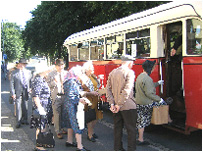 History of Penkhull revealed in new filmBy Richard Talbot The historian and lecturer from Stoke on Trent, Richard Talbot, has created his third local history film on the Staffordshire village of Penkhull. Richard Talbot, one of North Staffordshire’s most well-known historians, tells us how he came to make another film about the history of his local area. I hope my latest film, which is in the form of tour around Penkhull, will be seen as a well illustrated history of the village, as never seen before.  Richard Talbot The film which I have called ‘The Last Penkhull Circular’ is my third, in a series. The Last Penkhull Circular (the bus's destination board was entitled The Penkhull Circular) follows the old bus route from the town of Stoke, through Oakhill to Penkhull then as it returns to Stoke via Hartshill. Together with memories of the passengers we explore many features of Penkhull’s history. There was no shortage of local residents - who were coming forward dressed in typical 1930/40s costume! HistoryThe village of Penkhull sits neatly overlooking the junction of the River Trent and the Lyme Brook at Hanford. Penkhull was the scene of the 1842 Chartists Riots in the Potteries. This involved a group setting about ransacking the large Georgian home of Mr Thomas Bailey-Rose, at Beech Grove, who was the only stipendiary magistrate for Stoke-on-Trent. The history shows the building restoration. Any village is not complete without its church and chapel, and in this history I recount the history of both the Parish Church where the full congregation takes part and the Methodist Chapel which in its day was the hub of village activity. I even re-produce many early films of the Pantomimes. Oh yes I have! For the first time a full history of Penkhull Garden Village is given, that group of houses at the top of Trent Valley Road built from 1910. Here I discuss the large estate, play recordings, display many old photographs and maps, even re-produce a film of King George and Queen Mary making a visit there in 1913. The villageRecords show that Penkhull remained as a Royal Manor until 1308, after which it became absorbed into the Royal Manor of Newcastle-under-Lyme. It is this abundance of previously unknown material that has allowed a unique insight into the history of Penkhull as part of the Manor of Newcastle. Previous workFrom the age of eighteen I became a hardened enthusiast of history, reading as much as I could soak up at any one time. It didn’t matter what period, all was fascinating, and to delve into the past to discover a by-gone age was something remarkable. One of the most important decisions I have made came six years ago, when I decided to switch from recording history in book to recording on film. This different method of communication was an instant success. My first film, ‘Farming throughout the Ages’ traced farming within a community from 1086; and the video recording of the last farm left in the area, Penkhull Farm, together with many recordings, plans, documents and photographs formed much of the content. Three years later I filmed a second film ‘Whatever Happed to Old Penkhull?' This covered not only its early history as an introduction but moves on quickly to record the period when the City Council placed a clearance order on most of the village to be replaced by council house property in the 1960. **** last updated: 11/03/2008 at 14:44 SEE ALSOYou are in: Stoke & Staffordshire > History > Local History > History of Penkhull revealed in new film
|
| | About the BBC | Help | Terms of Use | Privacy & Cookies Policy |



 Listen to the
  Watch the