My long-standing interest in what's now called "personal testimony" history was given added impetus during the 1970s. It was then I had a series of private conversations with people who had at some time previously worked in the ceramic industry of North Staffordshire. If they had one thing in common it was the richness of their individual experiences which, fortunately, they were usually able to recall with an impressive clarity.
I was particularly conscious at this time of the sad fact that, unless someone took the trouble to establish a permanent record of these memories, valuable information would disappear with the holder's passing. So I decided to go with a tape-recorder and get down their memories. The book My book, "Potters: Oral History and the Staffordshire Ceramic Industry" helps to sum up and identify that project (which I undertook while employed as Keeper of Ceramics at the Potteries Museum in Hanley, a job I held before joining Staffordshire University). | "(The) interviews revealed a remarkable mixture of pride in one's work, and pathos and humour. This was not dry, inanimate history..." | |
I was especially conscious that recorded history has rarely preserved the testimonies of ordinary working people. From the Industrial Revolution up until the Second World War, the voices of ordinary people were only required when being used as "evidence" by social reformers. (Of course, the famous example of this sort of research was behind the decision of Queen Victoria's government to appoint a commission for the investigation of conditions surrounding the employment of children in industry. In the case of children employed in ceramic manufacture, the inspectors sent to North Staffordshire were Samuel Scriven, in 1842, and Robert Baker, in 1865, who interviewed the children themselves).
It occurred to me that, chronologically speaking, the children that Scriven and Baker had interviewed were a mere two generations removed from people working in the Potteries in the twentieth century, many of whom at this time (the 1970s) were in fact, though retired, still alive and well and living in the region! Memories In recording their reminiscences I wanted, amongst other things, to establish the extent to which their experiences differed from those of their grandparents' generation. The resulting tape-recorded interviews revealed a remarkable mixture of pride in one's work, and pathos and humour. This was not dry, inanimate history but a history characterised by vigour and a strength of character. The first person I interviewed was retired dentist, Arnold Wain of Trentham. Mr Wain was the perfect interviewee in that he had on numerous occasions been invited to talk about a life that had seen him emerge from a childhood characterised by poverty to become a highly respected dentist, city councillor and lay preacher.
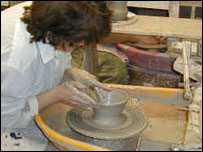
Moreover, his son John Wain also achieved great distinction in becoming Professor of Poetry at Oxford. For Mr Wain however, working in the ceramic industry was never a part of his long-term plans. For other people that I interviewed it was a life-long career. I met Mrs Alice Morris, who was still working in a Longton factory at the age of seventy-seven. Her testimony revealed that work, possibly perceived by many to be monotonous and unrewarding, was for her a source of great satisfaction and pleasure. Other contributors describe skills that by the 1970s were rare under industrial conditions. Retired thrower George Myatt, for instance, described experiencing the change over from steam power to a wheel driven by an electric motor. Other aspects of his job were more typical of the nineteenth century, such as when he describes working by gaslight in a workshop that was originally part of an old Longton pub called The British Volunteer! All in all, there are ten interviewees in the book, all of whom worked in the industry in one capacity or other. The most famous I suppose must be the late Reginald Haggar, the painter who started off his career as a designer at Minton. Reports To put the interviews into context, I also decided to include, at the back of the book, copies of those original reports by Scriven and baker. They make fascinating reading even now.
I hope too that readers will enjoy the numerous old photos and engravings of the pottery industry - many of which the Potteries Museum allowed me to use, and for which I thank them. My hope? That these ten interviews will tell a largely hidden story. Gordon Elliott Details "Potters: Oral History and the Staffordshire Ceramic Industry" is currently on sale in several bookshops in the region, notably the Potteries Museum. It is also available to buy online through the publishers' website below. |