To view the progress of the campaign week by week, click on the link to the "Herceptin Campaign Diary) on the right hand side of this page. There is also a messageboard on that page, where you can leave your comments.
********
There were tears of disappointment outside government offices in September 2005 after women campaigning for increased access to Herceptin were told.. "you will have to wait..."
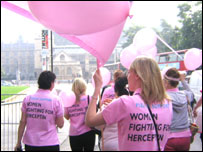
Around fifty women from the "Fighting for Herceptin" campaign group had marched to
Downing Street to hand in a petition of 34,000 signatures, only to hear Health minister Rosie Winterton tell them that their hopes were a long way from being realised.
The women's reaction? --- The fight must go on! What's the campaign all about? Dot Griffiths from Hartshill in Stoke on Trent started the campaign after finding out the drug (which she’s now having) isn’t given to women in the early stages of cancer.
She asked around at the Oncology department of the University Hospital of North Staffs to try to discover which women would qualify.
In fact, many didn’t know about it - so she started getting them together and launching a campaign of letters and meetings. As the campaign progressed, the new group went to the meetings of the local health authorities to ask some very pointed questions.
They then appeared in national papers with their campaign, and on BBC Breakfast and Woman’s Hour on Radio 4.
The petition was started, and the group organised dozens of events in order to start collecting signatures... which led them to Number 10 Downing Street on September 22nd 2005. What is Herceptin? It’s a drug given via a drip to those with breast cancer after treatment with radiotherapy or chemotherapy, with the hope it’ll stop any further cancer developing. Only about one in six women can use it: those who have the Her2 protein in their blood. However, it’s not licensed at the moment for use in primary breast cancer.
It’s only licensed for people with ‘secondaries’ (that is, women who have cancer for the second time). It’s still going through procedures at the moment to get it approved and licensed.
But the campaigners claim that as many as 2,000 women may be dying in the UK each
year because they are denied access to Herceptin. They say that clinical trials had shown that if it is given to women after they are first diagnosed, it will halve the chances of them having a recurring episode of breast cancer and increase their life span.
In early 2005, the charity "Cancer BACUP" said it could be 2007 before Herceptin is widely available on the NHS - because that's the length of time for the appraisal process to be carried out by the National Institute for Health and Clinical Excellence (Nice).
Makers Roche are expected to submit an application for its use in early cancer treatment early in 2006.
Since then the Health Secretary has shown more support, by ordering a fast-track assessment of the drug which could make it more widely available and quicker.
But another problem arose. ocal campaigners have been upset to learn that there will be no money ring-fenced for providing herceptin within North Staffordshire's local health authorities.
So, some women are now taking out bank loans or thinking of re-mortgaging their homes to fund the £40,000 it costs for a year’s treatment. Who's who in the Campaign? Dot Griffiths is spearheading the "Fighting for Herceptin" campaign. She already gets Herceptin on the NHS because she has secondary cancer.
She was unable to go to London because she was ill in hospital. Elaine Barbour is from Abbey Houlton in Stoke on Trent, and is a single mum with four children. She’s already had primary cancer; and thinks Herceptin will prevent her getting any further cancer. She’s paying for the treatment privately, using her own savings and loans from family and friends.
Her mum has taken out a bank loan to help her afford the £40,000. She’s planning to take her case to the European Court because, as a single mum, she should qualify for legal aid. Lynne Burton is from Clayton in Newcastle-under-Lyme. In fact, she has a second bout of cancer, but, because it’s a slightly different type it doesn’t count as secondary and she doesn’t get Herceptin! As you can imagine, she's very angry.
But the campaign has many many supporters - including Melanie Waite, Alison Poole, and Mary Potts; and you'll be hearing more of them in the coming months. What's Next? You can find out more about the campaign's progress by reading the Herceptin Diary on this website.
Judging by their determination and passion, these women will not be giving up easily!
Helen Thomas (with extra research from Mark Stewart & Mick Tucker) |