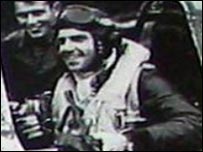
| The final flight path | The plane was first spotted screaming over Tillington School (then known as Holmcroft) as it traced its way over fields. As it continued over the it banks to the north-west to avoid collision with residential areas. Perrin's Mustang ended up crashing on farmland between Creswell Home Farm and the Round Spinney. |
...Sometime during the flight, petrol began leaking from the fuel pump primer on the right hand side of the fuselage – below the front of the cockpit. This caused the cabin to fill with volatile fuel vapour. Captain Perrin could have bailed out at this stage since he was at an altitude where this would have still been possible. However, in doing so, as has been said, the plane would have crashed on the town. Conscious of the havoc this would cause, he decided to stay with his craft. Clear of the built-up area there would be a better chance of making a forced landing. When southeast of the town centre, Captain Perrin banked the Mustang north-northwest, toward what he thought to be flatter terrain – an area of open farmland in 1944. Seighford aerodrome also lay in that direction, as did Warton, to which he may still have thought there was a chance he could return. The fire at this time may well have appeared less dangerous or may not even have started at all, there merely being a smell of fuel in the cockpit. For whatever reason, approaching Holmcroft Road, at an altitude of approximately 1000 feet, matters took a turn for the worse, such that Captain Perrin must land the plane immediately or risk being burnt alive in the cockpit. It was after having cleared the housing estate at an altitude of 600 feet, on final approach to a crash-landing that disaster struck. 'Volatile mixture'  | | Mustang Drive - a fitting tribute |
The volatile mixture within the cockpit ignited. The resulting explosion blew the Plexiglas out of the canopy leaving behind the metal frame (in which the emergency release lever was later found to be undisturbed). Either because Captain Perrin had been killed by this blast or was rendered unconscious, the plane turned over in a steep dive, its engine screaming full throttle, left wing pointing vertically toward the ground. This was the final attitude of the Mustang, a moment dramatically captured in witness statements. Farmer Arthur James Malpass, in a written statement to Staffordshire Police described what he saw: "I looked over the top of the cow shed and saw an aeroplane banking-flying on its side. It is possible the plane was in a spin and it was not much higher than the cow shed. "The engine was in motion and full out making a terrific noise as it travelled out of my sight toward my field of growing wheat. Shortly afterwards I heard a bang and an explosion when the machine struck the ground in the field of wheat a distance of about 350 yards away from me." Final plunge An employee of Mr. Malpass, farm labourer Alan Bryans, who was working in a nearby hayfield, also witnessed the final plunge of the plane: "I saw an aeroplane coming down toward earth in a spin with smoke coming from the right hand front of the plane. "The engine was running full out and the machine came down into the field of growing wheat only a short distance away (the next field to where I was working). It exploded and caught fire on the ground. There was an orange flash as the plane struck the ground." The police report stated: “A farm girl, on whose place the crash took place,” said, "I heard a loud noise and noticed the aircraft at an altitude I judged to be about 600 feet. The plane was enveloped in dense smoke as it turned over. "The aircraft righted itself and made a deep curving dive to the left over the farm house and plunged into the ground." Whether this person was a relative of Mr. Malpass, perhaps his daughter, or a living-in farm-worker, was not recorded on the statement and therefore is unknown. Another person (again not identified) related a similar story to the military police on duty at the crash, except: "he saw flames coming from the aircraft." Leaking fuel USAAF Inspector Kadow who visited the site the next day (5th July) stated: "Gasoline had been present at the right side of the cockpit, either from leaking primer lines or a leak from the primer itself. "A spark from the electrical equipment on the right side of the fuselage caused fuel to explode. This shattered the canopy and enveloped the right side of the cockpit and pilot in flames. The flames set fire to the fuselage tank causing a fire that burned through the top of the rear fuselage and burned the paint and fabric off the tail. "The plane struck the ground on the left wing. The crash burst the wing tanks causing local fires. The aircraft was completely wrecked with no parts salvageable. "Upon examining the wreckage, the following was particularly noted: Bottom of Pilot's seat badly scorched; front face of armour plate behind Pilot's seat badly scorched; rear face showed no sign of scorching; right side of fuselage badly burned; left wing very badly damaged; right wing in fairly good condition; frame of cockpit canopy was found intact near wreckage except for complete absence of Plexiglas; canopy emergency release had not been disturbed." Staffordshire County Police Sergeant W.C Amphlett declared in an official statement: "I beg to state that it would appear that the machine was flying in a North Westerly direction – having travelled over part of the South East of Stafford town when apparently it made a pancake landing in the field. "On touching down the machine exploded and caught fire. The pilot was flung from the machine and his body dismembered beyond recognition."  | | The crash site as it stands today |
Striking throughout the sequence of events that inexorably unfolded on that long ago July day was the bravery of the pilot. Despite the risk of an explosion in the cockpit and aware no doubt of the danger of crash-landing in unknown terrain, he decided against parachuting out. He determinedly kept his fiery plane airborne long enough to clear Holmcroft Primary School (and Holmcroft housing estate immediately north of it – see maps), aiming to come down in open farmland beyond the last house on Second Avenue. This Captain Perrin succeeded in doing; tragically not in the manner he’d hoped. Further Note to Readers: Those requiring more information concerning the crash can read the official report of the accident along with a copy of this account, view black and white photographs taken of the scene at the time of the crash (unfortunately rather dark and difficult to interpret) and copies of witness statements, at The William Salt Library, Eastgate Street, Stafford. Additionally, commemorative plaques along with photographs and a biographical sketch of Captain Perrin – presented to the people of Stafford, England, by citizens of the twinned County of Stafford, Virginia, USA – can be viewed at the Civic Suite in the Civic Centre, Riverside, Stafford. Local residents should know that Perrin Close was named after the pilot. More recently, part of a new development near the crash site has been named Mustang Drive. Here it is planned to place an historic marker identifying the exact location of the crash. Further eyewitness reports, personal accounts, comments on this article, or anything else thought to be relating to the tragedy should be submitted to the William Salt Library for possible inclusion in the historic file. Thanks to my brother John and his eldest son Nigel for their vital contributions to this article, including photographs of present day Mustang Drive and the various web sites, without which any account would not have been possible. Return to previous parts... Click on the links situated in the top right of the page or in the beige coloured box below. Got a WW2 story of your own? Well, if so get in touch with the CSV Action Desk on 01782 221225 - and ask for Jim or Dave! From your experiences in service to how things were in wartime Britain we want to hear from you... |