| 13 November 2014 |

| |
| BBC Homepage | | |
| |||
| Contact Us | | |
Local HeroesYou are in: Stoke & Staffordshire > History > Local Heroes > Brian The Great 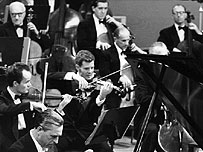 Brian The GreatFew people today know of Havergal Brian, the greatest composer to come from Staffordshire. Historian Fred Hughes profiles the Potteries man whose works call for some of the largest orchestras possible. In 1909, a local music critic from Stoke-on-Trent reported on what he claimed to be an 'orchestral crisis in England.' The 33 year old parochial journalist from Longton had, for a long time, been making angry accusations against against the directors of regional orchestras. He was accusing them of ignoring the work of English composers in preference to the European maestros. The music critic of course had a personal interest in English choral music... for he was none other than Havergal Brian, who went on later to be the composer of 32 symphonies, 5 operas, 5, suites, 2 violin concertos, a cello concerto and more than 100 songs! Dresden, Stoke on TrentBrian was born in Dresden, a district of Longton in southern Stoke on Trent. From a young age he became deeply enraptured and beguiled by choral church music. He became a choir boy and learned the violin, piano and cello, supplementing his tuition fees by playing the organ at Longton's St James Church, nearby Holy Trinity But he soon began a lifetime of musical composition, earning substantial praise from none other than the great Edward Elgar, who thought his work was 'original.' Soon, he made his London debut under the conductorship of Sir Henry Wood at a Proms concert in 1907, and he was considered to be a rising star. Shakespeare's sonnetsOne thing that Brian did do was to set many of Shakespeare's sonnets to music. Indeed, the very popular 'Shall I Compare Thee To A Summer's Day' is a piece still very often heard today in concert halls and on classical radio broadcasting stations. Sadly problems in his private life overtook the realisation of his dreams of fame. His career took a dive, and, for a long period, his work fell into obscurity. However, in 1954, Robert Simpson, a BBC music producer, assisted Brian in getting his 8th Symphony performed - after which there was a reawakening interest in his music. Size mattersBut orchestras found real problems in perfoming Brian's work because of the complexity of his compositions, and most especially, the huge scale of musicians and instruments required for their performance. Some of his pieces required orchestras twice the normal size! His work was almost too grand for performance - one opera alone of his called for massive and elaborate scenery... including a live elephant, fairground roundabouts, four choirs and a cast of seventy! No one doubted that Havergal Brian was an important English composer, but it was the requirement of assembling such large orchestras that defeated most of the producers. This was eased somewhat in 1966 when Sir Adrian Boult managed to organise and conduct the London Symphony Orchestra at the Albert Hall in a performance of Brian's most notable work, the Gothic Symphony. Cantankerous and 'okkard'Havergal, though, didn't make life easier for his supporters - displaying his Potteries cussedness, and being such a cantankerous man, that he was known, in the local parlance, as the 'okkard cuss'. Such was his reputation for being difficult, "Awkward Cuss" was the name used in the title of a biographical documentary about him performed after his death at North Staffordshire's Victoria Theatre. Gothic revivalNevertheless, his home city did him proud by then also putting together one of the few-ever performances of the Gothic - this time at the Victoria Hall in Hanley. The effort was massive, so massive that it could not have happened had not many local amateur choirs also taken part. Today Brian is almost forgotten, but there is little doubt that he would have been a considerable force in Edwardian English symphony music had he exchanged complexity for brevity. Havergal lived a long life, dying at the age of 96 at Shoreham on Sea in the south of England. Fred Hugheslast updated: 17/11/2008 at 10:21 SEE ALSOYou are in: Stoke & Staffordshire > History > Local Heroes > Brian The Great |
| | About the BBC | Help | Terms of Use | Privacy & Cookies Policy |