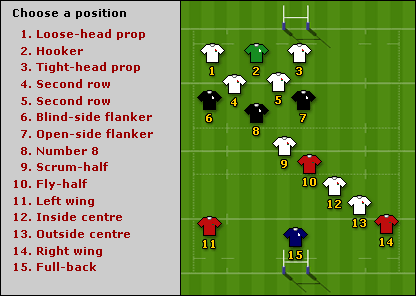
 Both second row players need to be strong, athletic and dynamic.
And height is also useful, particularly in the number five shirt.
Their basic roles is the same as the number four - to secure possession and, as with all the forwards, to tackle tight in to the set-piece and the breakdowns.
At the line-out, the taller second row (usually wearing the five shirt) tends to be the number four-jumper.
 | There's a lot of movement, a lot of deception and a lot of dynamism |
A ball thrown to him has got further to travel and is obviously in the air longer than it would be if it was aimed at the two-jumper.
So the four-jumper has to deal with more variations in the air - you can either go forward, straight up or backwards.
But with the way the game has changed, players regularly shift around positions as the line-out is thrown.
The days of jumping in your one position are over.
There's a lot of movement, a lot of deception and a lot of dynamism and that's very different.
In the scrum, the taller second row may be the loose head lock, which is on the left side of the scrum.
The loose-head tends to move more - he's only bound in on one side, so his left hand is loose, while the tight-head is tightly bound in and pretty stationary. 


 E-mail this to a friend
  Printable version


Bookmark with:
What are these?