|
 |
 | | Other Sports: Horse Racing: Grand National 2002 |

 | |  Monday, 25 March, 2002, 12:24 GMT Monday, 25 March, 2002, 12:24 GMT One man and his microphone 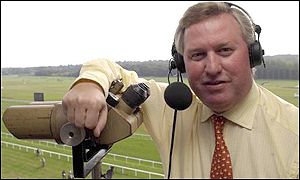 McGrath reckons he has the best job in the world By BBC Sport Online's Scott Heinrich It is a measure of Jim McGrath's competence that the retirement of revered commentator Sir Peter O'Sullevan was not a forlorn one for BBC racing. A racecaller of broad experience, McGrath's is the Antipodean drawl heard whenever Grandstand crosses to the galloping drama that is the sport of kings. But for different circumstances almost 30 years ago, McGrath might never have made it to Britain. Indeed, the incumbent voice of racing on BBC TV might have been a mimicry of the relaxed, balanced tones of O'Sullevan rather than those of McGrath. Ambition drove a young McGrath out of his homeland in the early '70s, a lack of opportunities forcing him to pack his microphone and set sail for the racecourses of the world. "I was calling in Melbourne and there were three excellent callers who had been there for at total of 100 years between them," McGrath tells BBC Sport Online.
"So I set off in 1973 and came here in 1984 after commentating in Hong Kong, essentially to work for Phoenix Park in Dublin doing course commentaries in the summer. "I then got the opportunity to call a couple of races at York during the Ebor meeting in 1984. "I got very favourable publicity in the racing press and also in the national press, and being a different voice and style attracted attention." And so began his journey to the top of the racecalling tree. McGrath soon joined the BBC under the wings of O'Sullevan and succeeded the celebrated commentator following his retirement in 1997. But if he yearns for recognition in Australia (where he is little-known) as one of its finest media exports, it doesn't show. "I don't really think you can structure your professional life to prove to those who are sitting in judgment that you're this or you're that," McGrath argues.
"I certainly wouldn't change my career direction to prove a point. "I go back to do the Melbourne Cup every year and for me that's my little piece of indulging myself in the Australian racing scene. It's fantastic and I love it." When McGrath speaks of his self-imposed exile from Australia, listen hard and you can hear the ambitious, yet ultimately disheartened, young man just trying to get an even break. But he holds no regrets. In fact, things could scarcely have worked out better. McGrath's yearly pilgrimage to call the Melbourne Cup for BBC Five Live represents more than a mere homecoming. It's a culmination of his professional efforts, an affirmation of sorts. Nobody in Australia would be listening, but ask McGrath and he'd say nobody needs to. In the grand scheme it's just another point of evidence that McGrath's career has come full circle. By making it in the United Kingdom, McGrath's horizons have broadened immeasurably, his portfolio strong enough to make the most decorated racecallers down under weak with envy. "I consider the BBC job to be the number one commentating job in the world because you've got such a great group of races to call," he states. "But a lot of these jobs depend on how the incumbent develops it, and Sir Peter O'Sullevan developed it into a very important position.
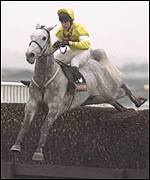
By virtue of his job description, McGrath tends to make people either very happy or very broke. There is no middle ground. But racing is a treacherous pursuit, one that sometimes goes beyond the precincts of pennies and pounds. A facet of his work is to convey racecourse tragedies into sensitive narrative, and that's the one time you suspect McGrath might hate his job. The death of the hugely popular One Man at a BBC-covered meeting at Aintree in 1998 stands out. On his previous start, One Man had won in the Queen Mother Champion Chase at Cheltenham, the scene of two inglorious failings in the '96 and '97 Gold Cups. The grey was racing on the crest of a wave, but he would jump his final fence at Aintree and it was McGrath's job to tell us so. "I could see from my commentary position that One Man was on the floor and that he was probably dead at the time. "It's a bit like breaking bad news to somebody and I went back to the fall and said that things are not looking too good for One Man. "I hoped that would prepare people for the inevitable when the announcement came that he had died.
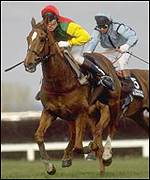
For all the fashion of the Flat, McGrath says his favourite race, to watch and to call, is the Grand National. "Watching Mr Frisk's win in 1990 gave me lots of enjoyment. "He was 20/1 and I backed him. Marcus Armytage gave the horse such a great ride. "It was a great thrill but the one I wish I was there for was when Crisp was runner-up to Red Rum in 1973. "Crisp gave Red Rum 23lb and I think they broke the course record by something like 19 seconds. "It was a staggering performance by Crisp, especially when you consider the National horse Red Rum went on to be. "I was listening to the race on the radio in Australia and I wish I could have been there." You can bet McGrath switches off the microphone at the end of the day with the contented air of a man doing what he loves. Because in McGrath's world, if you're happy with your lot you've a lot to be happy about. | |
See also:  Other top Grand National 2002 stories: Links to more Grand National 2002 stories are at the foot of the page. | |||||||||||||||||||||||||
 | | | | |
|  Links to more Grand National 2002 stories |

| ||
 | ^^ Back to top | |
| Front Page | Football | Cricket | Rugby Union | Rugby League | Tennis | Golf | Motorsport | Boxing | Athletics | Other Sports | Sports Talk | In Depth | Photo Galleries | TV & Radio | BBC Pundits | Question of Sport | Funny Old Game ------------------------------------------------------------ BBC News >> | BBC Weather >> -------------------------------------------------------------------------------- © MMII|News Sources|Privacy | ||