| |
| |
By Tom Fordyce
BBC Sport Online |
 |
|
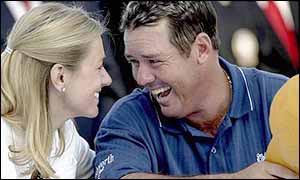
Sure, Rich Beem's USPGA win at Hazeltine was a shock.
There was not a golf fan in the world who thought a 31-year-old former mobile phone salesman would trump the glamour boys.
But, then again, maybe we should have known better.
The USPGA is golf's rogue Major, the tournament that refuses to conform to expectations.
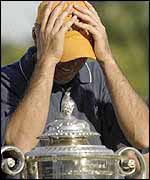 Beem's unexpected win follows in a USPGA tradition
|
While the Masters, the Open Championship and the US Open tend to throw up one surprise winner a decade, the USPGA churns them out time and time again. Before this week, Beem had only ever played in three Majors, missing the cut at the 1999 Open and 2001 US Open and tying for 70th place at the 1999 USPGA.
Perfect - a rank outsider, ready to carry on the grand tradition symbolised by John Daly's three-shot triumph 11 years ago.
Daly's fag-smoking, beer-swilling, mullet-sporting win could never have happened at Augusta. But the USPGA? Absolutely.
The image of the championship as the Major most likely to be won by an outsider carries back to 1985, when Hubert Green took the title at Cherry Hills.
Remember Hubert? Didn't think so.
The champions from later in that decade are more familiar, but in the main precisely because their USPGA wins were responsible for projecting them from the pack.
Bob Tway in 1986, Jeff Sluman in 1988 - neither were pre-tournament tips, and neither would ever get close to another Major win.
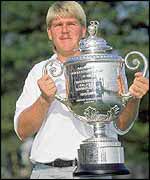 Daly takes his shock win in 1991
|
Tway's holed bunker shot on the 72nd hole to beat Greg Norman was the classic manner in which to take the tournament - out of the blue, and upstaging the bookies' favourite.
In the 1990s the last Major of the year became, at least until Tiger came along, the province of the boys from the chasing pack.
Steve Elkington at the Riviera Country Club in 1995, Mark Brooks at Valhalla the following year - fine players the both of them, but never members of golf's aristocracy.
Elkington's tale, like that of Tway, confounded the critics' best predictions.
The previous year he had been hospitalised following a viral infection, had a malignant growth removed from his shoulder and then underwent further surgery to fix a sinus problem which had hampered his breathing for most of his life.
Who would win the play-off - a convalescent also-ran or a Colin Montgomerie at the peak of his powers?
We should have guessed.
Strangely, the USPGA is also the Major that Europeans simply cannot win.
Despite the Stateside successes of Faldo, Olazabal, Langer and the rest, the title has not been won by a European since Scot Tommy Armour way back in 1930. And even he went on to take US citizenship.
Some of the all-time greats, men capable of destroying rivals and courses all over the world in every sort of condition, found the USPGA a title too far.
Maybe it is because the courses where the tournament is played leave more men in contention than, say, the windy links of the Open or the tight fairways favoured by the US Open.
But the big names always seem to have more competition at the USPGA.
Neither Arnold Palmer nor Tom Watson ever won the event, preventing them from completing the full set of Major titles.
Tiger Woods, until Sunday, had never finished second in a Major.
That fact was used as evidence of his greatness - when he is close to a win, unlike Phil Mickelson or Monty, he seals the deal.
Not any more. Golf's great party-pooper had struck again.