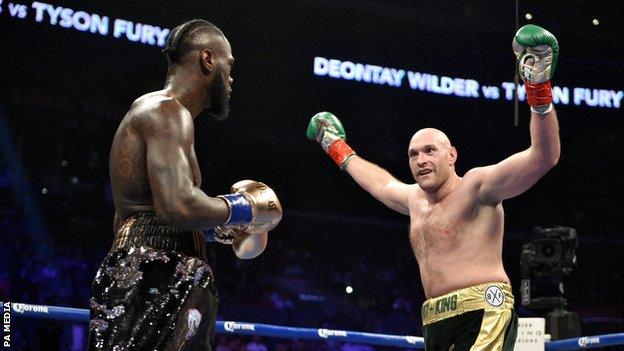
Tyson Fury took the WBC title from Deontay Wilder a month before lockdown began

The text message came just after 4pm on Monday, 16 March.
"They're scrapping qualifier after tonight. Teams just been told"
I was eating at the Westfield shopping centre in Stratford, east London, in between sessions of the Olympic boxing qualifying tournament for the European region being held at the Copper Box Arena nearby.
The atmosphere around an event drenched in confusion was eerily prescient.
The competition got under way two days earlier and spectators were allowed in on the Saturday and the Sunday, before an announcement was made about taking the event "behind closed doors" from Monday onwards. And then came the decision to call it off.
At the time, the total number of deaths from Covid-19 in the UK stood at 35.
We could not have known - maybe did not want to know - how our sporting world was about to change.
Just a month earlier, the BBC boxing team had spent fight week in Las Vegas as Tyson Fury delivered on a promise to take the fight to - and the WBC title from - Deontay Wilder.
"That's the Kronk way," said Fury's new trainer Sugarhill Steward (albeit using a slightly more colourful vocabulary) when we spoke afterwards in Fury's dressing-room at the MGM Grand Garden Arena.
Steward's late uncle Emanuel, a legend among trainers, had been in Fury's corner for just one night back in 2010 and touted the then 22-year-old "Gypsy King" as a future world champion.
The former WBO middleweight title-holder Andy Lee was another vital member of the Fury camp in Vegas and, as a Kronk alumnus himself, wondered whether Fury would have been even better with a prolonged spell around "Manny".
The gate receipts at the MGM that night amounted to around $17m, a record for a heavyweight contest in Vegas and a timely reminder of the importance of crowds in terms of the visceral and financial impact on big fights.
Gladiators were never meant to bare their chests and souls in empty arenas.
For 118 days between March and July, boxing in the UK went dark.
Bubbles, sanitisers and corner men dressed like NHS staff became the norm on resumption as promoters such as Eddie Hearn and Frank Warren stressed the importance of keeping the sport relevant.
Of Britain's 1,000 or so licensed professional boxers, the vast majority have not seen competitive action in 2020 and the full consequences of the pandemic might not be calculable for some time.
Somehow, the new normal met with a degree of acceptance. It had to.

Matchroom Sport staged fights in the garden of its head office
Brad Foster led the way with a lively defence of the his British super-bantamweight title on Warren's opening show at the BT Sport studios in London and the "take-two-to-land-one" battle between Ted Cheeseman and Sam Eggington in Hearn's 'Matchroom Square Garden' in Brentwood in August brought much-needed confirmation that boxing in near-silence could work.
On our podcast, 5live Boxing With Costello and Bunce, we compiled a series during the summer months entitled 'Greatest Fights' and invited some of the sport's biggest names to re-watch and relive memorable showdowns from the past.
On the first of 10 shows, a giddy Sugar Ray Leonard gave us a blow-by-blow account of his unforgettable win against Thomas Hearns in Vegas back in 1981.
Watching Sugar Ray shadow-boxing as he spoke passionately on a Zoom call from California was an experience to be cherished and one to make trash of the conventional wisdom about meeting your heroes.
Elsewhere in the series, we featured Tyson and Holyfield, Benn and Eubank, Gatti and Ward among others. Like boxing fans the world over, we went searching for what used to be - to fill the void left by what wasn't to be.
Covering fights meant time in a 'fight bubble', with Covid tests and isolation periods the precursors to confinement within limited areas of a hotel and group meals served buffet-style as opponents sometimes faced awkward moments on entering and leaving the lifts.
During fight weeks at the Wembley Arena, the only outside space within the 'bubble' hotel for exercise and fresh air was a narrow balcony alongside the dining area.
The scale of the commitment by promoters was as commendable as the boxers' readiness to adapt.
New ventures carried reminders of an old certainty, that few sports are as unpredictable.
Teofimo Lopez matched Tyson Fury in the nominations for Performance of the Year with his dismantling of the Ukrainian conjuror Vasili Lomachenko in Vegas in October.
Here in the UK, Dillian Whyte, Daniel Dubois and Anthony Yarde were all on the end of monumental upsets. Did they just go hungry in their necessity to feed off a crowd?

Anthony Joshua beat Kubrat Pulev in front of 1,000 fans at Wembley
In the past nine months, only one British bill has been blessed with a paying crowd.
As London bathed in the halcyon days of Tier 2 restrictions, Anthony Joshua pounded Kubrat Pulev to the canvas in front of 1,000 fans at Wembley.
It was genuinely stirring to hear again a chorus of "Sweet Caroline" swirling around a big-fight arena before the boxers emerged.
"It's a sign of times returning to normal," said Whyte, co-commentating for BBC 5 Live at the time.
On that Saturday evening, leaving the hotel to make the short walk to the arena, I stopped off at the accreditation desk to collect the wristband which would give me access to the arena floor.
A temperature reading, taken not from my forehead but from from my wrist, produced a worryingly high figure, more akin to a volcano. Another check, same concern.
At that stage, it looked as if I'd be denied entry on medical grounds … until a second staff member at the desk realised that my wrist had been placed directly over a kettle they were boiling for hot drinks and winter sustenance.
Third time lucky, I was on my way in. It truly was a year like no other.
Related topics
- Published29 November 2021