
Information: How to deliver information when public speaking

Delivering Information
In order to see this content you need to have both Javascript enabled and Flash installed. Visit BBC Webwise for full instructions

Lord Spencer, Speaker Mentor
Lord Spencer, Speaker Mentor - "Any speaker's job is to deliver information"

Ben Shephard, TV Presenter
Ben Shephard from GMTV - "An audience should feel informed"

Hugh, Auctioneer
Hugh, Auctioneer - "Don't tell the audience what they already know"
How to Inform An Audience
Delivering information is key to a speaker's role. But what information should a speaker give, how much and how?
Lord Spencer, Speaker Mentor
For Speaker Mentor Lord Spencer delivering information has been a lifelong task, beginning by earning pocket money as a young Tour Guide at his family home.
"Whether you're a Best Man at a wedding or reporting to the board at an AGM," Lord Spencer explained; "You've got to remember what your role is as a speaker and what information you're trying to get across".
A tangible structure is key for Lord Spencer: "You must flag up, pretty much at the beginning what you're going to say. You must have a coherent middle but at the end, don't be shy to bang home again what you want to say".
Bombarding an audience with stats, graphs and figures isn't always the best way to ensure that the audience remembers your message.
"If you can inject yourself into it, or people you know, or experiences you've had, that keeps everyone on their toes and gives them a possibility of identifying with the speaker".
And the key reaction from an audience? "There's nothing more symbolic of having caught your audience than total silence," concluded Lord Spencer.

Ben Shephard, TV Presenter
GMTV host Ben Shephard thinks the most important thing a speaker can do is to keep their delivery fresh.
"It's so important that you don't get complacent about what you're presenting," Ben told us.
"You want to make sure that the audience thinks that this is the first time you've done it, no matter how many times you've done it," Ben said.
"You want it to be spontaneous, you want it to be energetic, you want it to be lively, you want to be informative - you want to convey all of that in how you present".
So how does a well informed audience feel? "Enlightened," Ben explained; "There's always that moment when you think - I didn't know that".
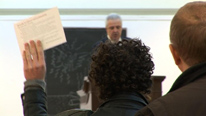
Auctioneer Hugh faces a bid
Under the Hammer
Auctioneer Hugh Edmeades delivers information from rostrums worldwide, as a well travelled Everyday Speaker.
For Hugh, less is often more with the information he needs to deliver: "Clients have got the catalogues in front of them, they know what I'm selling. I take the view 'don't tell them what they already know'...".
With different sales every day, often in different auction houses, Hugh has to keep on top of his game: "All my auctions are different, one day I could be doing jewellery, one day it's contemporary art".
Importantly, Hugh adapts his approach, dependent on the audience he's facing; "Auctions are pure theatre, you have a different audience for each show, so it's a question of understanding the mood of the room".
And with sales taking him as far as Hong Kong, New York and Dubai, Hugh's faced audiences worldwide: "It's a different day and a different dollar, so it's never a dull moment".
Things to Remember
Think about structure - start and end with a clear message
Make your piece personal
Keep your delivery fresh
Be concise with the amount of information you deliver
Adapt to your audience - keep it relevant
Programme information
There are no upcoming episodes.
The Speaker series has now concluded. This site will no longer be updated.

More from The Speaker
More from bbc.co.uk
BBC iD
BBC iDBBC navigation
BBC links

BBC © 2014The BBC is not responsible for the content of external sites. Read more.
This page is best viewed in an up-to-date web browser with style sheets (CSS) enabled. While you will be able to view the content of this page in your current browser, you will not be able to get the full visual experience. Please consider upgrading your browser software or enabling style sheets (CSS) if you are able to do so.

