 | 13 November 2014 |

| |
| BBC Homepage | | |
| |||
| Contact Us | | |
Miners StrikeYou are in: South Yorkshire > History > Miners Strike > Miners Strike 1984: Sir Bernard Ingham 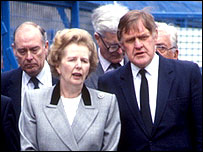 Thatcher and Ingham: Hillsborough 1989 Miners Strike 1984: Sir Bernard InghamBBC Radio Sheffield's Everard Davy talked to Margaret Thatcher's press secretary in 2004, on the 20th anniversary of the start of the Miners Strike. Sir Bernard Ingham gives the government's point of view of the 1984 Miners Strike. Yorkshireman Sir Bernard Ingham was educated at Hebden Bridge Grammar School and worked as a journalist on the Hebden Bridge Times and Yorkshire Evening Post, the Yorkshire Post and The Guardian. He became Margaret Thatcher's press secretary in 1979 and remained in the post until 1990. BBC Radio Sheffield's Everard Davy asked Sir Ingham about his time with Mrs Thatcher in 2004 - the time of the Miners Strike 20th anniversary.
Help playing audio/video "Margaret Thatcher was elected in 1979 and in her first month she went to the Department of Energy, where I was then working, to discuss with the senior management how she could live with Arthur Scargill; because she'd identified the very near certainty that there would be a challenge from that quarter before she was very much older. 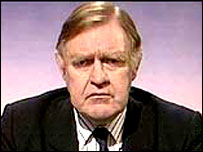 Sir Bernard Ingham "Of course they couldn't tell her and it wasn't a particularly happy meeting but she had to wait, I think it was two years, before Arthur Scargill really mounted his challenge. "She then discovered that in spite of that meeting in 1979, the government would be unable - the country would be unable - to withstand a long coal strike and therefore you may recall she called a truce, as it were. "It was a fairly expensive truce politically, in that she agreed to reduce coal imports to a minimum, to withdraw the closure programme, to improve redundancy terms and to look at the NCB's finances." So that was in 1981, because she realised at the time that she couldn't take on Arthur Scargill?"She couldn't withstand the strike and there's no point going into a battle if you can't win, that only damages the country to no purpose." So going back five years before the year-long strike, she was already beginning to plan how she might tackle such a thing?"Well, is there any wonder? We'd seen what Arthur Scargill did in the Miners Strike in 1974. He brought the Saltley Coke Depot to a halt. Why? Sheer force of mob numbers. "You know how he operated and I think the general feeling - in fact she admits in her book - that after the experience of the Conservative government of 1970-74, she hardly doubted that one day we would have to face a miners' strike. 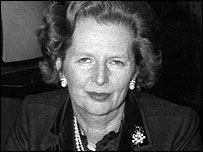 Margaret Thatcher, 1985 "Now all kinds of people say that she was wanting one: it's absolute nonsense. No government of whatever political complexion wants that kind of strike: which goes on interminably; the result of which is in doubt; and which causes tremendous economic and personal hardship. Nobody wants that at all." What were the tactics then between 1981 and 1984?"Build up stocks. Nigel Lawson was in charge of that and he built up stocks, not at pit heads, they built up stocks at power stations. "Stocks of coal and oil and of course they primed the nuclear power stations to produce a lot more, which they did and everything was done to maximise what became the - a regular word - daily use endurance: the nation's endurance." And was this all going on in secret or was any of this openly discussed?"Well you can't hide the movement of stocks of coal can you? I suppose it's much more difficult to detect oil stocks. But you can't hide stocks of coal, people knew what was going on. In any case, they had to be moved - I mean this was one of the reasons for, one of the industrial reasons for the strike. And that was that unsold stocks were piling up at pit heads: they had to be moved out; and of course they were." The other thing that's said about the year-long miners' strike is that the miners were on the verge of winning it, if they'd carried on a bit longer they would have won. What do you say to that?"No they wouldn't, not in terms of endurance of stocks. This was always a test of will of course but they wouldn't have defeated Margaret Thatcher's will either. She was absolutely determined that this country would be rid of political strikes. She regarded this as entirely a political strike." How long would she have carried on for then?"Until endurance failed of course. But endurance was, thanks to the efforts of Peter Walker and the electricity industry, and not least the head of the CEGB, endurance was rather like a piece of elastic, it went on and on and on..." You've mentioned there some of the other characters who were involved at the time. But it's very much personalised isn't it? Between Mrs Thatcher and Arthur Scargill. Is that the way it was?"Er, well no it wasn't actually because I think the government was behind Margaret Thatcher. And indeed a very large amount of people in the country had had enough, that's why they voted her in in 1979. "They'd seen the "winter of discontent", they'd seen two decades, three decades of industrial unrest and disputes dragging the country down. 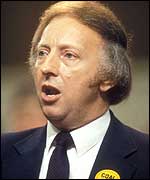 Arthur Scargill "I'm not passing any comment about the quality of British management, which I also thought was abysmal, having been in the Department of Employment for five years. But the fact is that strikes were bleeding the country white and it wasn't just Margaret Thatcher, although that was the iron will at the centre of it. "There was a government determination to rescue Britain from extra-parliamentary, undemocratic efforts to control the nation." And in terms of that as well, the police operation during the miners strike, was Mrs Thatcher in charge of that?"No she wasn't in charge of it but she set the policy tone, which was to enforce the law. "And we're not having mobs of people running around the country intimidating people, both in their homes and outside work, into not going to work, because the law must be enforced." There's plenty of stories about the police intimidating miners at the time.."Well of course there always will be." You don't think there's any truth in that?"I've no idea, I wasn't there, but I mean I think it is inevitable that in the circumstances such stories would gain currency." Looking at it now, twenty years on [2004] and you talk about the industrial turmoil before this… but the industrial wasteland that have been since, the deprivation in the coalfield areas. What are your thoughts now twenty years on?"Well when I go through the Yorkshire coalfield these days I see it is infinitely greener than it ever was. 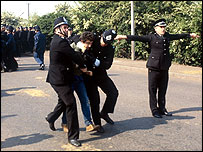 "Now, if all the government had done was to secure the defeat of the miners and not have any regard for the consequences, then that would be I think a black mark and a very black mark against them. "But they didn't and alternative jobs came - admittedly some of them came quite slowly and some people didn't work again." Some people are still waiting, I was going to say -"Well they may well be. But the fact is that the area has recovered and of course that has been made easier by a greater mobility of labour: people travelling distances to go to work. "And that is certainly true I think in Yorkshire, well it's certainly true all of Britain now. But the restoration, as it were, of Yorkshire from the ravages of mining is going on apace and new jobs have been created."
Help playing audio/video That is the irony I suppose of mining, you call it ravages but it was work, it was life wasn't it for many of those areas?"I'm not denying it, of course it was life and there were mining communities all up and down and I'm a part product of one, in the sense that my grandmother came out of the Staffordshire coalfield. But they have gone. But all kinds of industries have gone. "What was so sacred about a mining industry, which, over which crocodile tears had been wept on innumerable trade union conference platforms, which I have covered, about the dastardly business of working down a pit? "Then as soon as the possibility of ending, or the closure of pits arises, then there is a tremendous hullabaloo about the importance of pits. "Now, yes they were important, they were crucial to people's livelihoods, but that doesn't mean to say that there weren't alternatives." You mention that, but let's put it this way: you talk about the turmoil that was being caused by industrial action, by strikes and how that was crippling industry. But it seems that the solution is that we won't have an industry in future."Well no I don't think that that was the solution." 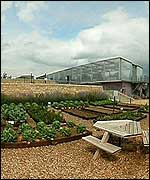 The Earth Centre was built on ex-mining land It has been hasn't it? In terms of the coal industry."No, I'm sorry. Well now yes I mean and erm the Yorkshire miners in particular were grossly ill-served by Arthur Scargill, I think that what would have happened without a strike is that there would have undoubtedly been a much smaller coal industry. "Indeed 75% of the pits when Ian Macgregor came to office were not making a profit, they were making a loss. It would have inevitably have been smaller but I think it would have been much larger than it is today without Scargill. "I don't think any government would have dared close as many pits as did close because of the ravages of that strike."
Help playing audio/video :: Sir Bernard Ingham was speaking to BBC Radio Sheffield's Everard Davy in March 2004. last updated: 25/08/2009 at 12:01 SEE ALSOYou are in: South Yorkshire > History > Miners Strike > Miners Strike 1984: Sir Bernard Ingham    More information about the Miners' Strike in South Yorkshire |
| | About the BBC | Help | Terms of Use | Privacy & Cookies Policy |
