 | 13 November 2014 |

| |
| BBC Homepage England | | |
| |||
| » | South Today Latest stories Recent news Presenters Reporters Inside Out Politics Show Accountability | | |
| Contact Us | | |
Made in EnglandYou are in: South Today > Made in England > Projection challenge 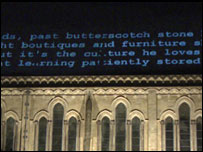 Projections Projection challengeThe roof of Salisbury Cathedral is long and grey, so projecting lines of readable text onto it is a major technical challenge. Audio-visual engineer, Colin Parnell explains how it's done. We like a challenge, so when Surtees Audio Visual were asked to provide the equipment and expertise to make the projection element of the "Consequences" project a reality, we jumped at the chance. It's also an honour to be trusted by the BBC and the team at Salisbury Cathedral to fulfil this role, and one that we knew would take some careful planning, as well as some very modern technology.  The writers at Salisbury Cathedral The challengeThe most important considerations on a project like this are distances, sizes, ratios etc, so our first step was a visit to the site, which also involved a wonderful tour of the insides of the Cathedral that people don't usually get to see. Myself, a colleague and an intrepid BBC producer took to the tiny, windy and rather steep stairs to the roof, accompanied by a knowledgeable and very friendly communications and PR officer, Sarah Flanaghan from the Cathedral. (Slightly) Out of breath after climbing the hundreds, perhaps thousands, of wooden and stone steps, we reached the top of the spire, to witness a most spectacular view, and were able to see the scope of what was going to be required. We took some measurements and looked at the potential sites for our projection equipment, and discussed the options available. How it's doneThe roof is a long and thin shape, approximately 54m wide and 8m high. Projectors are all fairly standard in the ratio of their panels, either 4:3, the old TV format, or 16:9, the new widescreen version you see on Plasma and LCDs. I decided to split the projection into three, so that each projector would provide a third of the image, in 16:9 ratio, at 18m wide each, this means the height would be 10m. A little too much for the height of the roof, but acceptable, and it should be unnoticeable. 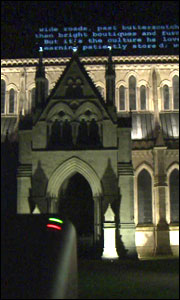 Testing the projectors The BBC and Arts Council have commissioned a specific piece of software to provide the image that we must project for the roof. A 3 headed graphic card system, will then distribute the picture to the three projectors. This kind of event requires some serious brightness from the projectors - measured in Lumens. To put it into perspective, a desktop projector, like the ones you can buy in the shops, produces around 2,000 Lumens. This is adequate for a screen up to about 3m wide. Remember, we need to fill 54m, and even split into three, I still need 18m to be filled, so we are using 3 x 15,000 Lumen projectors. Professional projectors such as these can have different lenses attached, so we have to measure the width of the screen image. We use this figure with a measurement of the "throw" distance - the distance between the projector and the "screen", which in this case is the roof. Then we calculate the size of lens that we need. Luckily, these units can run on an ordinary 13 amp mains socket, so we can plug into the Cathedral with long extension cables. Then we must ensure the projectors are safe and high enough to avoid obstructions from passing people - so above head height. This requires small scaffold towers to be erected. The computer software will provide the image to the three projectors. We then must line up the projectors as quickly as possible, preferably when it is still rather light, and be ready to ensure it works seamlessly. We will also be projecting on the South Face of the cathedral with images and video provided by the BBC. This is a simpler affair, and will be using 2 x 6500 Lumens projectors, lined up together, to provide almost 13,000 Lumens. This will be fed by a small vision mixer and video and computer equipment. Competition from the elementsIf it happens to rain, the equipment mustn't get wet. A roof is required, and some protective sheeting. There is another thing to consider. The one thing that projectors cannot compete with, at the moment, and possibly never will be able to, is the sun. Consider the £1.99 torch bought from a petrol station. In a cupboard, late at night in your house, this torch would easily provide ample light to search for something and could light a persons face entirely. Now consider the use of that same torch on the beach on a sunny day. With projectors, the surrounding ambient light is the competition for the projector. So, you will understand, that during the day, when it is quite bright, you will not see anything on the roof. But as night sets in you will clearly see, for miles around, the result of many people's written and creative talent and work, and a technical achievement, on this special St Georges Day. Colin Parnell, 26th March 2009last updated: 09/04/2009 at 17:10 SEE ALSOYou are in: South Today > Made in England > Projection challenge [an error occurred while processing this directive] |
| | About the BBC | Help | Terms of Use | Privacy & Cookies Policy |


